 how-to
How Do You Reconstitute Research Peptides Safely?
Last Updated: October 24, 2026
Quick Summary
Reconstituting research peptides safely means dissolving the lyophilized powder slowly along the vial wall with bacteriostatic or sterile water, then swirling gently instead of shaking. Swab the stopper, let it dry fully, use a fresh needle for every entry, and label each vial with concentration and date. Match the diluent to your compound's documentation, since not every peptide tolerates preservatives.
- Let sealed vials reach room temperature before opening, because cold vials pull moisture from the air.
- Choose bacteriostatic water for multi-dose vials and sterile water for preservative-sensitive compounds used immediately.
- Calculate concentration as peptide amount divided by total volume, such as 5 mg in 2 mL giving 2.5 mg/mL.
- Refrigerate reconstituted solutions steadily rather than freezing them, and protect vials from light.
- Swab the stopper with 70% isopropyl alcohol and let it dry at least 30 seconds before every entry.
Table of Contents
- What You Need Before You Start Reconstituting Research Peptides
- Bacteriostatic Water vs. Sterile Water: Choosing Your Diluent
- A Research Peptide Reconstitution Protocol, Step by Step
- Peptide Solvent Compatibility: Matching the Diluent to the Compound
- Peptide Reconstitution Calculation With Worked Examples
- Peptide Storage and Stability After Reconstitution
- Common Mistakes, Contamination Control, and Disposal
- Ordering Peptides With Documentation You Can Defend
- Frequently Asked Questions
What You Need Before You Start Reconstituting Research Peptides
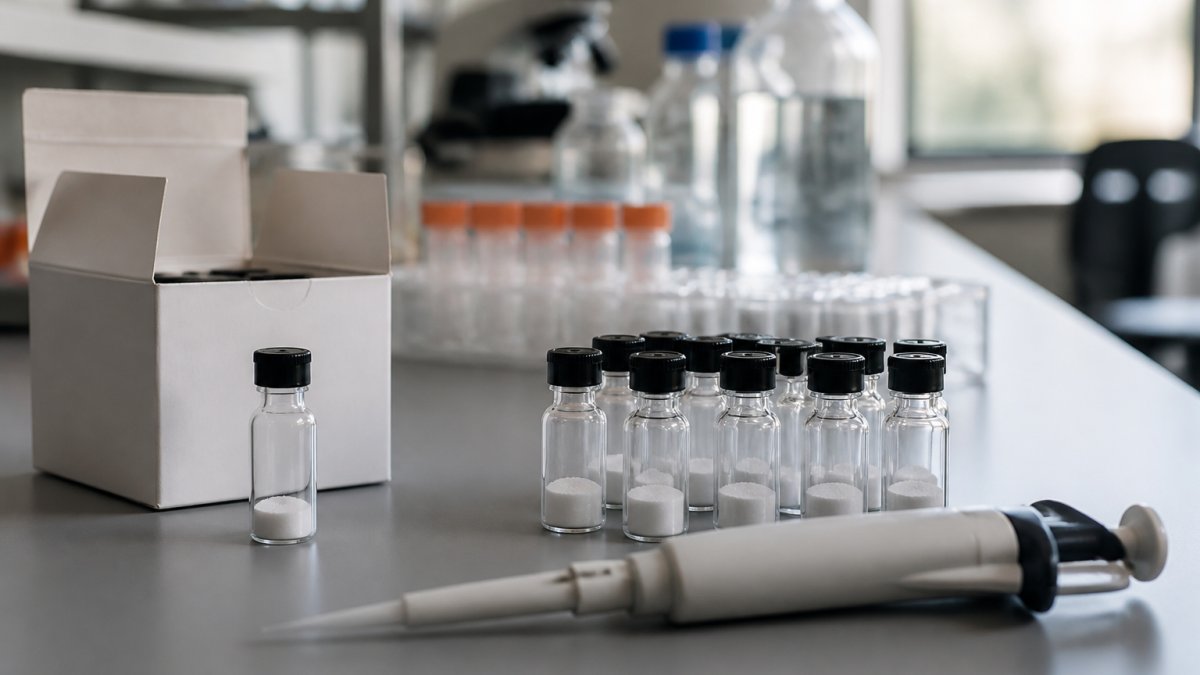
Reconstituting research peptides means dissolving a lyophilized powder in a liquid so you can measure and handle it accurately. Done well, it protects compound integrity. Done carelessly, it ruins the sample before the first assay.
Here is what to have on the bench before you open any vial:
- The lyophilized peptide vial, at room temperature
- Bacteriostatic water or sterile water, chosen for your compound
- A mixing syringe sized to the volume you need
- Alcohol wipes for the stopper and the bench
- Nitrile gloves and a clean, non-porous work surface
- A permanent marker for labeling date and concentration
- A calculator or a written dilution plan
Two things trip people up here. First, cold vials pull moisture from the air, so let them reach room temperature sealed. Second, a syringe that is too large makes small-volume draws imprecise. Match the tool to the job.
Bacteriostatic Water vs. Sterile Water: Choosing Your Diluent
Bacteriostatic water contains a preservative that slows bacterial growth in a multi-dose vial. Sterile water has no preservative.
Choose bacteriostatic water when you will draw from the same vial more than once and want added protection against contamination.
The USP guidance on sterile compounding sets the standard most labs follow for sterile preparations, and it is worth reading before you settle on a diluent.
One caveat that rarely gets mentioned: benzyl alcohol, the common preservative, is not compatible with every peptide.
For a deeper side-by-side, our team keeps a full comparison in Bacteriostatic Water vs Sterile Water for Peptides.
A Research Peptide Reconstitution Protocol, Step by Step
The protocol below is the sequence we recommend for a standard lyophilized vial. Work slowly. Rushing is the most common cause of foaming and loss.
Preparing the Vial and Work Area
Wipe the bench with alcohol and let it air dry. Put on gloves. Swab the vial stopper and let it dry fully, since wet alcohol can seep into the vial.
Set out every tool before you start. Fumbling mid-protocol is how contamination happens. If you want a fuller checklist for the bench itself, see our vial handling best practices.
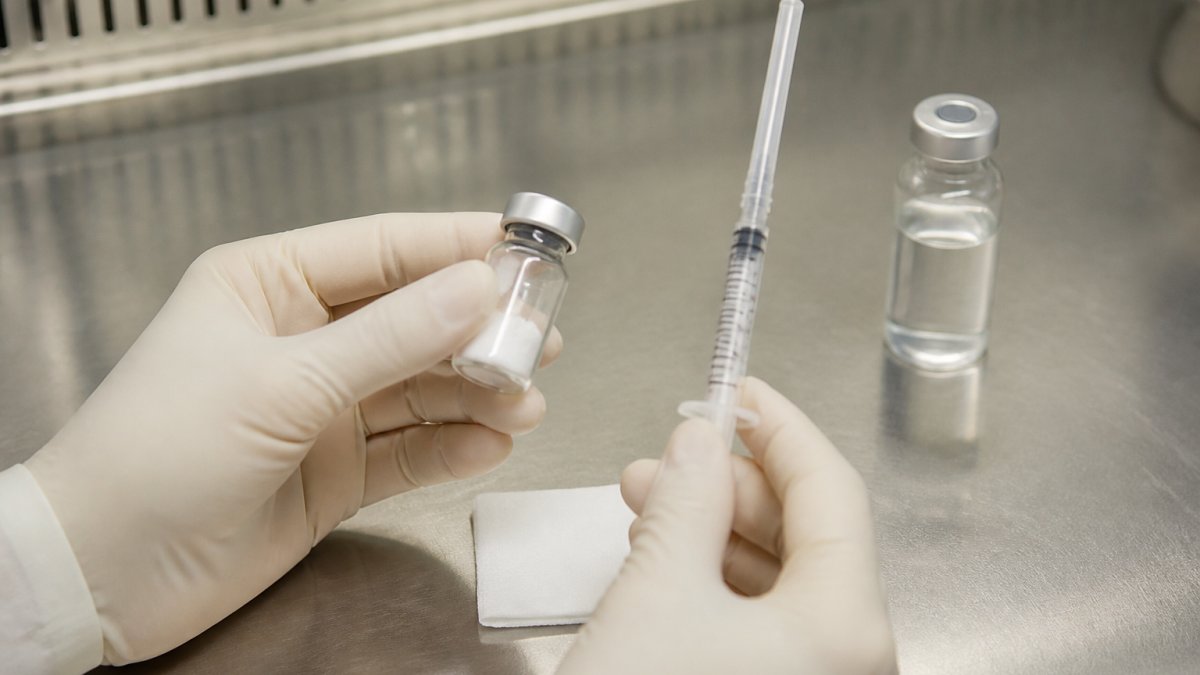
Adding Liquid Slowly Along the Vial Wall
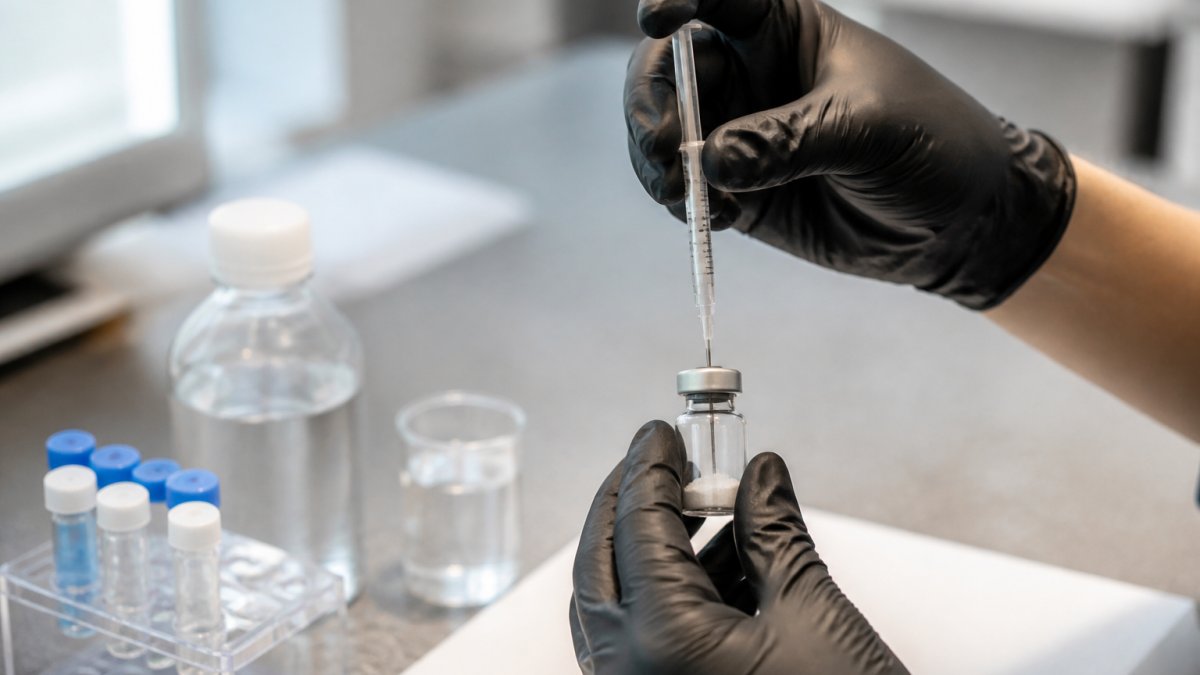
Draw your diluent, then angle the needle so the stream runs down the inside wall of the vial. Never squirt directly onto the powder.
Add the full volume, then stop. Do not shake. Swirl gently, or roll the vial between your palms, until the powder dissolves.
Watch out: shaking is the fastest way to denature a fragile peptide. If the solution turns cloudy or will not clear, stop and check compatibility before proceeding.
Peptide Solvent Compatibility: Matching the Diluent to the Compound
Not every peptide dissolves in water. Hydrophobic sequences often need a small amount of acetic acid before water is added. Hydrophilic compounds usually dissolve readily in bacteriostatic or sterile water.
The practical rule: read the compound's documentation first, then match the solvent to it. Guessing wastes vials.
A common mistake is assuming one diluent works for the whole shelf. It does not.
Peptide Reconstitution Calculation With Worked Examples
Concentration is the amount of peptide divided by the total volume of solution.
Worked example one. You have a 5 mg vial and add 2 mL of diluent.
Worked example two. You have a 10 mg vial and want 5 mg/mL.
Write the concentration and date on the vial label immediately. Memory fails, and mislabeled vials get discarded.
For a full walkthrough of the math, including unit conversions, see our guide on how to calculate reconstitution ratios.
| Vial Size | Diluent Added | Concentration | 0.2 mL Draw Delivers |
|---|---|---|---|
| 5 mg | 2 mL | 2.5 mg/mL | 0.5 mg |
| 10 mg | 2 mL | 5 mg/mL | 1.0 mg |
| 10 mg | 5 mL | 2 mg/mL | 0.4 mg |
| 2 mg | 1 mL | 2 mg/mL | 0.4 mg |
Peptide Storage and Stability After Reconstitution
Reconstituted peptide is far less stable than powder. Once the lyophilized cake is dissolved, the compound is exposed to water, oxygen, and light, and degradation pathways that were dormant in the solid state become active. There is no universal shelf life, stability depends on the peptide, the solvent, the concentration, the container, and the storage conditions.
What Actually Drives Degradation
- Hydrolysis. Water breaks peptide bonds over time; the rate rises with temperature and pH extremes.
- Oxidation. Oxygen attacks susceptible residues, especially methionine and cysteine; headspace air and light accelerate it.
- Aggregation. Hydrophobic sequences can self-associate into fibrils or particulates, which is why concentration and solvent choice matter.
- Adsorption. Dilute solutions can lose peptide to the walls of the container; low-binding tubes reduce this.
- Preservative interactions. Benzyl alcohol in bacteriostatic water is not compatible with every peptide, check compound documentation before assuming it is the safe default.
Storage Rules That Hold Across Compounds
- Refrigerate at a steady cold temperature, not the freezer, freezing a reconstituted solution can concentrate solutes and damage the peptide.
- Wrap the vial in foil or keep it in a dark box; amber vials help but are not a substitute for light protection.
- Never leave a solution on a warm bench for hours.
- Label the reconstitution date, concentration, and your chosen discard date on every vial.
- Discard any solution that turns cloudy, discolored, or shows particulates.
Beyond-Use Dates: Why There Is No Single Number
A beyond-use date (BUD) is the date after which a preparation should no longer be used. The USP guidance on sterile compounding frames BUDs in terms of risk level and storage conditions rather than a single universal window, and that framing is the right one to borrow: your BUD should come from the compound's documentation and your own validated protocol, not from a blog post.
Our peptide storage guide covers stability in more detail, including container and light-protection choices.
Common Mistakes, Contamination Control, and Disposal
The same errors show up again and again. Here are the ones we see most:
- Shaking instead of swirling, which foams and damages the peptide
- Skipping the stopper swab, which invites contamination
- Reusing a syringe across vials
- Forgetting to label concentration and date
- Storing solution at room temperature for long stretches
- Injecting air into the vial too forcefully and pressurizing it
- Leaving a needle in the stopper between draws
Aseptic Technique: The Mechanics That Actually Matter
Most contamination in peptide work does not come from a dirty bench. It comes from vial access, the moment the needle passes through the stopper. A few mechanics decide whether that moment is clean:
- Swab and wait. Wipe the stopper with a 70% isopropyl alcohol pad and let it dry for at least 30 seconds. Wet alcohol on the stopper can be pushed into the vial by the needle.
- Use a fresh needle for every entry. A needle that has touched a bench, a glove, or another vial is no longer sterile, even if it looks clean.
- Equalize pressure. As you add diluent, the vial pressurizes. Withdraw an equivalent volume of air first, or vent with a sterile filter needle, so the stopper does not spray solution when you withdraw.
- Do not touch the needle shaft. Hold the hub. Gloved fingers are not sterile.
- Keep the vial upright and capped between draws, and never set a syringe down on the bench with the needle exposed.
Sterile Supplies and Single-Use Discipline
Use individually packaged, sterile syringes and needles, and treat every one as single-use, including across vials of the same compound. Multi-dose vials are the classic vector for cross-contamination, which is why the preservative in bacteriostatic water matters but does not substitute for technique. The CDC guidance on safe injection practices is a solid reference for handling discipline and the single-dose/single-use principle.
Disposal and Incident Response
- Sharps: place needles and syringes in a puncture-resistant sharps container immediately after use. Do not recap by hand, and do not overfill the container.
- Compromised solutions: discard rather than salvage. A vial that has been dropped, left uncapped, or shows cloudiness is not worth the assay.
- Stopper damage: a coring event (a rubber fragment in the solution) means the vial is compromised, discard it and note the lot.
- Spills: absorb with a disposable pad, clean the surface with alcohol, and discard the pad as contaminated waste.
If a vial is compromised, remove it from the work area at once and record the lot, date, and observation. That record is what lets you defend the rest of the batch.
Ordering Peptides With Documentation You Can Defend
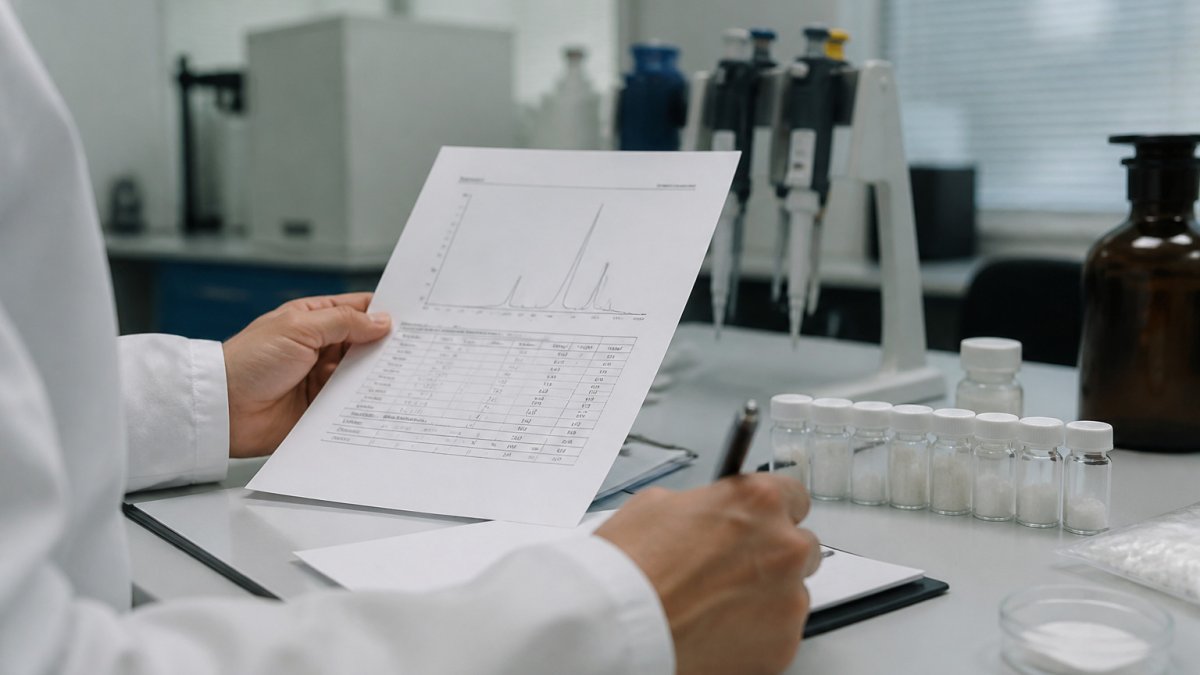
Documentation is what separates a defensible result from an unverifiable one. When your data gets scrutinized, the paperwork matters as much as the compound.
Bluegrass Research supplies research-grade peptides with lot-specific COA documentation and third-party analytical testing, so every order carries transparent verification records. Shipping is discreet, with no external branding, and we package materials for organized storage.
If you are weighing whether the paperwork is worth it, our article on research documentation breaks down the case plainly.
Frequently Asked Questions
What does it mean to reconstitute a research peptide?
Reconstitution means dissolving a lyophilized powder back into liquid form by adding a measured diluent, usually bacteriostatic water or sterile water. The powder is the peptide; the liquid restores it to a solution you can pipette or aliquot for lab work. The volume you add sets the concentration, so the math matters as much as the mixing. Add the liquid slowly down the vial wall, then swirl gently. Never shake a peptide vial, because agitation can damage the peptide structure.
How do researchers choose a solvent for peptide reconstitution?
Most water-soluble peptides dissolve cleanly in bacteriostatic water, which contains 0.9% benzyl alcohol to slow bacterial growth in multi-use vials. Hydrophobic sequences may need a small amount of acetic acid or a compatible co-solvent first. Check the lot-specific COA and the supplier's solubility note before you commit. If the solution turns cloudy or will not clear after gentle swirling, stop and confirm the recommended solvent rather than adding more liquid blindly.
How should reconstituted research peptides be labeled and documented?
Label every vial with the compound name, lot number, reconstitution date, diluent used, final concentration, and your initials. Record the same details in your lab notebook or inventory system, and attach the lot-specific COA to that record. This matters if results are scrutinized later, since it ties the material to a verified purity record. Log storage location and temperature too, and note the discard date you set so no one uses an expired solution.
What factors affect the stability of a reconstituted peptide?
Temperature, light exposure, repeated freeze-thaw cycles, and bacterial contamination drive most degradation. Most reconstituted peptides hold at 2 to 8 degrees Celsius for short-term work and are better aliquoted and frozen for longer storage, though the exact window varies by compound. Keep vials away from direct light, avoid warming them above room temperature, and never refreeze a thawed aliquot. Follow the beyond-use date on your documentation rather than guessing.
Reconstitution rewards discipline: clean bench, correct diluent, slow addition, honest labels. If you want compounds backed by lot-specific documentation and third-party testing, Bluegrass Research is built for exactly that. Get started with Bluegrass Research and give your next protocol a verified foundation.