 how-to
Buying Research Peptides for Universities: A 2026 Guide
Table of Contents
- Why University Labs Need a Formal Procurement Process for Research Peptides
- The Peptide Procurement Checklist: From Requisition to Receiving
- Reading a Peptide Certificate of Analysis: What to Verify
- How to Evaluate Research-Grade Peptide Suppliers
- Can Universities Buy Research Peptides Wholesale? Bulk Ordering and Budgeting
- Research-Use-Only Compliance and Institutional Purchasing Boundaries
- Choosing a Supplier for Buying Research Peptides for Universities
- Frequently Asked Questions
Last Updated: October 20, 2026
Why University Labs Need a Formal Procurement Process for Research Peptides
At Bluegrass Research, we supply research-grade peptides to academic and independent laboratories. The stakes are straightforward.
Informal ordering creates three predictable failures. Records break down when the person who placed the order leaves the lab.
A formal process fixes all three. It also makes institutional purchasing, vendor qualification, and audit preparation ordinary administrative work rather than a scramble.
The sections below walk through the full cycle: requisition, vendor screening, receiving, certificate of analysis review, supplier evaluation, and budgeting.
The Peptide Procurement Checklist: From Requisition to Receiving
A peptide procurement checklist is a written sequence of approvals, verifications, and records that follows each order from internal request through delivery and storage. At a university, the checklist has to satisfy two audiences at once: the lab, which needs the material and its documentation, and the procurement office, which needs the transaction to fit institutional rules.
Step 1: Requisition and Internal Approval
Start with a requisition that names the compound, quantity, intended study, responsible investigator, and the account or grant to be charged. Attach the supplier's research-use-only statement and a sample certificate of analysis to the requisition itself. That single habit answers most reviewer questions before they are asked.
If the purchase will be charged to a federal award, confirm that the cost is allowable, allocable, and consistently treated under the sponsor's terms and the institution's cost accounting standards.
Step 2: Vendor Onboarding and Approved Supplier Lists
Many universities maintain an approved supplier list, and a new vendor may need to be onboarded before a purchase order can be issued. Onboarding typically requires the supplier's legal name, remittance address, tax identification number, and a completed vendor information form. Some institutions also require a W-9 and a conflict-of-interest disclosure from the requesting investigator.
Ask your procurement office three questions before the first order:
- Is this supplier already in the vendor master file, or does it need onboarding?
- Does the institution require a signed supplier agreement or terms-and-conditions review?
- Are there restrictions on international suppliers or on suppliers that cannot accept a standard purchase order?
A supplier that cannot accept a purchase order, provide a formal quote, or complete a vendor form will stall the transaction regardless of product quality. Screen for that early.
Step 3: Purchase Order Terms and Tax-Exempt Purchasing
Most universities are tax-exempt and will not pay sales tax on qualifying purchases. Provide the supplier with the institution's tax-exempt certificate or exemption number at the quote stage, and confirm in writing that the invoice will not include sales tax.
Build documentation requirements into the purchase order itself. A practical clause requires the supplier to include the lot-specific certificate of analysis, the research-use-only statement, and the packing slip with the shipment, and to reference the purchase order number on all documents. That clause turns a documentation request into a contractual obligation.
Step 4: Receiving, Inspection, and Recordkeeping
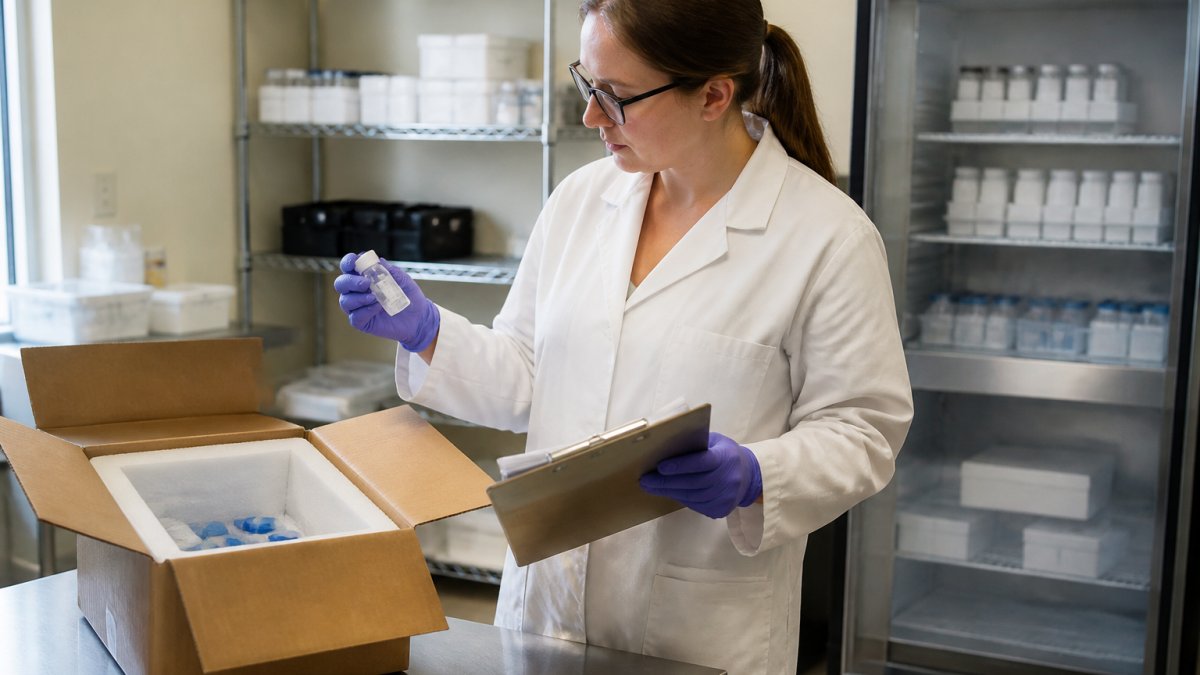
Inspect packaging on arrival and note any temperature excursion, seal damage, or labeling gap on the receiving form. Record the lot number, date received, quantity, and storage location in a lab log. Store according to the supplier's stated conditions and label the container with the receipt date.
Match the packing slip to the purchase order before routing the invoice for payment. Three-way matching, purchase order, receiving record, and invoice, is standard institutional practice and catches quantity and pricing discrepancies before they become payment problems. A common mistake is photographing the box but never recording the lot number in the inventory system.
| Stage | Key Action | Record Produced |
|---|---|---|
| Requisition | Name compound, quantity, study, investigator, account | Signed requisition form |
| Vendor onboarding | Confirm vendor master status or complete onboarding | Vendor file entry |
| Quote and PO | Obtain formal quote; include documentation clause; apply tax exemption | Quote and purchase order |
| Receiving | Inspect, log lot number, label container, match to PO | Receiving form and inventory entry |
| Payment | Three-way match before invoice approval | Approved invoice record |
| Storage | Store per stated conditions | Storage location log |
Reading a Peptide Certificate of Analysis: What to Verify
A peptide certificate of analysis is a lot-specific document reporting the identity, purity, and test methods applied to a single manufactured batch. It is not a marketing sheet, and it should never be generic.
Verify these items in order:
- Lot number matching the vial label and your purchase order
- Identity confirmation, typically by mass spectrometry
- Purity figure with the analytical method named, usually high-performance liquid chromatography
- Test date and the name of the testing laboratory
- Storage and handling instructions
- Research-use-only designation
If the COA lists a purity figure without naming the method, treat that figure as unverified. If the lot number does not match the shipment, stop and contact the supplier before opening the vial.
How to Evaluate Research-Grade Peptide Suppliers
Evaluating research-grade peptide suppliers comes down to documentation depth. A supplier that cannot produce a lot-specific COA on request is not a research supplier, regardless of catalog size.
Third-Party Testing and Lot-Specific Documentation
Third-party testing means an outside laboratory performed the identity and purity analysis rather than the supplier's own bench. Ask which laboratory, and confirm the COA carries that laboratory's name and report date. Lot-specific documentation means the paperwork belongs to your batch, not to the product line in general.
Independent Verification of Certificates of Analysis
Independent verification is the step most labs skip. Cross-check the COA lot number against the vial label, the packing slip, and your purchase order. Look for internal consistency: does the reported molecular weight match the stated compound? Do the test dates precede the ship date?
When something looks inconsistent, request the underlying analytical report. Reputable suppliers provide it. Reluctance is itself an answer.
Can Universities Buy Research Peptides Wholesale? Bulk Ordering and Budgeting
Yes. Universities can buy research peptides in bulk quantities, and many suppliers price larger orders more favorably than single-vial purchases. The practical question is not whether bulk ordering is possible but whether your budget and storage can absorb it.
Budget for more than the catalog line item. Total procurement cost includes shipping, any temperature-controlled handling, storage consumables, and the staff time spent on receiving and recordkeeping.
Plan orders around study timelines rather than calendar convenience. Consolidating a semester's requirements into fewer, larger orders reduces shipping overhead and simplifies lot tracking, provided your freezer capacity and stability window support it.
Research-Use-Only Compliance and Institutional Purchasing Boundaries
Research-use-only means the material is sold for laboratory research and is not for human or veterinary use. That designation is the boundary line for institutional purchasing, and it should appear on the certificate of analysis, the vial label, and the order documentation. The distinction matters because a product intended for laboratory research is not reviewed or approved through the pathways that apply to drugs, biologics, or veterinary products, and it must not be repurposed for those uses.
What the Research-Use-Only Boundary Actually Separates
The boundary separates two categories of material with different regulatory treatment. Products approved for human use go through the Food and Drug Administration's drug or biologic review pathways. Veterinary products go through a separate approval process.
For a university buyer, the practical consequence is that the research-use-only designation must be documented at the point of purchase and preserved with the study records. If a protocol, grant, or manuscript describes work with a research peptide, the batch file should show that the material was purchased and labeled for research use.
What Institutional Reviewers Typically Examine
Institutional review of a peptide purchase usually asks four things:
- What the material is, compound identity, quantity, and the research-use-only designation on the label and certificate of analysis.
- Who is responsible, the principal investigator or lab manager accountable for receipt, storage, and use.
- How it will be handled and stored, storage conditions, chain-of-custody records, and disposal procedures consistent with institutional policy.
- Whether the intended use fits institutional rules, confirmation that the material is for laboratory research and not for human or veterinary administration.
A supplier that ships discreetly can still satisfy those requirements, because discretion concerns external branding, not the paperwork inside the package. Confirm with your procurement office that unbranded shipping is acceptable before the first order, not after.
Documentation to Keep on File
Keep the research-use-only statement, the lot-specific certificate of analysis, the purchase order, the receiving record, and the storage log together in one file per order. When a compliance review arrives months later, that file answers the question without a search. If the supplier's documentation is silent on the research-use-only designation, request a written statement before the material is used.
Choosing a Supplier for Buying Research Peptides for Universities
Choosing a supplier for buying research peptides for universities should rest on documentation you can verify, not on catalog breadth.
At Bluegrass Research, every compound ships with lot-specific COA documentation and third-party analytical testing records, and orders ship discreetly with no external branding so institutional receiving desks can process them normally.
What most supplier comparisons miss is that switching vendors is cheap compared with defending undocumented material. Run a small qualification order first. Verify the COA against the shipment, confirm turnaround time, and test the support channel with a real technical question.
FDA guidance on research-use-only labeling
NIH grants policy on procurement documentation
NIST reference materials and traceability guidance
Frequently Asked Questions
Is it illegal to purchase research-grade peptides for university labs?
No federal law prohibits purchasing research-grade peptides for laboratory research. However, the legal boundary is intended use. Peptides labeled research-use-only are not approved for human consumption, and selling them for that purpose is illegal. Universities must ensure purchases stay within institutional research protocols. Some peptides may also fall under controlled substance schedules or state restrictions, so check with your institution's compliance office before ordering.
What documentation should a university request when buying research peptides?
Request a lot-specific certificate of analysis (COA) for every batch, showing purity by HPLC, identity confirmation by mass spectrometry, and third-party testing results. Also ask for batch records, storage recommendations, and a statement of research-use-only intended use. Keep these records with your purchase order and receiving log. This documentation supports traceability and defends your results if they are scrutinized.
How can university labs compare peptide purity and analytical testing across suppliers?
Compare COAs side by side: look for HPLC purity percentages, mass spectrometry identity data, and whether testing was done by an independent lab. Check that the COA matches the lot number on the vial. Ask suppliers about their quality control methods and whether they provide batch records. A supplier that shares detailed, lot-specific data is more reliable than one offering generic certificates.
Where can universities buy research peptides wholesale?
Many research-grade peptide suppliers offer wholesale or bulk pricing for institutional orders. Contact suppliers directly with your anticipated volume and request a quote. Confirm they provide lot-specific COAs, third-party testing, and discreet shipping that meets your procurement requirements. Bluegrass Research supplies research-grade peptides with lot-specific documentation and can discuss bulk orders through their website.
Procurement friction rarely comes from the science. It comes from missing paperwork, unclear vendor qualification, and records that cannot be reconstructed after the fact. Bluegrass Research supports university laboratories with lot-specific COA documentation, third-party analytical testing, and discreet shipping that fits institutional receiving workflows. Start with a qualification order and see the documentation for yourself.