 ultimate-guide
How to Verify Peptide Purity: A 2026 Guide
Table of Contents
- What Peptide Purity Actually Means for Research
- HPLC Peptide Analysis: The Primary Verification Method
- Mass Spectrometry: Confirming Molecular Weight and Identity
- How to Read a Peptide COA Step by Step
- Why Third-Party Peptide Testing Labs Matter
- Common Peptide Impurities, Degradation, and Batch-to-Batch Variability
- How to Verify Peptide Purity: Putting the Methods Together
- Frequently Asked Questions
Last Updated: September 1, 2026
What Peptide Purity Actually Means for Research
Peptide purity is the percentage of the target peptide compound present in a sample relative to all other chemical species, including synthesis byproducts, truncated sequences, and residual reagents. A peptide reported at 98% purity contains 2% of everything else, and in rigorous laboratory work, that 2% can compromise experimental reproducibility or introduce confounding variables.
A peptide that looks correct by name and molecular weight can still carry impurities that interfere with receptor binding assays, cell viability studies, or pharmacological modeling. The purity percentage is an analytical measurement, not a marketing claim, and understanding how it is derived is essential to trusting it.
At Bluegrass Research, we've built our entire supply process around this principle: documentation must be traceable, lot-specific, and generated by independent laboratories. This guide explains how to verify peptide purity yourself, what the key analytical methods reveal, and how to read the documentation that separates research-grade material from everything else.
HPLC Peptide Analysis: The Primary Verification Method
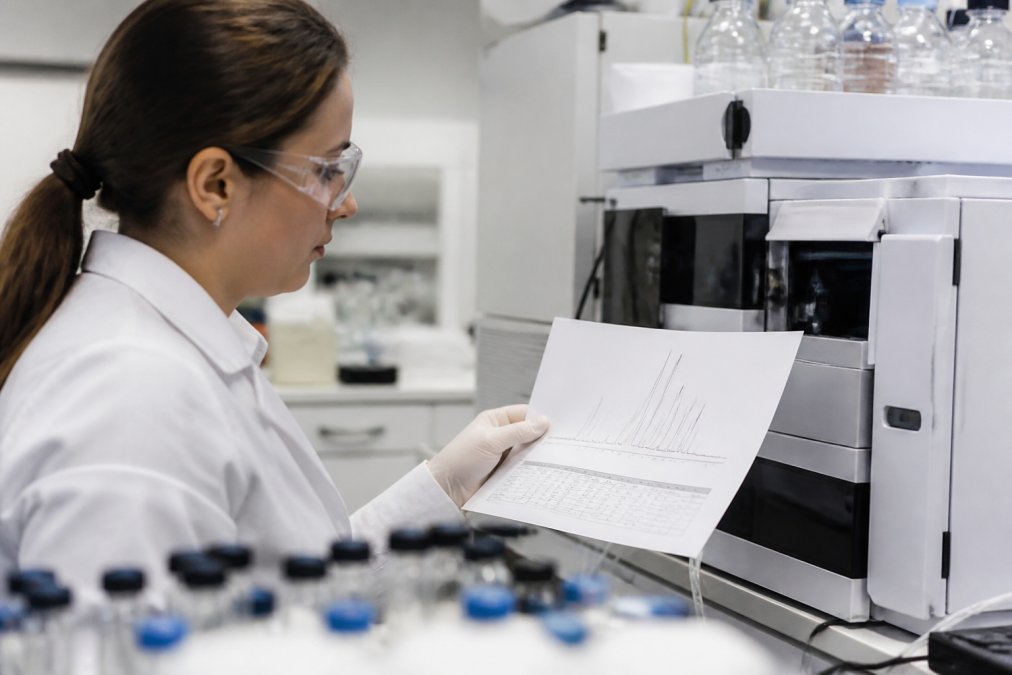
HPLC peptide analysis is the gold standard for quantifying purity in research-grade compounds. High-Performance Liquid Chromatography separates the components of a peptide sample based on their interactions with a stationary phase, producing a chromatogram that maps each chemical species as a distinct peak. A dissolved peptide sample is injected into a column under high pressure, and different compounds travel through at different rates, eluting at characteristic retention times.
Reading the Chromatogram and Interpreting Main Peak Area
The main peak area is the core metric in HPLC-based purity assessment. Purity percentage is calculated by dividing the area of the main peak by the total area of all peaks in the chromatogram, then multiplying by 100. A compound with a single dominant peak and minimal surrounding peaks is high-purity material.
This calculation assumes equal UV response across all species, an assumption that holds reasonably well for peptide bonds but breaks down for certain impurity types. Secondary peaks representing deletion sequences or oxidized variants may not absorb UV light identically to the target peptide, which means the reported purity is always an approximation, not an absolute.
Retention time is equally important. Each peak's position on the time axis identifies the compound. If the main peak elutes at an unexpected retention time compared to a reference standard, that is a red flag regardless of how clean the chromatogram looks overall.
For research purposes, a purity threshold of 95% or greater is generally considered research-grade. Pharmacological studies and receptor binding assays often demand 98% or higher. Anything below 90% should prompt a conversation with the supplier about lot replacement.
UV Absorbance at 214 nm and What It Reveals
HPLC detection for peptides is typically performed at 214 nm, a UV absorbance wavelength that targets the peptide bond itself rather than aromatic side chains. This makes 214 nm detection broadly applicable across peptide sequences, including those lacking aromatic residues like tyrosine, tryptophan, or phenylalanine.
The practical implication: 214 nm detection captures almost all peptide-related species in the sample, including truncated sequences and deletion peptides that would be invisible at the more commonly cited 280 nm wavelength. Suppliers who report purity from 280 nm measurements on non-aromatic peptides are providing incomplete data. A high-quality COA will specify the detection wavelength used. If it does not, ask.
Mass Spectrometry: Confirming Molecular Weight and Identity
Mass spectrometry confirms molecular weight and compound identity, something HPLC alone cannot do. While HPLC tells you how much of something is present, MS tells you what that something actually is. The technique ionizes the peptide sample and measures the mass-to-charge ratio of the resulting ions. The observed molecular weight is then compared against the theoretical molecular weight calculated from the peptide's amino acid sequence.
According to US Pharmacopeia peptide characterization guidelines, mass spectrometric verification is considered an essential component of peptide identity confirmation for research applications. Electrospray ionization (ESI-MS) is the most common technique used because it handles large, polar molecules well and produces multiply-charged ions that allow accurate mass determination across a wide molecular weight range.
What MS does not tell you is purity percentage. A sample can produce a perfect MS spectrum while still containing significant impurities at concentrations below the detection threshold. This is why HPLC and MS are complementary methods, not alternatives. A complete analytical validation requires both.
How to Read a Peptide COA Step by Step
A Certificate of Analysis is the primary document through which a supplier communicates the analytical results for a specific lot of peptide material. Reading a COA correctly requires knowing which fields are critical and which are red flags.

Work through a COA in this sequence:
- Confirm the lot number. The lot number on the COA must match the lot number on the product label.
- Check the compound name and sequence. Confirm the amino acid sequence matches your order specifications exactly, including any modifications such as amidation, acetylation, or PEGylation.
- Verify the molecular weight. The observed MW from MS should match the theoretical MW within instrument tolerance, typically ±0.1 Da for small peptides.
- Read the purity percentage. This should be derived from HPLC analysis, with the detection wavelength specified.
- Examine the chromatogram. The raw chromatogram should be included, not just the calculated percentage.
- Check the testing laboratory. The issuing laboratory should be named and, ideally, independent of the manufacturer.
- Note the test date. Analytical data within 12 months for a lyophilized powder held under proper conditions is generally valid.
According to FDA guidance on analytical procedures and method validation, documentation traceability is a foundational requirement in any analytical quality assurance framework.
| COA Field | What to Check | Red Flag |
|---|---|---|
| Lot number | Matches product label exactly | Generic or missing lot number |
| Purity (%) | HPLC-derived, ≥95% for research use | No method specified |
| Molecular weight | MS observed vs. theoretical within ±0.1 Da | Large discrepancy or missing |
| Detection wavelength | 214 nm for peptide bond detection | 280 nm only, or not stated |
| Testing laboratory | Named, independent third party | Manufacturer's in-house only |
| Chromatogram | Raw data included | Percentage only, no chromatogram |
| Test date | Within 12-24 months | Undated or very old |
Lot-Specific vs. Generic COA Documents
A lot-specific COA contains analytical data generated from the exact batch of material you receive. A generic COA contains representative data from a previous batch, applied to all lots of that compound. Peptide synthesis is not perfectly reproducible between batches, so a generic COA tells you that one batch met specifications at some point in the past. A lot-specific COA tells you that your batch meets specifications now.
Many suppliers provide generic COAs as standard practice. Lot-specific documentation is the only format that supports true analytical traceability and is essential for researchers whose results need to be defensible under scrutiny.
Common Red Flags in COA Documentation
The most common red flag is a purity percentage without a supporting chromatogram. Any supplier can type a number. The chromatogram is the evidence. Other red flags include: a COA that lists only mass spectrometry data with no HPLC results; a document with no named testing laboratory; a purity figure rounded suspiciously to exactly 99.0% across multiple compounds; and any COA that cannot be linked to a specific lot number.
Why Third-Party Peptide Testing Labs Matter
Third-party peptide testing labs provide analytical independence, the assurance that the organization measuring purity has no financial incentive to report a favorable result. In-house testing by the manufacturer creates an obvious conflict of interest, even when the analytical work itself is technically sound.
Independent laboratory testing means the chromatographic data, mass spectra, and purity calculations were generated by scientists who are accountable to analytical accuracy rather than sales volume. For researchers whose work will be published, peer-reviewed, or used in regulatory submissions, this distinction is significant.
Third-party labs operate under their own accreditation requirements and standard operating procedures. Their instruments are independently calibrated. Their analysts have no knowledge of what purity result would be commercially convenient. This separation is the structural basis of trustworthy documentation.
Bluegrass Research operates on a third-party testing model as a core feature of our supply process. Every lot comes with documentation from an independent analytical laboratory, not internal quality control data.
Common Peptide Impurities, Degradation, and Batch-to-Batch Variability
Peptide synthesis produces a predictable set of impurities. Understanding them helps researchers interpret impurity profiles on COA documents and assess whether a given level of contamination is acceptable for their application.
The most common synthesis-related impurities include deletion peptides (sequences missing one or more amino acids), truncated sequences (peptides that terminated early), oxidized variants (methionine and cysteine residues with +16 Da mass shifts), trifluoroacetic acid (TFA) salts (residual from cleavage steps), and aggregated species (self-associated dimers or higher-order aggregates).
Batch-to-batch variability is a real phenomenon in peptide synthesis, even from reputable suppliers. Minor changes in reagent quality, reaction temperature, or cleavage conditions can shift the impurity profile between lots. This is precisely why lot-specific COA documentation matters.
As documented in NIH guidance on research reagent quality and reproducibility, reagent variability is one of the leading contributors to irreproducible research results in biomedical science.
How Storage Conditions Affect Purity Over Time
A peptide that arrives at 98% purity will not remain at 98% purity indefinitely. Degradation is accelerated by moisture and oxygen exposure. A compound stored improperly for three months can degrade meaningfully even if it arrived in perfect condition.
Practical storage guidelines for research peptides: store lyophilized powder at -20°C or colder in a sealed, desiccated container; avoid repeated freeze-thaw cycles; use reconstituted peptide solutions within the timeframe specified in the product documentation; and pay particular attention to peptides containing cysteine, methionine, or tryptophan, which are higher-risk for oxidative degradation.
If you are testing or retesting a compound that has been in storage, the current purity may differ from the COA value. Age and storage history are relevant variables.
How to Verify Peptide Purity: Putting the Methods Together
To verify peptide purity rigorously, researchers should apply HPLC and mass spectrometry in combination, evaluate the COA documentation against the criteria above, and account for storage history. No single method is sufficient on its own.
Start with the COA and confirm it is lot-specific and third-party tested. Examine the chromatogram and MS data directly. If the documentation is complete and the analytical data is clean, you have a defensible basis for using the material. If anything is missing or inconsistent, contact the supplier before proceeding.
For researchers working with complex sequences, the documentation standard should be higher. The more consequential the application, the more important it is that every step of the verification chain is traceable.
Home Testing: What Is and Is Not Feasible
Home testing of peptide purity is not feasible. HPLC instruments cost tens of thousands of dollars and require trained operators and regular calibration. Mass spectrometers are similarly capital-intensive and technically demanding.
What researchers can do without laboratory equipment is evaluate documentation quality. Reviewing a COA for lot specificity, checking whether a chromatogram is included, confirming the testing laboratory is named and independent, and comparing the observed molecular weight against the theoretical value are all document-level checks that require only knowledge, not instrumentation.
Some academic institutions have access to shared analytical facilities or core laboratories where researchers can submit samples for independent HPLC and MS analysis. The Association of Biomolecular Resource Facilities directory of core labs maintains a searchable directory of analytical core facilities at research institutions.
Verifying peptide purity requires understanding what HPLC and mass spectrometry actually measure, knowing how to read a COA critically, and recognizing the difference between lot-specific documentation and generic paperwork. Bluegrass Research was built for researchers who take this seriously. Every compound we supply comes with lot-specific, third-party analytical documentation, discreet shipping with no external branding, and the kind of transparent verification records that hold up to peer review and institutional scrutiny. Shop Now to see current availability and request documentation samples before you order.
Frequently Asked Questions
How do I know if my peptides are pure?
The most reliable way to verify peptide purity is to review a lot-specific Certificate of Analysis that includes HPLC chromatogram data and mass spectrometry results. The HPLC report shows purity as a percentage of the main peak area relative to all detected peaks, while mass spectrometry confirms the correct molecular weight. Any COA that lacks lot-specific data, shows no chromatogram, or omits the testing lab's identity should be treated as insufficient documentation for research-grade use.
What is a Certificate of Analysis (COA) for peptides?
A COA is an analytical document issued after laboratory testing that records a peptide compound's verified chemical properties, including purity percentage, molecular weight, and impurities profile. A legitimate, research-grade COA is lot-specific, meaning it corresponds to the exact production batch you receive, and is generated by an independent third-party lab rather than the supplier itself. It typically includes HPLC chromatogram data, mass spectrometry results, and the conditions under which the lyophilized powder was analyzed.
Is there a way to test peptide purity at home?
Meaningful peptide purity testing at home is not feasible. HPLC and mass spectrometry require specialized instrumentation, trained operators, and controlled analytical conditions that no home setup can replicate. Some basic colorimetric assays exist, but they cannot quantify purity percentage or identify specific impurities. The practical alternative is to source peptides that already come with third-party, lot-specific COA documentation, so the analytical validation has been completed before the compound reaches your lab.
Why is third-party testing important for peptide research?
When a supplier tests its own products in-house, there is an inherent conflict of interest that can compromise analytical objectivity. Third-party peptide testing labs operate independently, with no financial stake in the result, making their COA data far more credible for research documentation. For researchers whose results may face peer review or institutional scrutiny, having lab-verified purity data from an independent facility is often essential to defending the integrity of experimental findings.
This article was written using GrandRanker
Frequently Asked Questions
How do I know if my peptides are pure?
The most reliable way to verify peptide purity is to review a lot-specific Certificate of Analysis that includes HPLC chromatogram data and mass spectrometry results. The HPLC report shows purity as a percentage of the main peak area relative to all detected peaks, while mass spectrometry confirms the correct molecular weight. Any COA that lacks lot-specific data, shows no chromatogram, or omits the testing lab's identity should be treated as insufficient documentation for research-grade use.
What is a Certificate of Analysis (COA) for peptides?
A COA is an analytical document issued after laboratory testing that records a peptide compound's verified chemical properties, including purity percentage, molecular weight, and impurities profile. A legitimate, research-grade COA is lot-specific, meaning it corresponds to the exact production batch you receive, and is generated by an independent third-party lab rather than the supplier itself. It typically includes HPLC chromatogram data, mass spectrometry results, and the conditions under which the lyophilized powder was analyzed.
Is there a way to test peptide purity at home?
Meaningful peptide purity testing at home is not feasible. HPLC and mass spectrometry require specialized instrumentation, trained operators, and controlled analytical conditions that no home setup can replicate. Some basic colorimetric assays exist, but they cannot quantify purity percentage or identify specific impurities. The practical alternative is to source peptides that already come with third-party, lot-specific COA documentation, so the analytical validation has been completed before the compound reaches your lab.
Why is third-party testing important for peptide research?
When a supplier tests its own products in-house, there is an inherent conflict of interest that can compromise analytical objectivity. Third-party peptide testing labs operate independently, with no financial stake in the result, making their COA data far more credible for research documentation. For researchers whose results may face peer review or institutional scrutiny, having lab-verified purity data from an independent facility is often essential to defending the integrity of experimental findings.