 how-to
How to Spot Fraudulent Peptide Certificates of Analysis
Last Updated: October 30, 2026
Quick Summary
To spot fraudulent peptide certificates of analysis, match the report's lot number to your vial, then confirm the testing laboratory independently using contact details you find yourself. Check that identity is confirmed by mass spectrometry, not just a purity percentage. Ask for raw HPLC and mass data if anything is unclear.
- Match the lot number on the report to the label on your vial, character by character.
- Find the testing laboratory's contact details yourself, not from the COA or a QR code.
- Confirm the report number directly with the laboratory from its own records.
- A purity percentage alone does not confirm identity; check for mass spectrometry results.
- Treat a single 100% purity result with no impurity profile as a red flag.
Table of Contents
- What a Peptide Certificate of Analysis Can and Cannot Prove
- How to Verify a Peptide COA Before You Trust It
- Peptide COA Lot Number Verification Against Your Vial Label
- Confirming the Laboratory and Tracing the Report to a Sample
- HPLC and Mass Spectrometry Peptide Testing: What Each Result Shows
- Peptide COA Red Flags That Signal a Fake or Unreliable Report
- What to Do When a Peptide COA Fails Verification
- Requesting a Verifiable Lot-Specific COA Before Your Next Order
- Frequently Asked Questions
Peptide buyers are right to be cautious. A certificate of analysis (COA) is the main document that tells you what is actually in a vial, yet a polished PDF is easy to produce and hard to check. Knowing how to spot fraudulent peptide certificates of analysis protects your study data, your budget, and your credibility.
What a Peptide Certificate of Analysis Can and Cannot Prove
A certificate of analysis is a document a laboratory issues to report the test results for a specific batch of material.
A COA can establish what one laboratory measured on one sample at one time. It cannot prove the vial in your hand came from that sample, or that the material was stored and handled correctly after testing.
Keep these limits in mind:
- A COA describes a test, not a product. The result applies only to the sample tested.
- Purity and content are different things. Purity is the share of the target peptide relative to other peptide-related material. Content is how much actual peptide is in the vial, often lower than purity because of counter-ions and water.
- A clean report does not guarantee shipping or storage. Temperature exposure can degrade a compound after it leaves the lab.
Treat the COA as one piece of evidence. Your job is to test whether that evidence holds together.
How to Verify a Peptide COA Before You Trust It
Use this workflow before you rely on any report. Work through the steps in order. For a fuller step-by-step verification guide, see how to verify peptide purity.
- Confirm the report has a unique identifier. Look for a report number, a lot or batch number, and a test date.
- Check that the lot number matches your vial. Compare the number on the report with the label on the vial you received.
- Identify the testing laboratory. Note its name, address, and accreditation claims.
- Look up the laboratory independently. Find its contact details through a source you choose, not from the COA itself.
- Read the methods section. Confirm which analytical techniques were used.
- Review the results against the stated specifications. Check that the numbers meet the limits the report itself sets.
- Ask the supplier for the raw data if anything is unclear. Chromatograms and mass spectra are harder to fake convincingly than summary tables.
A common mistake is stopping at step two. A matching number proves very little if the laboratory cannot be verified.
Peptide COA Lot Number Verification Against Your Vial Label
The lot number is the link between the report and your product. If that link is weak, the report is not useful.
Follow these checks:
- Compare the characters exactly. Look for transposed digits, a missing letter, or a suffix added to one document but not the other.
- Check the label on the vial itself, not a copy or a photo sent by the supplier.
- Confirm the lot number appears on the report and not only in a cover letter. Your evidence should come from the test document.
If the lot number cannot be matched with confidence, do not assume a match. Ask for clarification in writing.
Confirming the Laboratory and Tracing the Report to a Sample
A COA is only as credible as the laboratory that produced it and the chain that connects your vial to the tested sample. Most guides stop at "check the lab exists." That is not enough. Use the workflow below to verify the laboratory independently, confirm the report identifiers, and document what you find.
Step 1: Extract the identifiers from the report itself
Before you contact anyone, write down the following exactly as they appear on the COA:
- Laboratory legal name and any DBA ("doing business as") name
- Laboratory address and phone number printed on the report
- Report or certificate number
Do not copy these from a supplier's product page or a cover email. Use the PDF itself. If the report is an image-only scan, ask for a text-based original.
Step 2: Find the laboratory through a source you choose
Open a separate browser tab and search for the laboratory by its legal name and address. You are looking for an independent footprint: a working phone number, a physical address that maps to a real commercial location, a professional website with a services page, and ideally a listing in a state business registry or an accreditation directory.
A common pattern in fraudulent COAs is a laboratory name that appears only on the COA and on the supplier's own site. If the only search results for the lab are pages controlled by the seller, treat the report as unverified.
Search state business registries to confirm the laboratory entity
Step 3: Contact the laboratory through independently sourced details
Call or email the laboratory using the contact information you found yourself, not the phone number or email printed on the COA. To find where independent purity testing can be done, see where to test peptides for purity. Ask three questions:
- Did your laboratory issue report number [X] on [date]?
- What sample identifiers and lot number are associated with that report?
- Can you send a copy of the report directly from your records?
A genuine laboratory can confirm or deny a report from its own records. A fraudulent one cannot. If the lab says it has no record of the report, stop and preserve everything.
Step 4: Confirm the report is traceable to a sample
A credible report ties the result to a specific sample through a documented chain of custody. Ask the laboratory, not just the supplier, whether the report records:
- How and when the sample was received
- The condition of the sample on receipt
- A unique sample ID that links to the lot number on your vial
If the laboratory cannot describe how the tested sample connects to your batch, the report may be genuine but irrelevant to the vial in your hand. That is a provenance gap, not a laboratory failure, and it matters just as much.
Step 5: Document the verification
Keep a short verification record for each lot you accept. A useful record includes:
- Date and time of each contact with the laboratory
- Name of the person you spoke with and the contact method used
- The laboratory's confirmation (or denial) of the report number
Store this record with your receiving paperwork. If a question arises later about study integrity, this is the file that answers it.
Be cautious of any report that lists no laboratory name, uses vague wording like "in-house testing" without detail, gives contact information that leads nowhere, or cannot be confirmed by the laboratory when you call.
HPLC and Mass Spectrometry Peptide Testing: What Each Result Shows
Two techniques appear on most peptide COAs, and each answers a different question. The most common reading error is treating a purity percentage as if it proved identity, dose, sterility, or safety. It does not. The table below summarizes what each test can and cannot establish, followed by the details you need to interpret the numbers correctly.
| Test | What it measures | What it can support | What it cannot prove |
|---|---|---|---|
| HPLC (usually reverse-phase) | Separation of components by retention behavior; purity reported as peak-area percentage | That the main peak is large relative to other detected peaks under the stated method | That the main peak is the intended peptide; sterility; endotoxin content; absence of undetected impurities |
| Mass spectrometry (MS, often ESI or MALDI) | Molecular mass of the detected species | That a species with the expected mass is present | Purity; quantity; that the mass corresponds to the labeled vial rather than the tested sample |
| Peptide content (often by nitrogen analysis or UV absorbance) | Amount of peptide mass in the sample | A content estimate that may be lower than purity due to counter-ions and water | Potency in a biological sense; correct dosing without a validated method |
| Residual solvents / contaminants (often by GC or ICP-MS) | Specific volatile or elemental impurities | Whether stated limits for those specific tests were met | That unlisted contaminants are absent |
Reading an HPLC result
High-performance liquid chromatography separates the components of a sample. Purity is usually reported as a percentage based on peak areas at a specified wavelength, commonly 214 nm or 220 nm for peptides. A high percentage means the main peak is large compared with the others detected under that method. It does not tell you what the main peak is.
When you read the HPLC section, check:
- Method and column: Is a method named (for example, a reverse-phase C18 gradient)? A purity figure with no method is hard to interpret.
- Wavelength: Purity at 214 nm and purity at 280 nm can differ. The report should state which was used.
- Integration and impurity profile: A real chromatogram shows minor peaks. A single peak at or near 100% with no impurity profile is unusual for synthetic material.
Reading a mass spectrometry result
Mass spectrometry measures molecular mass. It helps confirm identity: the measured mass should match the expected mass of the peptide, allowing for the ionization state and adducts. An HPLC trace can look clean while the mass points to the wrong molecule, so the two results should agree.
When you read the MS section, check:
- Expected versus observed mass: Both should be reported, with units in daltons (Da) or m/z.
- Ionization method and charge state: ESI and MALDI reports look different. The report should make clear what was measured.
- Adducts and salt forms: Sodium or potassium adducts and counter-ions can shift observed mass. A small offset is not automatically a red flag, but it should be explainable.
Purity versus content, in practice
Purity is the share of the target peptide relative to other peptide-related material in the sample. Content is how much actual peptide is present, often lower than purity because of counter-ions and water. A vial can be 98% pure by HPLC and still contain meaningfully less peptide by mass than the label implies. If your work depends on amount, look for a content measurement, not just a purity percentage.
What a COA does not establish
Even a complete, verifiable COA with clean HPLC and MS results does not establish that the material is sterile, free of endotoxin, safe for human use, or approved or authorized by any regulator. Analytical documentation is not regulatory approval. If a supplier implies otherwise, treat that as a claim to verify, not a fact.
A purity number on its own is not enough. Look for the identity result, the method, the units, and the acceptance criteria together, and read them as one package. For a deeper guide to interpreting peptide analysis results, see how to read peptide analysis.
Peptide COA Red Flags That Signal a Fake or Unreliable Report
Some warning signs are easy to spot once you know what to look for. No single flag proves fraud, but several together should stop you from relying on the document.
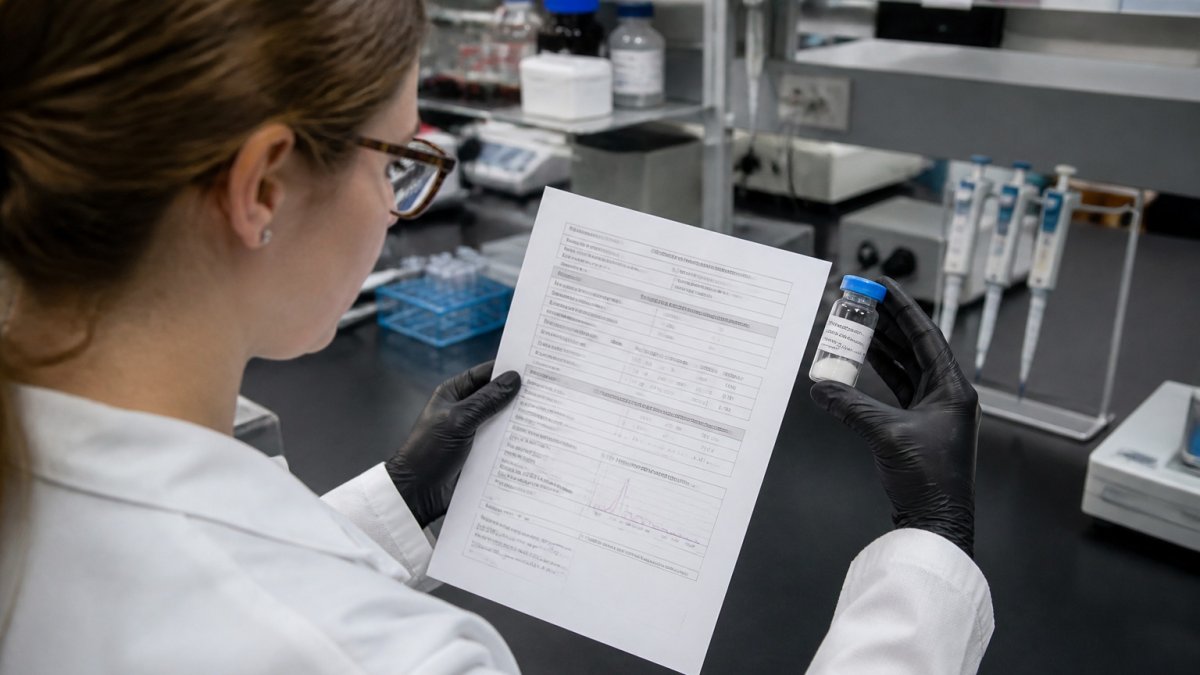
- Suspiciously perfect results. Purity figures at or near 100% with no impurity profile are unusual for real synthetic material.
- Missing batch details. No lot number, no test date, or no report identifier.
- Vague or unverifiable laboratory information. The lab cannot be found, or its contact details do not work.
Document each red flag you find. A written record helps if you later need to explain a decision.
What to Do When a Peptide COA Fails Verification
If a report fails one or more checks, follow a clear process rather than reacting in the moment.
- Stop using the material until the discrepancy is resolved.
- Record what you found, including the lot number, the report identifier, and the specific problem.
- Contact the supplier in writing and ask them to explain the discrepancy and provide the underlying raw data.
- Consider independent testing. A third-party laboratory you choose can test a sample of the material directly.
- Keep the material separate and label it clearly so it is not used by mistake.
- Decide whether to source from another supplier if the answers do not satisfy your standards.
Do not use material whose identity or purity you cannot confirm for research that will be reported or published.
Requesting a Verifiable Lot-Specific COA Before Your Next Order
The best time to check a COA is before you place an order.
When you request documentation, ask for the following:
- A lot-specific certificate tied to the batch you will receive
- The laboratory name and contact details, which you will verify yourself
- The test methods and dates
Bluegrass Research supplies lot-specific, third-party analytical documentation with its compounds, so researchers can run these checks.
Frequently Asked Questions
Purity describes the share of the target peptide relative to other peptide-related material in the sample.
What should I do if the lot number does not match? Do not assume a match.
Frequently Asked Questions
How can you tell if a peptide certificate of analysis is fake?
Start by checking whether the report names a specific lot or batch number that matches your vial label exactly. Then confirm the testing laboratory exists, has independent contact details, and can confirm the report by phone or email. Be cautious of reports with identical results across different batches, missing test dates, generic wording without a report identifier, or suspiciously perfect purity numbers. A report that cannot be traced to a specific sample and batch cannot establish that your material is the material tested.
What should a legitimate peptide COA include?
A legitimate peptide COA should list the peptide identity, lot or batch number, the testing laboratory name and contact information, the test date, the testing methods used, and the results with their acceptance criteria. It should include HPLC purity data, mass spectrometry or molecular mass confirmation, and ideally a unique report identifier. Results should be specific to one batch rather than a generic template reused across products.
Why should the lot number on a peptide COA match the product?
The lot number is the link between the analytical results and the physical vial in your lab. If the COA lot number does not match the label on your vial, the test results describe a different batch and cannot confirm your material's purity or identity. Always compare the lot number on the report with the vial label before you rely on the data, and keep both records together for your documentation.
What should you do if a peptide vendor will not provide a lot-specific COA?
Treat the refusal as a serious red flag and do not use the material for rigorous research until the gap is resolved. Ask the vendor for a lot-specific report that names the batch you received, and request the laboratory's contact details so you can verify the record independently. If the vendor cannot provide a traceable, batch-specific report, the material lacks the documentation needed to defend your results.