 ultimate-guide
How to Read Peptide Analysis: A Lab Guide
Table of Contents
- What Is a Certificate of Analysis and Why It Matters
- Key Components of a Peptide Lab Report
- Understanding Purity and HPLC Results
- Peptide HPLC vs Mass Spectrometry Interpretation
- What Is Peptide Net Peptide Content
- How to Spot Fraudulent Peptide Certificates of Analysis
- Step-by-Step Walkthrough: Reading Your First COA
- Common Mistakes to Avoid When Reading Peptide Analysis
- Frequently Asked Questions
Last Updated: September 18, 2026
What Is a Certificate of Analysis and Why It Matters
A Certificate of Analysis (COA) is the official document that verifies a peptide's chemical composition, purity, and quality through laboratory testing, understanding how to read peptide analysis is essential for any researcher. It's your proof that what you ordered matches what you received. Without it, you're buying blind.
The COA documents testing methods, results, and batch number so you can trace exactly which compound you're working with. For research applications involving metabolic peptides like Semaglutide analogs or Tirzepatide, the COA becomes your defense if results face scrutiny.
At Bluegrass Research, every compound includes lot-specific third-party analytical documentation, meaning independent laboratories verify materials before they reach your bench. This transparency ensures your research depends on verified, certain results.
The COA typically includes compound identification, batch information, purity percentages, chromatography data, and sometimes mass spectrometry results. Each section tells a different story about your material's quality and suitability for your specific research application.
Key Components of a Peptide Lab Report
A peptide lab report contains several critical sections. Understanding what each one means prevents costly mistakes and ensures your research stands on solid ground.
Compound Identification and CAS Number
The first thing you verify is whether the lab tested the right compound. Look for the exact compound name and its CAS number, a unique identifier assigned by the Chemical Abstracts Service that distinguishes one chemical from every other.
The CAS number is your anchor point. If the compound name or CAS number is missing, stop, that's a red flag. Legitimate suppliers include both the IUPAC name and CAS number; some also include the molecular formula for additional verification.
Batch and Lot Number Verification
Every batch gets a unique lot number that traces back to synthesis date, raw materials, and testing performed. Cross-reference the lot number on your COA with your container, they must match exactly. Batch-to-batch variability is real; the lot number ensures you know which batch's data you're reviewing.
Molecular Weight and Peptide Sequence
The molecular weight listed should match the theoretical weight calculated from the amino acid sequence. For synthetic peptides, verify the sequence (N-terminus to C-terminus) matches your order. Reports should note whether the peptide is in free form or as a salt (acetate or trifluoroacetic acid), which affects observed molecular weight.
Understanding Purity and HPLC Results
Purity is the percentage of your sample that is the desired peptide versus impurities or degradation products. HPLC (High-Performance Liquid Chromatography) is the standard measurement method.
Reading the Chromatogram
The chromatogram shows peaks representing different compounds; the largest should be your peptide, smaller ones are impurities. The x-axis shows retention time, the y-axis shows signal intensity. A clean chromatogram has one dominant peak with minimal smaller peaks; multiple large peaks suggest degradation or contamination. Baseline noise should be low and consistent; high noise masks small impurities and reduces reliability.
Peak Integration and Retention Time
Peak integration calculates the area under each peak, proportional to compound amount. Retention time should be consistent across batches; shifts larger than 0.2 minutes suggest degradation, moisture, or method error. Purity is calculated by dividing your peptide peak area by total peak area and multiplying by 100, 95% purity means 95% is desired peptide, 5% is other compounds.
Peptide HPLC vs Mass Spectrometry Interpretation
HPLC tells you how much peptide is present; mass spectrometry tells you what's there, molecular weight and structure.
When to Use Each Method
HPLC is first-line quality control, fast, reliable, and used for routine batch verification and stability checks. Mass spectrometry (MS) is used for molecular confirmation, especially for custom peptides or suspected degradation. Best practice: both methods. HPLC confirms purity; MS confirms identity.
Reading Mass Spectrometry Data
Mass spectrometry measures mass-to-charge ratio (m/z) of ionized molecules (Mass Spectrometer). The molecular ion peak should match your compound's theoretical weight. A clean spectrum has one dominant molecular ion peak with minimal fragmentation. If the listed weight is consistently off by a few Daltons, it may indicate a salt or modification (acetate or trifluoroacetic acid) that's part of the actual mass.
What Is Peptide Net Peptide Content
Peptide net peptide content is the percentage of your sample that is actually peptide, accounting for water, salt, and other non-peptide components, different from purity. A sample might be 95% pure by HPLC but only 80% peptide by net peptide content due to water and salt. This number matters when calculating dosages or concentrations, especially for Semaglutide analogs or metabolic peptides where exact concentrations are critical.
How to Spot Fraudulent Peptide Certificates of Analysis
Not all COAs are legitimate. Fraudulent or misleading reports are common in the research peptide market, and they can invalidate your entire study.
Red Flags in Lab Reports
Missing testing laboratory name and address is a major red flag, you can't verify credentials or contact them. Missing or vague analytical methods (just "tested by HPLC" with no column type, mobile phase, or wavelength) are incomplete or fraudulent. Unrealistically high purity (99.5%+) is rare; most legitimate peptides run 90-98%. Missing batch-to-batch variability documentation suggests the supplier isn't tracking quality; identical purity across batches to five decimal places indicates fabricated data.
Third-Party vs. Internal Lab Reports
Third-party lab reports come from independent testing facilities with no financial relationship to the supplier, the gold standard. Internal lab reports come from the supplier's own laboratory and carry inherent bias. The best suppliers, like Bluegrass Research, use third-party testing for lot-specific verification, removing questions about bias and ensuring independent labs protect their reputation.
Batch-to-Batch Variability and Storage Impact
Real peptide batches show slight variations; suppliers claiming perfect consistency are lying or not testing thoroughly. A COA should note storage conditions (temperature, light, humidity) and duration. Peptides stored at room temperature differ from those at -20°C. Temperature control during shipping matters, peptides exposed to heat or light may degrade.
Step-by-Step Walkthrough: Reading Your First COA
Follow these five steps to evaluate a COA and verify you're getting research-grade material.
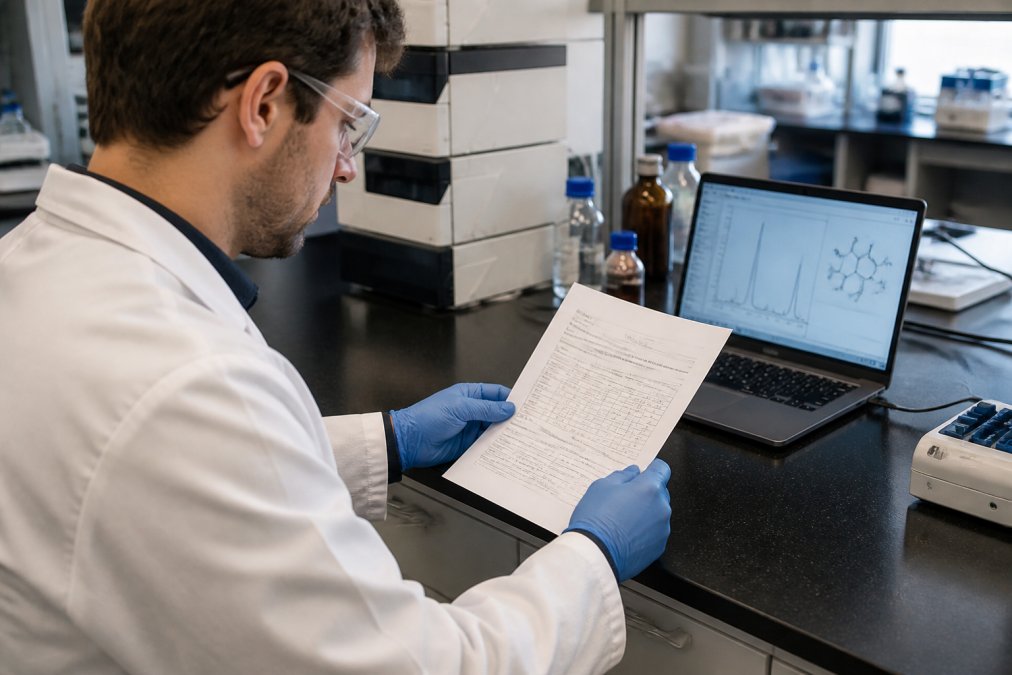
Step 1: Verify the Testing Laboratory
Find the laboratory name, address, and contact information. Search for it online, legitimate labs have websites and contact details. Call the lab to confirm they tested your specific batch. Check for certifications or accreditations relevant to pharmaceutical or research testing.
Step 2: Confirm Batch and Lot Information
Match the lot number on your COA to your container, they must be identical. Note the synthesis or testing date. If testing occurred months after synthesis, ask why; long delays suggest storage degradation.
Step 3: Check Purity Results and Impurity Profile
Look at the purity percentage, 90-95% is acceptable for most research; below 90% is questionable, above 98% is rare. Examine the chromatogram for one dominant peak (your peptide) and smaller peaks (impurities). Multiple similar-sized peaks suggest contamination or degradation; unlabeled impurity peaks are a red flag.
Step 4: Review Analytical Methods Used
Verify methods match your needs. For Semaglutide analog research, you need HPLC for purity and ideally MS for molecular confirmation. Check that method parameters (column type, mobile phase, wavelength) are documented. If details are missing, ask the supplier, legitimate ones can provide them.
Step 5: Assess Storage and Stability Data
Look for storage temperature, light conditions, and time stored. Peptides should be stored at -20°C or colder for long-term stability. If the COA includes stability data showing purity over time, that's excellent. If not, ask the supplier how long the material remains at stated purity under documented storage conditions.
Common Mistakes to Avoid When Reading Peptide Analysis
Don't skip reading the COA, take 10 minutes to verify its contents, as learning how to read peptide analysis prevents costly mistakes. High purity doesn't automatically mean high quality; impurity profiles matter as much as purity numbers. Never ignore missing information (testing lab name, batch number, analytical methods). Don't compare purity across different testing methods or labs without understanding methodology. Finally, don't work with suppliers who won't answer questions about their COAs.
Frequently Asked Questions
How do I interpret HPLC results for peptide purity?
HPLC results show purity through a chromatogram where the main peptide peak represents the primary compound. The peak height and area indicate concentration, while retention time identifies the specific peptide. Look for a single dominant peak occupying 95% or more of the total peak area for high-purity peptides. Secondary peaks represent impurities or degradation products. The baseline should be clean with minimal noise, and the integration method should match standard analytical frameworks for peptide quantitation.
What does 'net peptide content' mean on a lab report?
Net peptide content represents the actual amount of pure peptide in your sample, accounting for water, salt, and other non-peptide components. A lyophilized powder labeled 95% net peptide content means only 95% of the total weight is actual peptide; the remaining 5% is typically residual moisture, acetate, or trifluoroacetic acid from synthesis. This is critical for accurate dosing in research because you must calculate your true peptide mass by multiplying the total weight by the net peptide percentage.
How can I tell if a peptide analysis report is fraudulent?
Fraudulent reports often lack third-party laboratory credentials, show suspiciously perfect purity (100% is impossible), or contain generic data not specific to your lot number. Legitimate COAs include the testing laboratory's accreditation, unique batch identifiers, chromatograms with visible peaks and baseline noise, and specific retention times. Cross-reference the laboratory name with industry databases. Batch-to-batch variability is normal; identical results across multiple lots suggests fabricated data. Verify that the report matches your actual compound's molecular weight and peptide sequence.
Why is mass spectrometry data essential for peptide verification?
Mass spectrometry confirms the exact molecular weight of your peptide by measuring the mass-to-charge ratio, proving you have the correct compound. While HPLC shows purity by separation, MS provides structural validation and detects impurities invisible to chromatography. For research-grade peptides, MS data is the gold standard for compound identification and validation, especially for metabolic peptides used in clinical studies where results will face scrutiny.