 ultimate-guide
Peptide for Sale: A 2026 Research Buyer's Guide
Table of Contents
- What Separates Research-Grade Peptide Suppliers From Resellers
- Research-Grade Peptide Purity Standards and Testing Methods
- How to Read a Certificate of Analysis for Peptides
- Peptide Storage and Handling Best Practices for Laboratories
- Custom Peptide Synthesis vs. Catalog Peptides: Which Fits Your Study
- Safety and Regulatory Compliance When Buying Peptides for Research
- What to Evaluate Before You Buy Peptide Materials Online
- Frequently Asked Questions
Last Updated: October 1, 2026
What Separates Research-Grade Peptide Suppliers From Resellers
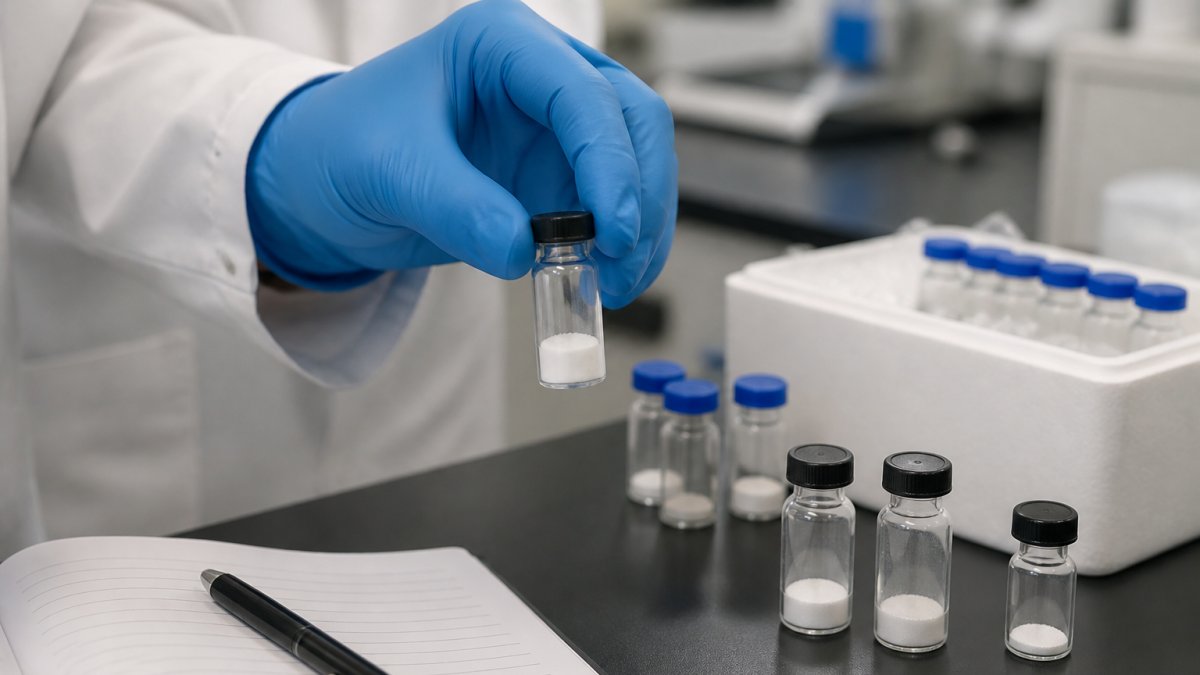
Searching for a peptide for sale returns two kinds of sellers. One synthesizes, purifies, and tests compounds in-house, shipping a lot-specific certificate of analysis with every vial. The other buys bulk material, relabels it, and forwards whatever documentation came in the box.
Research-Grade Peptide Purity Standards and Testing Methods
Research-grade purity means the compound meets a documented threshold, usually 95% or higher by HPLC, with identity confirmed by mass spectrometry. Purity and identity answer different questions, and you need both.
- HPLC analysis separates components by retention time and quantifies the main peak against impurities
- Mass spectrometry confirms molecular weight against the theoretical value for the peptide sequence
- Peptide characterization combines both into a lot-specific profile you can archive
HPLC and Mass Spectrometry: What Each Test Actually Confirms
High-performance liquid chromatography answers "how pure is this batch." The sample passes through a column, and each component elutes at a characteristic time. A clean chromatogram shows one dominant peak with minor shoulders; a messy one reveals truncated sequences and synthesis byproducts.
How to Read a Certificate of Analysis for Peptides
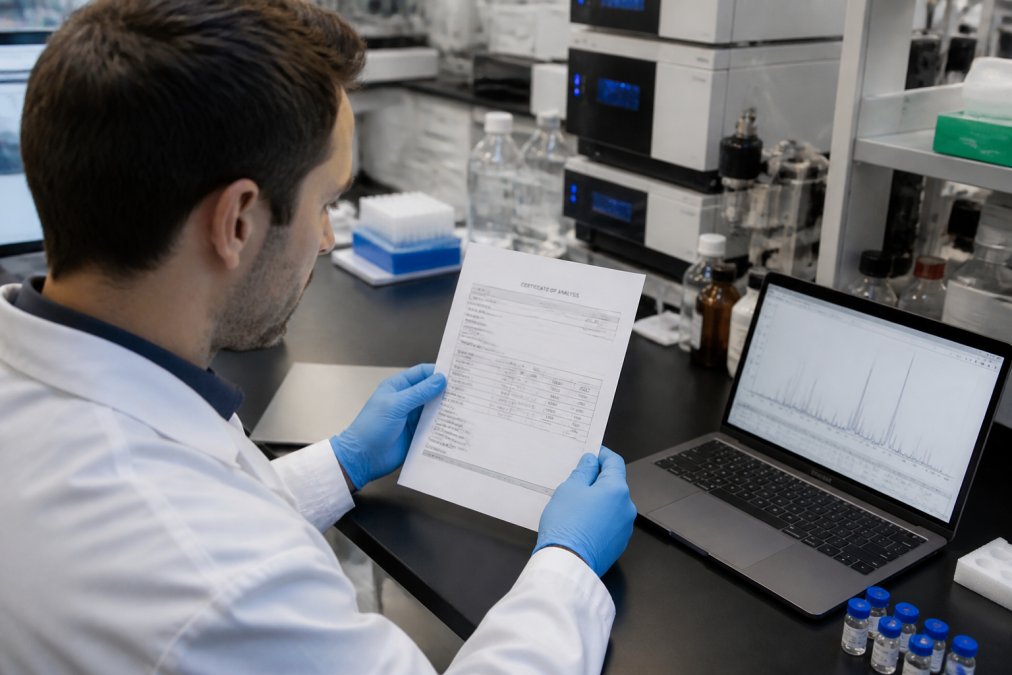
Reading a certificate of analysis for peptides means checking five fields: lot number, test method, purity result, identity result, and the testing laboratory's name. If any is missing, the document is decoration, not documentation.
Lot-Specific vs. Generic COAs: The Red Flags
A lot-specific COA traces to your exact batch. A generic COA describes a representative sample tested once and now attached to everything. The difference matters when your results get scrutinized.
Red flags to watch for:
-
- No lot number on the document
-
- Purity percentage with no attached chromatogram
-
- Identity confirmed by "appearance" rather than mass spectrometry
-
- Same COA file reused across multiple orders
-
- No named testing laboratory
-
- Dates that predate the batch you received
Peptide Storage and Handling Best Practices for Laboratories
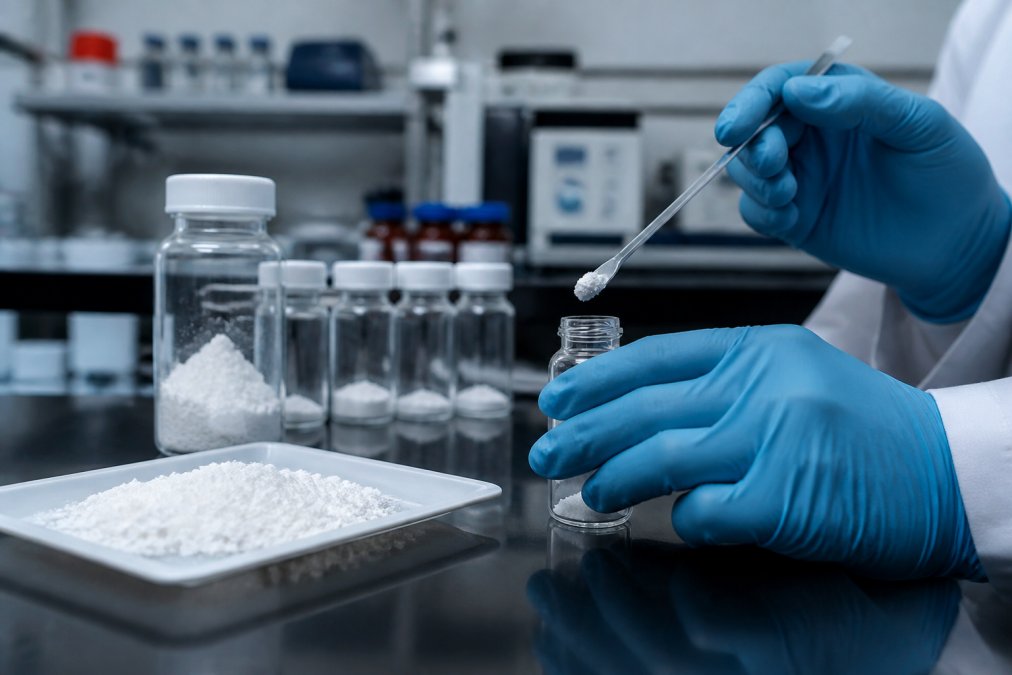
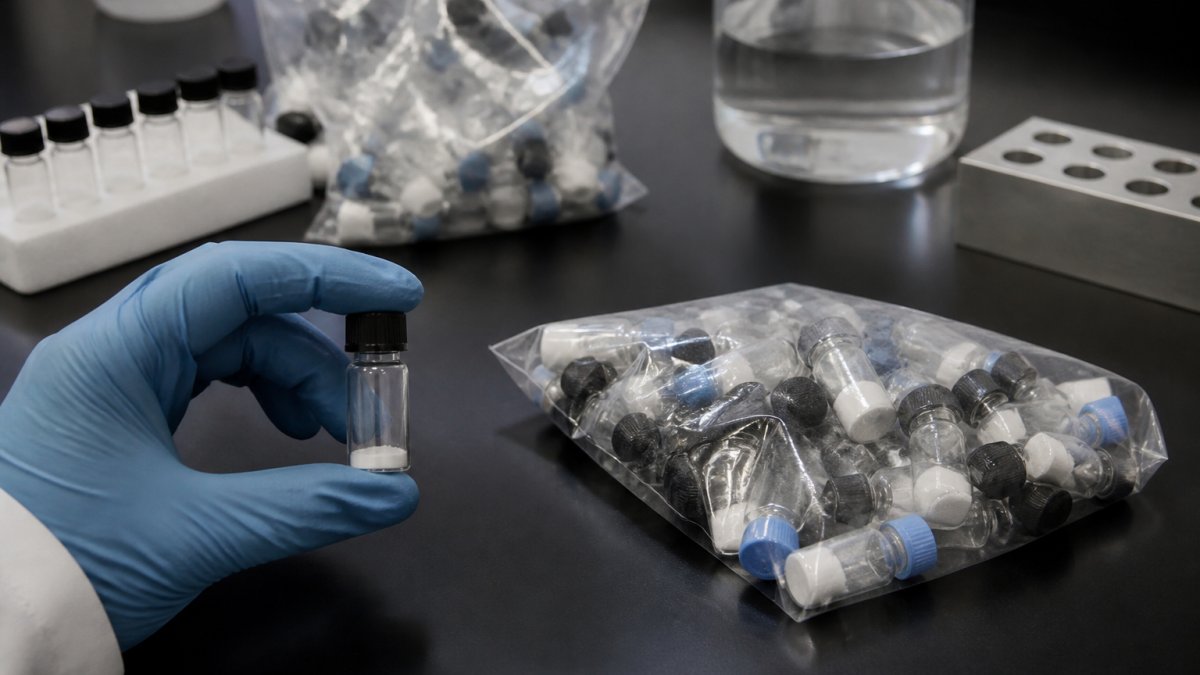
Storage conditions decide how long your peptide stays intact, and most degradation happens before the first assay. Lyophilized peptides, the freeze-dried powder most suppliers ship, are stable for extended periods when kept dry and cold. Once reconstituted, the clock accelerates.
Follow these handling practices:
- Store lyophilized powder at -20°C or lower, away from light
- Equilibrate vials to room temperature before opening to prevent condensation
- Reconstitute with sterile water or buffer appropriate to your assay
- Aliquot reconstituted peptide into single-use volumes to avoid freeze-thaw cycles
- Record reconstitution date and concentration on every aliquot
Reconstitution Math: Getting Concentration Right the First Time
Most reconstitution errors are arithmetic, not technique. Before opening the vial, note the peptide mass (printed on the label, usually in mg) and the target stock concentration (typically 1-5 mg/mL).
Solvent Selection by Peptide Character
Sterile water works for most hydrophilic sequences, but many research peptides, especially those with high hydrophobic residue content or a free C-terminal acid, will not fully dissolve in water alone. Signs of incomplete dissolution include persistent haze, visible particulates, or a low UV spectrophotometer reading.
What Actually Degrades a Peptide
Three mechanisms account for most peptide loss in a working lab:
- Hydrolysis, cleavage of the peptide backbone, accelerated by heat, extreme pH, and prolonged time in aqueous solution. This is why reconstituted stocks should be aliquoted and frozen rather than stored on the bench.
- Oxidation, modification of methionine, cysteine, and tryptophan residues by dissolved oxygen or reactive species. Oxidation shows up as a mass shift on re-analysis and can silently reduce activity.
- Aggregation, self-association of hydrophobic sequences into insoluble fibrils. Aggregation is often irreversible and is worsened by freeze-thaw cycling and high concentration.
Freeze-Thaw: The Habit That Ruins Stocks
Every freeze-thaw cycle subjects the peptide to ice-crystal formation, transient concentration spikes, and pH shifts in the residual liquid. For aggregation-prone sequences, a handful of cycles can lose the batch.
Long-Term Storage by Format
| Format | Temperature | Typical Stability Window | Notes |
|---|---|---|---|
| Lyophilized powder | -20°C | Months to years | Desiccate; protect from light |
| Lyophilized powder | -80°C | Extended | Preferred for long archival storage |
| Reconstituted stock | -20°C | Weeks | Aliquot before freezing |
| Reconstituted stock | -80°C | Longer | Best for aggregation-prone sequences |
| Working dilution | 4°C | Hours to days | Prepare fresh when possible |
Stability windows vary by sequence, so treat the table as a planning default. For a long-running study, run a small stability check, re-analyze an aliquot by HPLC after a defined interval, rather than assuming the label's shelf life applies to your storage conditions.
Custom Peptide Synthesis vs. Catalog Peptides: Which Fits Your Study
Custom synthesis fits novel sequences, labeled analogs, and modified residues no catalog carries. Catalog peptides fit standard, well-characterized sequences you need quickly and cheaply. The decision comes down to three questions: does the sequence exist off the shelf, how soon do you need it, and what documentation does your study require?
| Factor | Catalog Peptides | Custom Synthesis |
|---|---|---|
| Sequence | Standard, pre-validated | Your specification |
| Lead time | Ships from stock | Built to order |
| Modifications | Limited to listed variants | Labels, cyclization, substitutions |
| Documentation | Lot-specific COA | Lot-specific COA plus synthesis report |
| Best for | Replication studies, standard assays | Novel targets, method development |
How Custom Synthesis Actually Works
Most research peptides are built by solid-phase peptide synthesis (SPPS), in which amino acids are added one at a time to a growing chain anchored to a resin bead. Each cycle couples the next amino acid, then removes a protecting group so the following residue can attach. The chain is cleaved from the resin, purified, usually by preparative HPLC, and lyophilized.
Modifications You Can Request
Custom synthesis is where you specify chemistry the catalog cannot offer:
- Fluorescent labels, fluorescein, rhodamine, or similar tags attached at the N-terminus, C-terminus, or an internal lysine, depending on whether the label should sit near the binding site or away from it
- Biotinylation, for pull-down assays and streptavidin-based detection
- Cyclization, head-to-tail or disulfide bridges that constrain conformation and often improve stability
- D-amino acid substitutions, used to slow proteolytic degradation in certain assay systems
- Phosphorylated or methylated residues, to mimic post-translational modification states
- Isotope labels, for mass spectrometry or NMR work
What the Documentation Should Include
A catalog peptide typically ships with a lot-specific certificate of analysis covering purity by HPLC and identity by mass spectrometry. A custom order should add a synthesis report documenting the requested sequence, modifications, purification method, and observed versus theoretical molecular weight.
Lead Time and Cost Trade-offs
Catalog peptides ship from stock, often within days, and cost less because synthesis work is amortized across many orders. Custom synthesis is built to order, so lead time depends on sequence length, modification complexity, and purification difficulty, simple unmodified sequences move faster than heavily labeled or cyclic ones.
Before requesting a custom quote, confirm the exact sequence, any modifications, the desired purity grade, and the quantity you need. Suppliers quote faster and more accurately when those four items are specified up front.
Safety and Regulatory Compliance When Buying Peptides for Research
Compliance questions surface the moment institutional purchasing gets involved, and the answers depend on how the material is labeled and documented. Research peptides are sold for laboratory use, not human or veterinary administration, and that distinction shapes everything from labeling to shipping.
What to Evaluate Before You Buy Peptide Materials Online
Evaluate a peptide supplier on five criteria: documentation quality, testing transparency, shipping reliability, storage support, and responsiveness to technical questions. Price sits below all five, because a cheap vial with no COA costs more in wasted assay time.
Here is the evaluation framework:
- Documentation: Can they produce a lot-specific COA on request, before purchase?
- Testing: Is purity confirmed by HPLC and identity by mass spectrometry, with raw data attached?
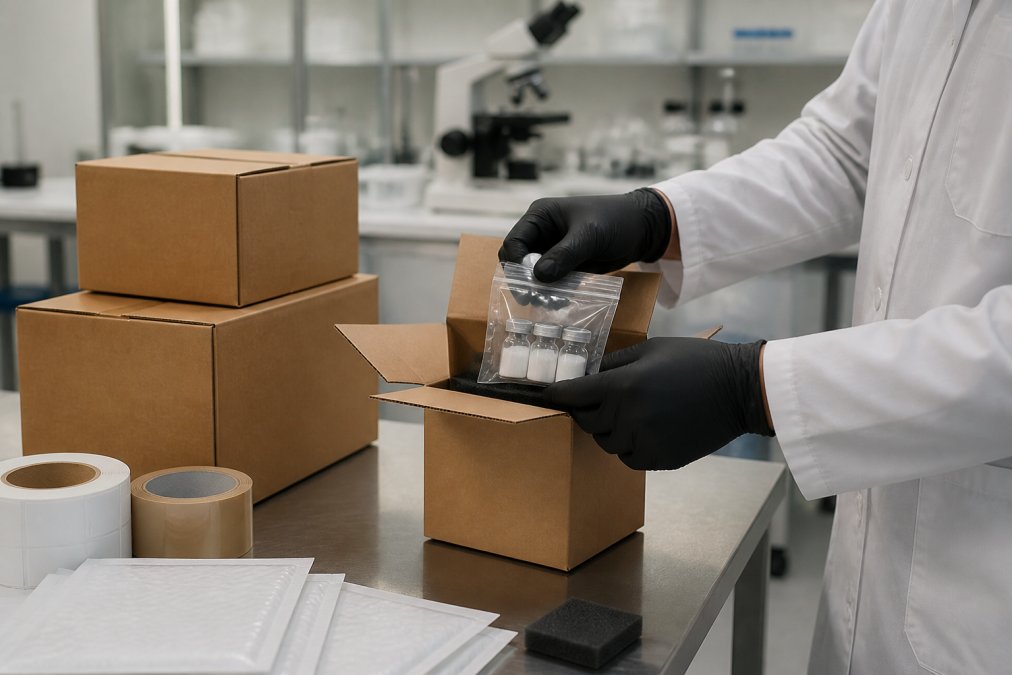
- Shipping: Do they control temperature in transit and ship discreetly?
- Storage: Do they supply guidance and containers suited to long-term storage?
- Support: Will a technical contact answer questions about method development or reconstitution?
Laboratories that need verified documentation on file before materials clear procurement.
Frequently Asked Questions
What criteria define a legitimate research-grade peptide supplier?
A legitimate supplier provides lot-specific certificates of analysis from third-party labs, not generic documents reused across batches. Look for HPLC purity data, mass spectrometry confirmation, and peptide sequence verification specific to your order's lot number. The supplier should also offer clear storage guidance, documented handling protocols, and shipping methods that protect compound stability in transit. Transparency about testing methods matters as much as the results themselves.
How can researchers verify peptide purity before purchase?
Request a sample COA before ordering and check that it includes HPLC chromatograms showing purity percentage, mass spectrometry data confirming molecular weight, and the specific lot number. A purity claim of 98% or higher backed by analytical testing is standard for research-grade material. If a supplier cannot provide lot-specific documentation on request, that is a signal to look elsewhere. Independent verification through your own lab's analytical testing is also good practice.
What documentation should accompany research-grade peptides?
Every shipment should include a lot-specific certificate of analysis showing HPLC purity results, mass spectrometry confirmation, peptide sequence, molecular weight, and the testing laboratory's identity. Some suppliers also provide sterility testing results and endotoxin levels for sensitive applications. Keep these records filed by lot number so you can trace any experimental anomalies back to the specific batch. Documentation should match the physical vial's lot number exactly.
Are there specific storage requirements for research peptides?
Lyophilized peptides should be stored at -20°C or lower, protected from light and moisture. Once reconstituted, most peptides require refrigeration at 2-8°C and should be used within a defined window, often days to weeks depending on the peptide. Avoid repeated freeze-thaw cycles, which degrade the peptide sequence. Aliquot reconstituted material before freezing to minimize handling damage. Always follow the specific storage guidance provided with your COA.
The challenge with sourcing peptides is not finding a supplier. It is finding one whose documentation survives scrutiny when your results are questioned. Bluegrass Research supplies research-grade materials with lot-specific, third-party analytical documentation, discreet shipping with no external branding, and professional storage solutions that keep compound integrity intact from dock to bench. Get started with Bluegrass Research and put verified purity behind every assay.