 how-to
Identifying Legitimate Lot-Specific COAs: 2026 Guide
Table of Contents
- What Makes a COA Lot-Specific and Why It Matters
- How to Verify Peptide COA: A Step-by-Step Workflow
- Common COA Red Flags That Signal Fraud
- Digital Verification Tools and Lab Accreditation Databases
- COA Template Comparison: What a Legitimate Document Includes
- Legal and Regulatory Recourse for Fraudulent Documentation
- Frequently Asked Questions
Last Updated: September 13, 2026
What Makes a COA Lot-Specific and Why It Matters
A lot-specific Certificate of Analysis ties analytical results to one manufacturing batch, not to a product line in general. That distinction is the entire basis for identifying legitimate lot specific COA documents. At Bluegrass Research, every compound ships with documentation traceable to the exact batch in the vial.
Generic paperwork describes a compound. Lot-specific documentation describes your compound. The difference matters when results get scrutinized, audited, or published.
Batch Identification vs. Generic Documentation
Batch identification is the practice of linking a certificate to a unique lot number printed on both the vial label and the document itself. Generic documentation skips this step entirely. It shows purity figures with no batch reference, which means the numbers could describe anything.
A legitimate lot-specific COA includes the batch number, a matching vial label, testing dates, and results that correspond to that single production run. If the document cannot be matched to a physical vial, it proves nothing.
How to Verify Peptide COA: A Step-by-Step Workflow
Verification is a cross-referencing exercise, not a reading exercise. You compare four things: the vial label, the document, the testing laboratory, and the analytical data. Here is how to verify peptide COA documents in a repeatable sequence.

Step 1: Match Lot Numbers and Vial Labeling
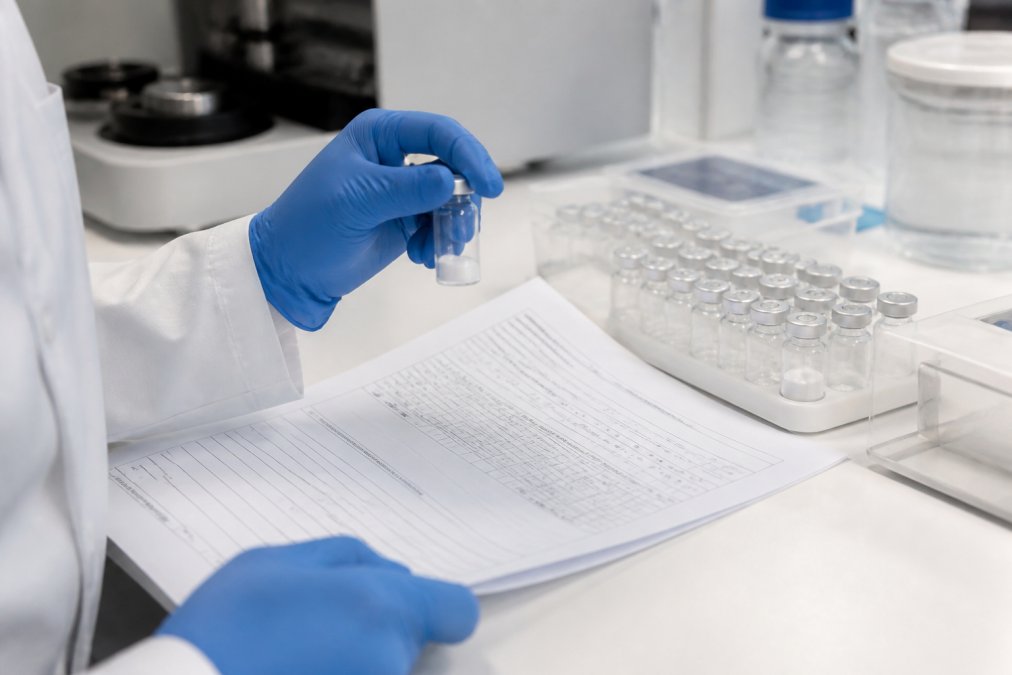
Check the lot number on the vial against the lot number on the certificate. They must match character for character. A common mistake is accepting a "batch number matching" claim without physically confirming it. If the vial has no lot number, or the number differs from the document, stop there.
Step 2: Check Lab Credentials and ISO Accreditation
Identify the testing laboratory named on the report, then confirm that laboratory holds current ISO accreditation for the specific tests performed. Many businesses find that accreditation databases are the fastest way to catch a fabricated lab name. A real laboratory will appear in an accreditation registry with a scope that covers purity analysis and related testing.
Step 3: Confirm Analytical Methods and Numerical Results
The document should state which analytical methods produced the results, typically HPLC for purity and mass spectrometry for compound identity. Look for numerical results with specification limits, not vague pass/fail language. A legitimate report shows actual figures and the range they were measured against.
Common COA Red Flags That Signal Fraud
Fraud detection on certificates comes down to inconsistencies. Watch for these common COA red flags:
- Purity listed as "99%" with no decimal precision or method stated
- No lot number, or a lot number that changes between orders for the same product
- A testing laboratory with no verifiable accreditation record
- Missing authorized signature or a signature block with no printed name and title
- Results presented without specification limits or testing parameters
- Identical documents across different batches, down to the formatting
Digital Verification Tools and Lab Accreditation Databases
Most guides stop at "check the lab's accreditation." That instruction is useless without knowing where to look and what a valid result actually shows. This section gives you the two verification workflows that catch the majority of fabricated certificates: an accreditation database lookup and a digital document check.
How to Look Up a Lab's ISO/IEC 17025 Accreditation
ISO/IEC 17025 is the international standard for testing and calibration laboratories, and it is the benchmark most legitimate analytical labs are accredited against (iso.org). Accreditation is granted by an accreditation body, not by the lab itself, and the scope of that accreditation is published. That published scope is what you verify.
Follow this sequence:
- Get the exact legal name of the laboratory from the certificate, not the brand name, not the website name. Fabricated certificates often use a trade name that does not exist as an accredited entity.
- Identify the accreditation body. In this market the recognized bodies include A2LA (American Association for Laboratory Accreditation) and PJLA (Perry Johnson Laboratory Accreditation), among others. A legitimate certificate will usually name the accreditation body and often the certificate number.
- Search the accreditation body's public directory for the lab's legal name. A2LA and PJLA both maintain searchable online directories of accredited labs.
- Open the lab's scope of accreditation and read the specific test methods listed. This is the step most buyers skip. A lab can be accredited for one method and not another. If your certificate claims HPLC purity analysis but the lab's published scope only covers, say, microbiological testing, the certificate is not backed by accreditation for that test.
- Confirm the accreditation is current. Directories list expiration or suspension status. An expired accreditation is not accreditation.
If the lab name does not appear in any accreditation body's directory, or appears with a scope that does not cover the tests on your certificate, treat the document as unverified regardless of how professional it looks.
Digital Verification: QR Codes, Document IDs, and Portals
A growing number of legitimate suppliers attach a machine-checkable identifier to each certificate. These are the formats worth knowing:
- QR codes that resolve to a hosted copy of the report on the supplier's or lab's domain. Scan it and confirm the URL matches the supplier's real domain, a QR code pointing to a lookalike domain is a red flag, not a feature.
- Unique document IDs or verification codes printed on the certificate that can be entered on the supplier's site to pull the original file. The value here is that the ID is tied to a single document; a reused ID across multiple orders means the document is not lot-specific.
- Supplier or lab portals where you log in and download the report directly from the source rather than receiving it as an email attachment. Portals reduce the risk of a doctored PDF being substituted in transit.
Why the Two Checks Belong Together
An accreditation lookup confirms the lab is real and qualified for the test. A digital identifier confirms the document is the one the lab or supplier actually issued. Either check alone can be defeated: a real lab's name can be printed on a fake report, and a convincing QR code can point to a fabricated portal. Running both closes the gap.
COA Template Comparison: What a Legitimate Document Includes
A legitimate certificate follows a consistent structure. Use this comparison to score any document you receive.
| Section | Legitimate COA | Red Flag Version |
|---|---|---|
| Lot number | Matches vial label exactly | Missing or mismatched |
| Testing lab | Named, verifiable accreditation | Generic or unverifiable name |
| Analytical methods | HPLC, mass spectrometry stated | Method omitted |
| Results | Numerical values with limits | Vague pass/fail only |
| Signature | Authorized signature with name and title | Unsigned or anonymous |
| Traceability | Batch identification and dates | No batch reference |
This template comparison is a starting filter, not a final verdict. A document can pass every row and still warrant a call to the lab if something feels off.
Legal and Regulatory Recourse for Fraudulent Documentation
Almost no guide tells you what to actually do after you receive a fake certificate. This section does. The goal is to preserve evidence, route the complaint to the right agency, and, for institutional buyers, trigger vendor remedies before the paper trail goes cold.
Step 1: Preserve the Evidence Before You React
Fraud claims are won or lost on documentation. Before you contact the supplier or discard anything:
- Keep the original certificate file exactly as received, do not re-save, re-export, or annotate it. Metadata (creation date, author, editing history) is often the strongest proof of tampering.
- Keep the vial or product with its label intact. The lot number on the physical label is the anchor for the whole claim.
- Keep all correspondence, emails, order confirmations, chat logs, invoices, in their original form.
- Photograph the sealed package, the vial, and the certificate together on arrival. This establishes that the document and product were shipped as a matched pair.
Step 2: Route the Complaint to the Right Agency
Different agencies have different jurisdiction, and sending a complaint to the wrong one delays it. Match the complaint to the conduct:
- Deceptive commercial practices. The FTC Act gives the FTC authority over unfair or deceptive acts or practices in commerce. A supplier that sells product backed by a fabricated certificate is making a deceptive claim. File through the FTC complaint portal.
- Regulated products and labeling. Where the product falls within FDA jurisdiction, labeling and documentation misrepresentations can be reported through the FDA reporting channels. The FDA's MedWatch program is the standard route for reporting problems with regulated products.
- Interstate fraud. Fabricated documentation used to induce a purchase across state lines can implicate federal mail and wire fraud statutes, which are enforced by the U.S. Department of Justice. These are criminal matters; the FTC and FDA routes are the practical starting points for most buyers.
Step 3: Institutional Buyers, Escalate Internally First
If you purchased through an institution, university, or company, your fastest remedy is usually internal, not federal:
- Notify your compliance or procurement office in writing. They can place the vendor on hold, pursue contract remedies, and issue a formal demand.
- Check whether the purchase falls under any vendor qualification or quality agreement. A supplier that certified lot-specific testing has likely breached that agreement, which gives you a contractual claim independent of any regulatory action.
- Preserve the chain of custody from shipment to storage. A documented, unbroken chain is what makes a contractual or fraud claim actionable months later.
What Recourse Realistically Looks Like
For most buyers, the practical outcome is not a federal prosecution, it is a documented complaint, a vendor dispute, and a supplier relationship you end. That is still worth doing. The record you build protects you if the product's quality is later challenged, and it contributes to the pattern that regulators use to prioritize enforcement. Treat reporting as part of your verification workflow, not an afterthought.
Frequently Asked Questions
How can I tell if a lot-specific COA is authentic?
Check that the lot number on the COA matches the vial label exactly. Verify the testing laboratory's ISO accreditation through official databases. Look for authorized signatures, numerical results for purity, and the specific analytical methods used, such as HPLC or mass spectrometry. Contact the lab directly to confirm they tested your batch.
What are the most common COA red flags?
Watch for generic documents that lack lot numbers, missing authorized signatures, results without numerical values, and lab names that cannot be verified. Fake COAs often use vague language like 'passes specification' without listing testing parameters.
Can I cross-reference a COA number with the testing facility?
Yes. Call or email the lab listed on the COA and provide the lot number and batch identification. They should confirm whether they tested that specific batch and whether the results match. If the lab has no record or refuses to verify, treat the document as suspect.
Why is lot-specific documentation critical for peptide research?
Lot-specific COAs tie purity analysis and quality control data to the exact batch you received. Generic documentation cannot confirm that your vial meets specification limits for compound identity. Without batch number matching, you cannot defend your results if they are scrutinized, and you risk using degraded or misidentified materials in your studies.