 how-to
University Lab Procurement Compliance Tips
Table of Contents
- Why Lab Procurement Compliance Matters for University Research
- Understanding Supplier Compliance and Certification Standards
- Peptide Certificate of Analysis Requirements and Documentation
- How to Verify Peptide Purity Documentation Before Purchase
- Grant-Funded Procurement Requirements and Expenditure Thresholds
- University Research Compliance Checklist for Lab Managers
- Building an Audit Trail and Maintaining Batch Traceability
- Frequently Asked Questions
Last Updated: September 3, 2026
Why Lab Procurement Compliance Matters for University Research
Lab procurement compliance keeps research defensible, funding intact, and institutional credibility secure. Cutting corners on documentation or supplier vetting triggers grant audit failures, questions research results, flags institutional funding, and can render published work suspect.
Grant-funded purchases and controlled compounds require complete audit trails: what was bought, from whom, quality verification, and storage documentation. Post-purchase audits often reveal insufficient supplier documentation, making compliance urgent.
This guide covers supplier certification standards, documentation requirements, grant compliance, and batch traceability to ensure your work withstands scrutiny.
Understanding Supplier Compliance and Certification Standards
Supplier compliance requires documented proof that vendors meet institutional and regulatory standards before placing orders.
Most universities require ISO 9001 (quality management) as baseline. For chemical and pharmaceutical compounds, ISO 17034 (testing laboratory accreditation) is standard (iso.org). FDA-regulated or grant-funded work may require additional certifications specific to the funding source.
At procurement intake, verify current certifications and expiration dates, compliance with vendor management policy, appropriate insurance coverage, and required conflict of interest disclosures. A supplier without proper certification can disqualify an entire purchase order. Document every verification in your procurement system for audit proof.
Peptide Certificate of Analysis Requirements and Documentation
The certificate of analysis (COA) is your proof of peptide purity and identity, it's not optional and makes your compound defensible.
A complete COA must include lot-specific testing data (actual results from the exact batch received, not theoretical ranges), lot number, molecular weight confirmation, purity percentage with methodology, analysis date, and laboratory certification.
Third-party analytical testing carries more weight than supplier self-testing. Confirm third-party requirements before ordering, as some suppliers include this as standard while others charge additional fees.
Store the COA with your compound in the same location as batch records, not separately in email or shared drives. Auditors cross-reference COAs against inventory and usage logs; mismatched lot numbers are compliance failures.
How to Verify Peptide Purity Documentation Before Purchase
Before committing to a supplier, request a sample COA from a recent batch (not a template) to verify documentation practices match your requirements.
Red flags in sample COAs include generic ranges instead of specific results, missing lot numbers or dates, no methodology listed, unsigned documents, or testing older than 12 months.
Ask suppliers whether testing is in-house or third-party, request accreditation status and third-party lab contact information, and verify quality assurance documentation or ISO certification.
For regulated or grant-funded research, cross-check supplier documentation standards against institutional requirements with your compliance office or grants administrator before ordering.
Integrating Supplier Verification into Your Procurement Workflow
Many universities integrate supplier compliance checks into ERP systems (Oracle, SAP, Workday) to flag missing certifications and incomplete documentation. Centralized compliance databases eliminate redundant verification and alert staff when certifications expire. Without automated systems, maintain a spreadsheet-based vendor master list with certifications, expiration dates, and verification dates, reviewed monthly. This creates an audit trail of institutional due diligence.
Documentation Standards and Audit Readiness
Create a supplier compliance record documenting verification date, certifications reviewed, COA findings, concerns or gaps, approval to use, and verifier name/title. This audit trail demonstrates due diligence in vendor selection.
Bluegrass Research provides lot-specific COAs verified through third-party testing with ISO 17034 accreditation, ensuring audit-ready documentation from day one.
Grant-Funded Procurement Requirements and Expenditure Thresholds
Grant funding carries procurement rules tied to funding source and award amount. Violations trigger audit findings, fund repayment, or disqualify future applications. Understanding applicable rules is non-negotiable.
Federal Funding and Competitive Procurement Thresholds
Federal grants follow Uniform Guidance (2 CFR Part 200) thresholds: $250,000+ requires formal competitive procurement; $10,000-$250,000 requires three competitive quotes; under $10,000 allows simplified procurement with documentation (whitehouse.gov).
Thresholds apply to aggregate purchases, not individual line items. Three $8,000 peptide orders totaling $24,000 must be treated as one $24,000 purchase requiring competitive quotes.
Sole-source procurement requires specific documented justification: vendor is the only source meeting technical requirements, or emergency circumstances prevent competition. Generic reasons like prior relationships are insufficient.
Private Foundation and Grant-Specific Rules
Private foundations and non-federal grants may impose different thresholds ($5,000 or $25,000 for competitive procurement). Check your grant's terms and conditions document or contact your grants office before ordering.
Federal grants prohibit purchases from vendors on the Excluded Parties List System (SAM.gov) (sam.gov). Some grants restrict vendors by country or require specific certifications (minority-owned, small disadvantaged businesses). Check grant-specific restrictions before ordering.
Expenditure Tracking and Budget Compliance
Grant budgets are fixed; exceeding them without approval results in audit findings or personal liability. Track spending monthly or quarterly in real time. Notify your PI and grants administrator immediately if approaching budget limits. Budget amendments require advance approval.
Audit Preparation for Grant-Funded Purchases
Auditors verify compliance with Uniform Guidance thresholds and competitive procurement rules. Organize records by grant including purchase orders, business justification, competitive quotes or sole-source documentation, vendor certifications, invoices, receiving documentation, and COAs. Common audit findings: missing competitive procurement documentation, insufficient vendor justification, incomplete COAs, and budget overages without amendment. These create compliance risk for future grants and delay closeout.
Documentation Checklist for Grant-Funded Purchases
- Confirm the purchase threshold that applies to your grant (Uniform Guidance $250,000/$10,000 or grant-specific threshold)
- If above threshold, document competitive procurement process (RFP, sealed bids, or competitive quotes from at least three vendors)
- If sole-source, document specific technical or emergency justification
- Verify vendor is not on the Excluded Parties List System (SAM.gov)
- Confirm vendor meets any grant-specific eligibility requirements (certifications, business status, geographic restrictions)
- Check that the purchase does not exceed your approved budget allocation
- Obtain required approvals from your PI, department, and grants office if needed
- File all procurement documentation in a single location organized by grant number
- Retain all records for at least three years after grant closeout (federal requirement)
Grant compliance is not optional, and it's not negotiable. Auditors have seen labs lose funding over documentation gaps that could have been prevented with proper planning.
University Research Compliance Checklist for Lab Managers
A systematic approach prevents compliance failures. Use this checklist before placing any significant order:
- Verify the purchase is consistent with your approved budget and grant terms
- Confirm the supplier holds required certifications (ISO standards, third-party accreditation, etc.)
- Check institutional vendor management system for any compliance flags
- Determine if the purchase amount triggers competitive procurement requirements
- Request a sample COA or documentation package from the supplier
- Confirm third-party testing is included if required by your grant or institution
- Document the business justification for this supplier (why them vs. alternatives)
- Obtain necessary approvals from your PI, department head, or compliance office
- Verify shipping and storage requirements align with your lab's capabilities
- Create a record in your procurement system with supplier contact and documentation details
- Upon delivery, cross-check received materials against the purchase order and COA
- File all documentation (invoice, COA, compliance approvals) in a single location
- Log the batch into your inventory system with lot number and expiration date
This checklist transforms compliance from reactive to proactive. It takes 15 minutes per order and saves hours during an audit.
Building an Audit Trail and Maintaining Batch Traceability
An audit trail is a documented record of every decision and action related to your purchase. It answers: Who approved this? When? Why? From whom did we buy it? What testing confirmed quality? Where is it stored? How was it used?
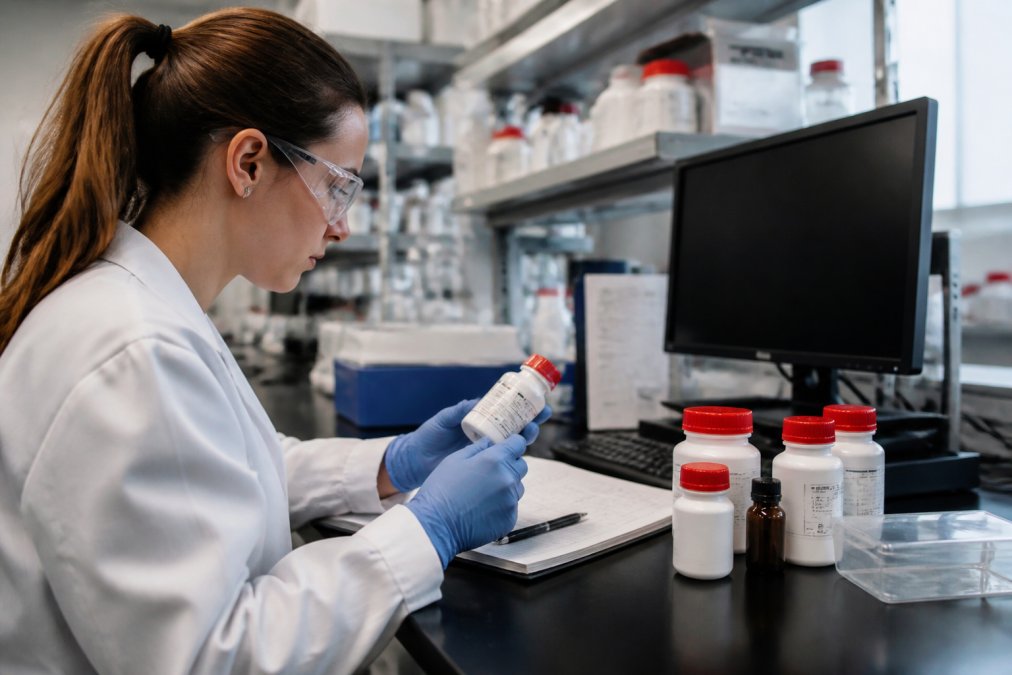
Purchase orders should include supplier name, product description, lot number, quantity, cost, approval chain, and business justification. Create receiving records documenting date received, packaging condition, lot number, and discrepancies. Attach COAs and supplier documentation to form your batch record.
Batch traceability links each lot from purchase through use. Log batches in inventory systems with supplier name, lot number, dates, storage conditions, quantities, and researcher names/dates. Batch numbers should appear in lab notebooks or electronic records to link data to verified compounds. Use consistent digital systems (spreadsheets or dedicated software) with complete entries and no gaps.
Lab procurement compliance protects research, funding, and institutional reputation. Supplier verification, documentation, grant compliance, and batch traceability are non-negotiable foundations for defensible work. Bluegrass Research provides lot-specific COAs, third-party verification, and transparent documentation to eliminate compliance friction. Shop Now and experience procurement that puts compliance first.
Frequently Asked Questions
How do I read a certificate of analysis for peptides?
A peptide certificate of analysis (COA) shows lot-specific purity data, identity confirmation, and third-party test results. Look for the lot number, analytical method used (HPLC, mass spectrometry), purity percentage, and the testing laboratory's accreditation. Verify the COA matches your purchase order lot number and confirms the compound meets your research specifications. Cross-reference the analytical method against your institutional requirements to ensure defensibility if results are scrutinized.
What documentation is required for university lab procurement?
Most universities require a request for proposal (RFP), vendor certification proof, COA documentation, safety data sheets (SDS), batch traceability records, and conflict of interest disclosures from suppliers. Verify your institution's specific procurement policy, as requirements vary. Grant-funded purchases often demand additional compliance documentation, expenditure justification, and audit-ready records. Check with your procurement office and grants management team for exact thresholds and forms before ordering.
Why is lot-specific traceability critical for research-grade peptides?
Lot-specific traceability links every batch to its analytical testing, manufacturing date, and storage conditions. This creates an unbroken audit trail essential for regulatory scrutiny, publication defense, and institutional compliance. If your research results are questioned, lot traceability proves your compound's integrity at the time of use. For clinical studies or grant-funded work, this documentation is often mandatory and protects both your research validity and your institution's compliance standing.
How do I verify third-party analytical documentation for research materials?
Check that the testing laboratory is ISO-accredited or recognized by your institutional standards. Confirm the COA includes the lab's name, accreditation number, and signature from a qualified analyst. Verify the analytical method matches your research needs (HPLC for purity, mass spectrometry for identity). Cross-check lot numbers between your purchase order, shipping documentation, and the COA. Contact the testing lab directly if anything appears inconsistent, legitimate suppliers welcome verification calls and can provide additional documentation if needed.
This article was written using GrandRanker