 comparison
Bacteriostatic Water vs Sterile Water for Peptides
Table of Contents
- What Is Bacteriostatic Water?
- What Is Sterile Water?
- Bacteriostatic Water vs Sterile Water for Peptides: Key Differences
- The Role of Benzyl Alcohol in Peptide Stability
- Peptide Reconstitution Guide: Choosing the Right Diluent
- How to Store Reconstituted Peptides and Bacteriostatic Water Shelf Life
- Risks of Improper Reconstitution and Disposal Protocols
- Frequently Asked Questions
Last Updated: September 29, 2026
What Is Bacteriostatic Water?
Bacteriostatic water is sterile water for injection that contains 0.9% benzyl alcohol, an antimicrobial preservative that suppresses bacterial growth and allows a single vial to be punctured multiple times. This makes it the standard diluent for multi-dose peptide research protocols, where a reconstituted compound is accessed repeatedly over days or weeks.
What Is Sterile Water?
Sterile water is purified water that contains no preservatives, additives, or antimicrobial agents. It is packaged for injection-grade use and carries a single-dose designation: once opened or punctured, it must be discarded within 24 hours.
Bacteriostatic Water vs Sterile Water for Peptides: Key Differences
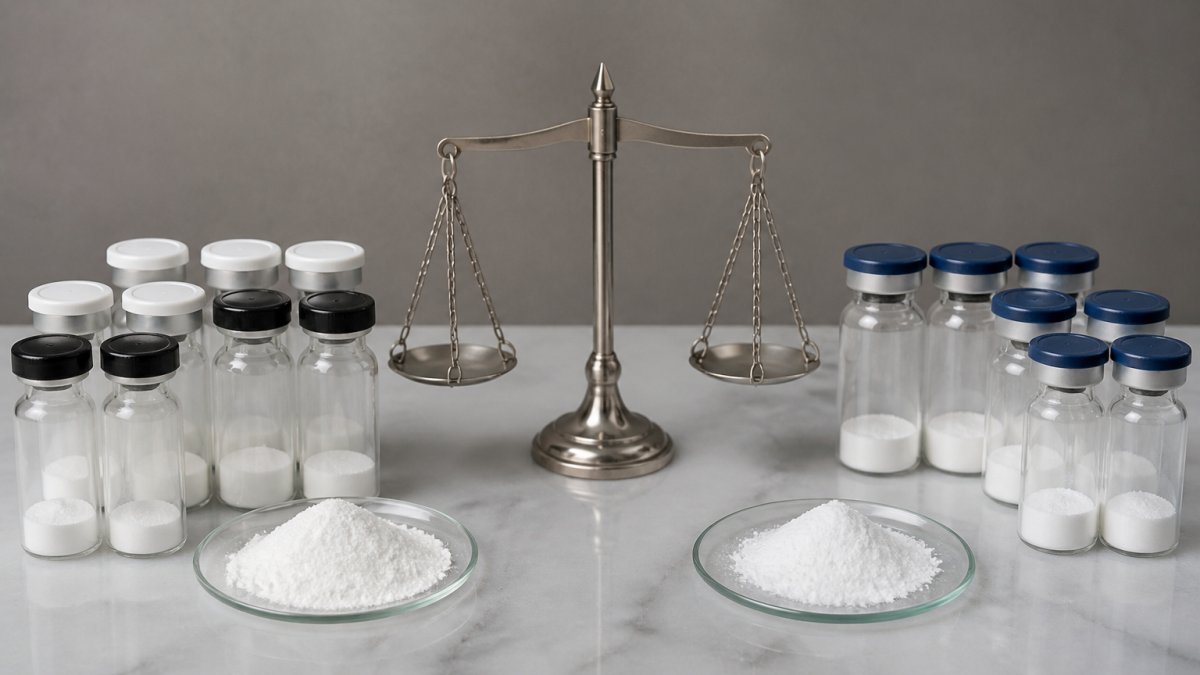
The core difference: bacteriostatic water supports multi-dose use through its preservative, while sterile water is limited to a single session because it has none. Everything else, including shelf life, contamination risk, and compatibility, follows from that one distinction.
| Feature | Bacteriostatic Water | Sterile Water |
|---|---|---|
| Preservative | 0.9% benzyl alcohol | None |
| Vial type | Multi-dose | Single-dose |
| Post-puncture window | Up to 28 days refrigerated | 24 hours |
| Repeated punctures | Supported | Not supported |
| Best for | Multi-session protocols | Same-day, full-vial use |
| Benzyl alcohol sensitivity | Not suitable for some peptides | No interaction risk |
The Role of Benzyl Alcohol in Peptide Stability
Benzyl alcohol does two jobs at once, and researchers often conflate them. First, it acts as a preservative, creating an environment where bacteria cannot multiply after a vial puncture. Second, it is a chemical actor that can change the solution a peptide sits in, and that second job is where most guides stop short.
How Benzyl Alcohol Can Interact With a Peptide Chain
Three mechanisms account for most benzyl-alcohol-peptide problems:
- Hydrophobic binding. Benzyl alcohol has an aromatic ring and a short alcohol chain, giving it affinity for hydrophobic patches on a peptide. Peptides with exposed hydrophobic regions, common in growth-hormone secretagogues and some GLP-1 analogs, can partially unfold or aggregate when the preservative docks onto those regions.
- pH shift. Bacteriostatic water is not buffered. Adding it to a lyophilized peptide can move the solution pH away from the peptide's stable range. A peptide that is stable at pH 5-6 may degrade faster at pH 7, and benzyl alcohol's presence does not correct that drift.
- Oxidation and deamidation acceleration. The alcohol group and trace dissolved oxygen can speed up oxidation of methionine and deamidation of asparagine residues, both of which are common degradation pathways in peptide chains.
Acidic vs. Basic Peptides: Why pH Matters More Than Sterility
Peptide solubility and stability are pH-dependent. Acidic peptides (net negative charge) tend to dissolve and stay stable in slightly basic solution; basic peptides (net positive charge) tend to prefer slightly acidic conditions. Because bacteriostatic water is unbuffered and near-neutral, it can push a peptide away from its optimal pH window.
| Peptide Character | Preferred pH Range | Bacteriostatic Water Effect | Sterile Water Effect |
|---|---|---|---|
| Acidic (net negative) | Slightly basic | May shift pH down, reducing solubility | Neutral; no preservative interaction |
| Basic (net positive) | Slightly acidic | May shift pH up, promoting aggregation | Neutral; no preservative interaction |
| Neutral / hydrophobic | Peptide-specific | Risk of hydrophobic binding to benzyl alcohol | No binding risk |
What This Means in Practice
If your peptide is known to be pH-sensitive or has exposed hydrophobic regions, sterile water or a buffer is the safer default, even though it costs you the multi-dose window. If your peptide is robust and your protocol spans multiple sessions, bacteriostatic water remains the practical choice. The preservative is not a passive bystander, treat it as a reagent with its own reactivity profile, and your results will be more reproducible across sessions.
Peptide Reconstitution Guide: Choosing the Right Diluent
Choosing a diluent comes down to three questions: how many sessions will this vial serve, is the peptide benzyl-alcohol sensitive, and what does your protocol document require. Answer those and the choice is usually obvious.
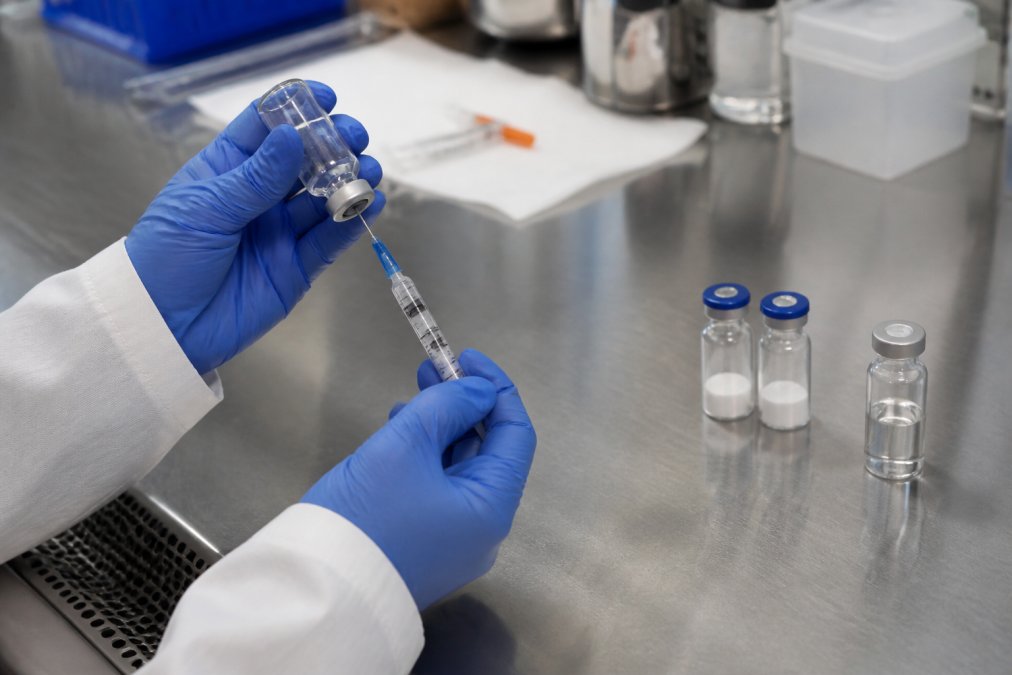
Work through this decision sequence:
- Single session, full vial consumed today? Use sterile water. No preservative means no interaction risk.
- Multiple sessions over days or weeks? Use bacteriostatic water. The preservative protects every puncture after the first.
- Peptide known to react with benzyl alcohol? Use sterile water and accept the 24-hour window, or switch to a buffer solution.
- Protocol requires documented sterility across sessions? Bacteriostatic water, stored correctly, is the defensible choice.
How to Store Reconstituted Peptides and Bacteriostatic Water Shelf Life
Bacteriostatic water shelf life runs up to 28 days after the first puncture when refrigerated, while sterile water must be discarded within 24 hours of opening. Storage temperature and light exposure determine whether you actually get that window.
Risks of Improper Reconstitution and Disposal Protocols
Reconstitution errors fall into two categories: contamination and chemical mismatch. Contamination happens when aseptic technique fails, letting bacteria into a vial that may lack preservative. Chemical mismatch happens when the wrong diluent meets a sensitive peptide. Both are preventable, and both leave physical evidence if you know what to look for.
Visual Identification: Reading a Vial Before You Use It
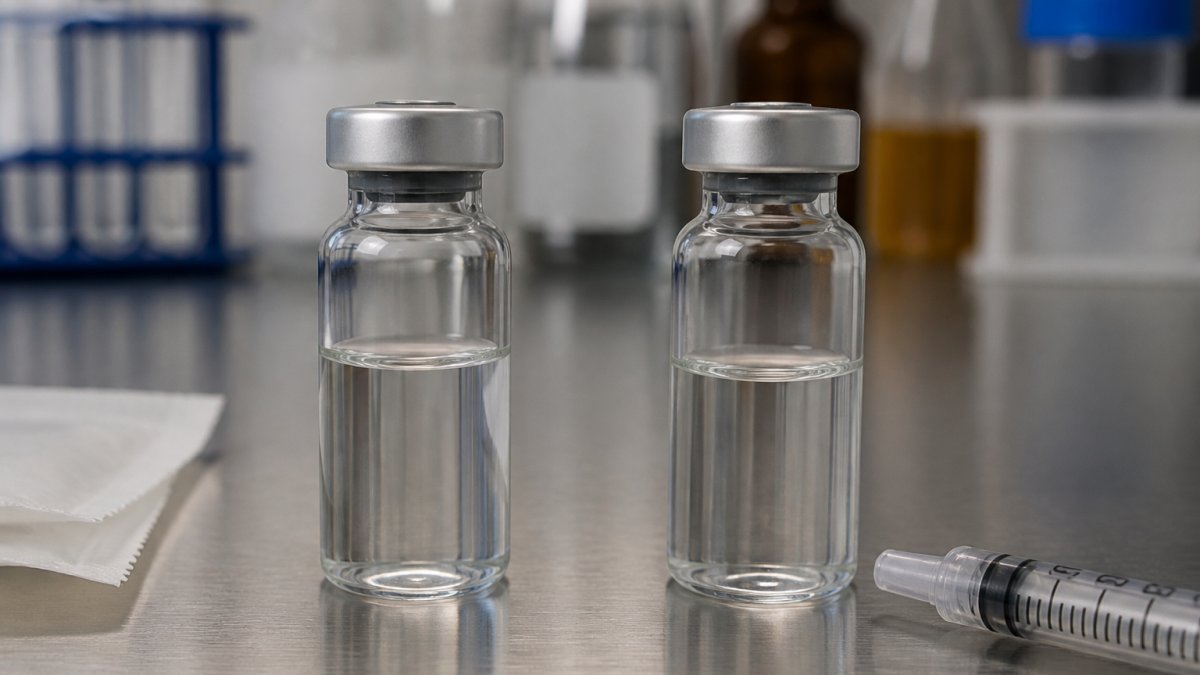
Before every draw, inspect the vial against a white background and then a dark one. Light and dark backgrounds reveal different problems.
| What You See | Likely Cause | Action |
|---|---|---|
| Cloudiness or haze | Aggregation, microbial growth, or peptide precipitation | Discard; do not inject |
| Visible particles or flakes | Particulate matter, rubber stopper fragments, or degraded peptide | Discard; do not inject |
| Color change (yellowing, browning) | Oxidation of peptide residues | Discard; do not inject |
| Film or ring at liquid line | Protein aggregation or dried residue | Discard; do not inject |
| Clear, colorless, no particles | Normal appearance | Proceed if within puncture window |
Common Reconstitution Mistakes
- Reusing a needle for multiple punctures, which transfers bacteria from the septum surface into the vial.
- Not swabbing the stopper with an alcohol wipe and letting it dry before puncture.
- Shaking the vial to speed dissolution, which introduces air and can shear peptide structure. Swirl gently instead.
- Drawing with a needle that touched a non-sterile surface, then re-entering the vial.
- Mixing diluents, topping off bacteriostatic water with sterile water, or vice versa, which defeats the preservative system.
- Ignoring the puncture date, so a vial sits past its 28-day window and gets used anyway.
Disposal Protocols for Vials, Needles, and Contaminated Materials
Disposal follows the same rules as any sharps and biological waste stream. The CDC guidance on sharps disposal outlines acceptable container standards for research and clinical settings.
- Needles and syringes go into a puncture-resistant, leak-proof sharps container. Do not recap, bend, or break needles. When the container is three-quarters full, seal it and follow your institution's or municipality's sharps disposal route.
- Used vials, including empty, expired, or contaminated ones, go into biohazard waste, not the regular trash. If your facility uses a biohazard box, place vials there. If not, check your local household hazardous waste or medical waste pickup program.
- Contaminated liquids should not be poured down a sink. Absorb with a spill pad or place the sealed vial in biohazard waste.
- Alcohol wipes, gloves, and bench pads that contacted the vial go into biohazard waste if they touched biological material.
- Document the disposal if your protocol requires a chain-of-custody record. A vial without a puncture date, a diluent without a lot number, and a result without a record are three separate integrity gaps.
Closing the Loop
Documentation and disposal are the two ends of the same safety chain. Bluegrass Research ships every compound with lot-specific COA documentation and third-party analytical testing, so the paper trail matches the vial in your hand, and when it is time to retire that vial, you know exactly what it was and when it was opened.
Frequently Asked Questions
Can I use sterile water instead of bacteriostatic water for peptides?
Yes, but only for single-session experiments where the entire vial is consumed immediately. Sterile water contains no preservative, so any leftover reconstituted peptide must be discarded within 24 hours. For multi-dose protocols or storage beyond one day, bacteriostatic water with 0.9% benzyl alcohol is the appropriate choice because it inhibits microbial growth across repeated vial punctures.
What is the best water for peptides?
Bacteriostatic water is best for most multi-dose peptide research because the benzyl alcohol preservative extends stability up to 28 days when refrigerated. Sterile water works for same-day, single-use experiments or peptides sensitive to benzyl alcohol. Match the diluent to your protocol length and the peptide's chemical compatibility.
How long does a peptide remain stable in bacteriostatic water vs. sterile water?
Reconstituted peptides in bacteriostatic water typically remain stable for up to 28 days when stored at 2-8°C, thanks to the preservative. In sterile water, stability drops to about 24 hours because there is no antimicrobial protection. Always follow the peptide manufacturer's specific stability data when available.
What happens if you inject just bacteriostatic water?
Bacteriostatic water is not intended for injection alone. It contains 0.9% benzyl alcohol, which can cause tissue irritation, pain, or hemolysis if administered without a dissolved compound. It is a diluent for reconstitution only, not a standalone injectable solution.
Is it safe to reconstitute peptides with sterile water?
Sterile water is safe for reconstitution when the entire vial is used in one session. Because it lacks a preservative, any remaining solution becomes a microbial growth risk within hours. For protocols requiring multiple draws from one vial, use bacteriostatic water instead to maintain sterility and peptide stability.