 how-to
How to Calculate Peptide Reconstitution Ratios
Table of Contents
- What Peptide Reconstitution Ratios Actually Mean
- Supplies and Diluent Selection Before You Calculate
- Step-by-Step Peptide Dilution Calculation
- Peptide Reconstitution Examples With Worked Math
- Using a Peptide Reconstitution Calculator Safely
- Peptide Handling and Documentation for Research Records
- Common Reconstitution Calculation Errors and How to Catch Them
- Conclusion: Building a Repeatable Reconstitution Workflow
- Frequently Asked Questions
Last Updated: October 8, 2026
What Peptide Reconstitution Ratios Actually Mean
A peptide reconstitution ratio is the relationship between the dry peptide in a vial and the volume of diluent you add. Get it wrong and every dose afterward is wrong. This guide from Bluegrass Research walks through how to calculate peptide reconstitution ratios step by step, with worked examples you can check against your own math.
Mass, Concentration, and Volume: The Three Variables
Every reconstitution problem comes down to three numbers.
- Mass: how much peptide is in the vial, usually listed in milligrams (mg)
- Volume: how much diluent you add, usually in milliliters (mL)
- Concentration: the result, expressed as mg/mL or mcg/mL
Why Ratio Precision Matters for Research Reproducibility
Small volume errors compound: if your concentration is off, every dose in that batch is off by the same margin. Consistent ratios let another researcher repeat your work exactly.
Supplies and Diluent Selection Before You Calculate
Choosing the right diluent comes before any math. It affects how stable the reconstituted peptide stays and how you document it.
At minimum, you need:
- The lyophilized peptide vial
- A diluent (bacteriostatic water or sterile water)
- Alcohol swabs for the vial stoppers
Bacteriostatic Water vs. Sterile Water: Which Diluent to Use
Bacteriostatic water contains benzyl alcohol, which slows bacterial growth, making it the common choice when a vial is used across several sessions.
Sterile water has no preservative and suits single-use situations or peptides incompatible with benzyl alcohol.
The two are not interchangeable. Check the peptide's documentation before you commit.
Syringe Scale Limitations and Measurement Accuracy
Your syringe sets the smallest volume you can reliably measure. A 1 mL syringe with 100 markings reads finer increments than a 3 mL syringe. If your draw volume falls below the smallest readable mark, adjust the diluent volume instead of guessing at a partial mark.
Step-by-Step Peptide Dilution Calculation
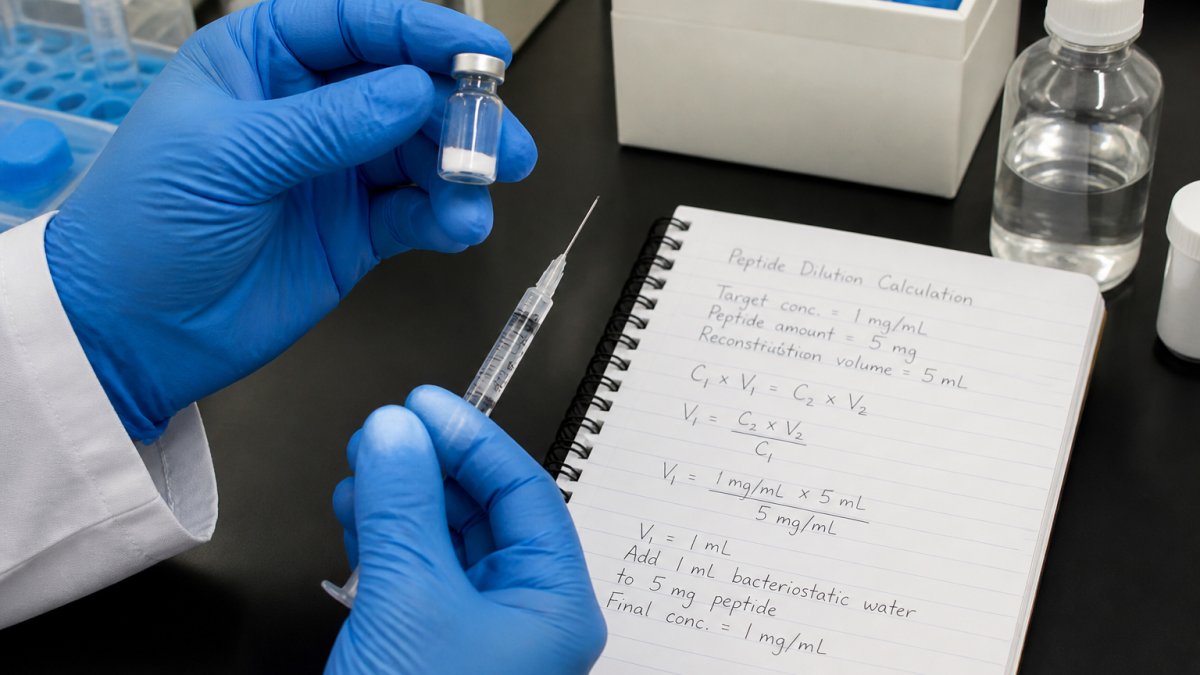
The peptide dilution calculation follows one formula. Concentration equals mass divided by volume. Everything else is unit conversion and checking.
Step 1: Record Vial Strength and Target Concentration
Write down the vial strength first, printed on the label as "5 mg" or "10 mg," then the concentration you want. Deciding the target first tells you how much diluent to add, rather than adding diluent and hoping.
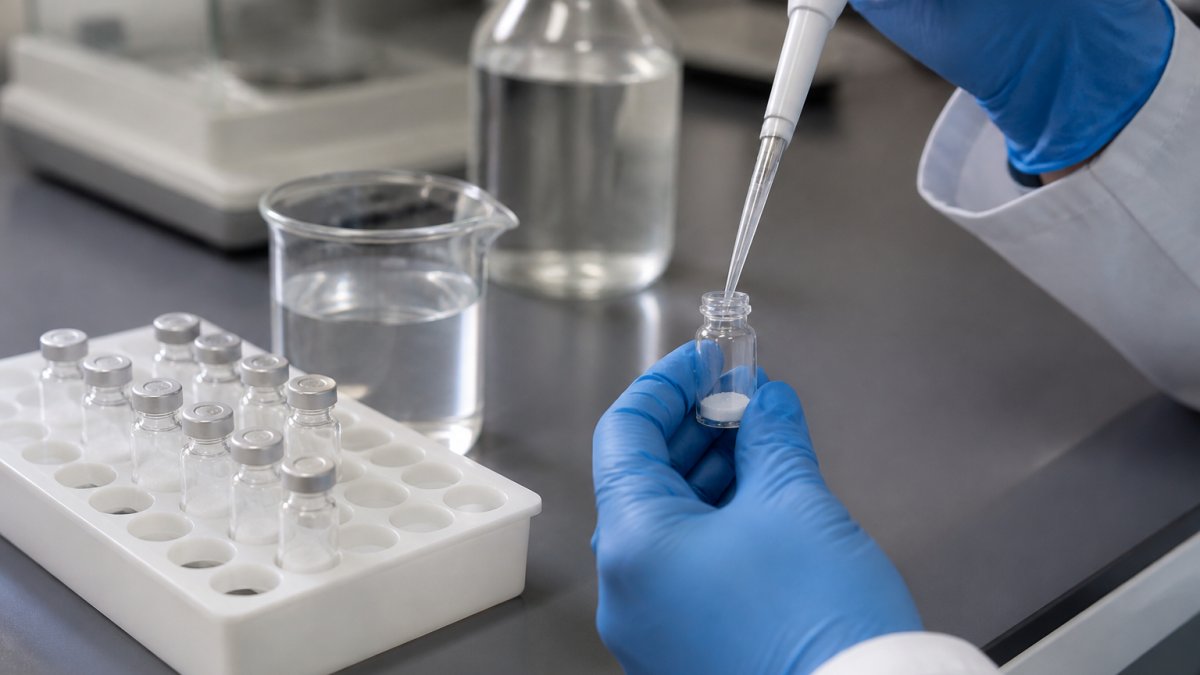
Step 2: Calculate the Diluent Volume to Add
Use this formula:
Diluent volume (mL) = peptide mass (mg) ÷ target concentration (mg/mL)
If you have a 5 mg vial and want a 2.5 mg/mL concentration, you add 2 mL of diluent. That is the reconstitution formula in its simplest form.
Step 3: Convert Milligrams to Micrograms and Verify Units
Many protocols list doses in micrograms (mcg), not milligrams. One milligram equals 1,000 micrograms. Convert before you draw.
Then check your work:
- Does the concentration make sense for the vial size?
- Are your units consistent (all mg, or all mcg)?
- Does the draw volume fit your syringe's readable range?
Peptide Reconstitution Examples With Worked Math
Two worked peptide reconstitution examples show how the numbers behave at different vial sizes.
Example 1: 5 mg Vial With 2 mL Diluent
- Mass: 5 mg
- Diluent: 2 mL
- Concentration: 5 ÷ 2 = 2.5 mg/mL, or 2,500 mcg/mL
If your target dose is 250 mcg, divide 250 by 2,500. That gives 0.1 mL, or 10 units on a U-100 syringe.
Example 2: 10 mg Vial With 3 mL Diluent
- Mass: 10 mg
- Diluent: 3 mL
- Concentration: 10 ÷ 3 = 3.33 mg/mL, or 3,333 mcg/mL
A 500 mcg target dose means 500 ÷ 3,333, about 0.15 mL. Document the rounded figure you actually used.
| Vial Strength | Diluent Added | Concentration | Draw for 250 mcg |
|---|---|---|---|
| 5 mg | 2 mL | 2.5 mg/mL | 0.10 mL |
| 10 mg | 2 mL | 5 mg/mL | 0.05 mL |
| 10 mg | 3 mL | 3.33 mg/mL | 0.075 mL |
| 15 mg | 5 mL | 3 mg/mL | 0.083 mL |
Using a Peptide Reconstitution Calculator Safely
A peptide reconstitution calculator handles the arithmetic but cannot catch a bad input. Treat it as one of two independent methods and require them to agree before you draw anything.
What a Calculator Can and Cannot Do
A calculator can divide mass by volume and convert units. It cannot read your vial label, confirm your diluent, or know whether the output volume is measurable with your syringe. Those judgment calls stay with you.
Before trusting any calculator's output, confirm:
- You entered vial strength in the same unit the label uses (mg vs. mcg)
- You entered diluent volume, not target dose volume
- The output concentration matches what you can measure with your syringe
Verify Calculator Output With Dimensional Analysis
Dimensional analysis is the cheapest error check available. Write the units into the equation and cancel them like fractions.
Worked check for a 5 mg vial reconstituted with 2 mL of diluent, targeting a 250 mcg draw:
- Concentration: 5 mg ÷ 2 mL = 2.5 mg/mL
- Convert to mcg: 2.5 mg/mL × 1,000 mcg/mg = 2,500 mcg/mL
- Draw volume: 250 mcg ÷ 2,500 mcg/mL = 0.1 mL
- Unit check: mcg ÷ (mcg/mL) = mL, the units cancel to volume, which is what you expect
If step 4 produced something other than mL, the equation was set up backward. Stop rather than adjusting the number until it looks right.
Independent Cross-Check Before You Draw
Run the same problem a second way: instead of dividing dose by concentration, find how many doses the vial contains, then divide total volume by that count.
- Total doses in vial: 5,000 mcg ÷ 250 mcg = 20 doses
- Volume per dose: 2 mL ÷ 20 doses = 0.1 mL
Both methods landing on 0.1 mL is the confirmation you want. If they disagree, an input is wrong, usually a unit mismatch or misread label.
Rounding Rules That Keep the Check Honest
Round only the final draw volume, to the smallest increment your syringe can read. A 1 mL syringe with 100 markings reads to 0.01 mL; a 3 mL syringe typically reads to 0.1 mL.
If the rounded volume falls below the smallest readable mark, do not estimate a partial mark.
When the Calculator and Your Math Disagree
Stop and find the discrepancy before proceeding. Usual causes, in rough order of frequency:
- A unit entered as mg when the label reads mcg, or the reverse
- Diluent volume entered as the target dose volume
- A decimal misplaced in the concentration field
Do not average the two answers or pick the more reasonable one. Resolve the input, then rerun both methods.
Peptide Handling and Documentation for Research Records
Good peptide handling and documentation turn a one-off calculation into a repeatable protocol, the section auditors and reviewers actually look at.
Sterile Technique and Contamination Prevention
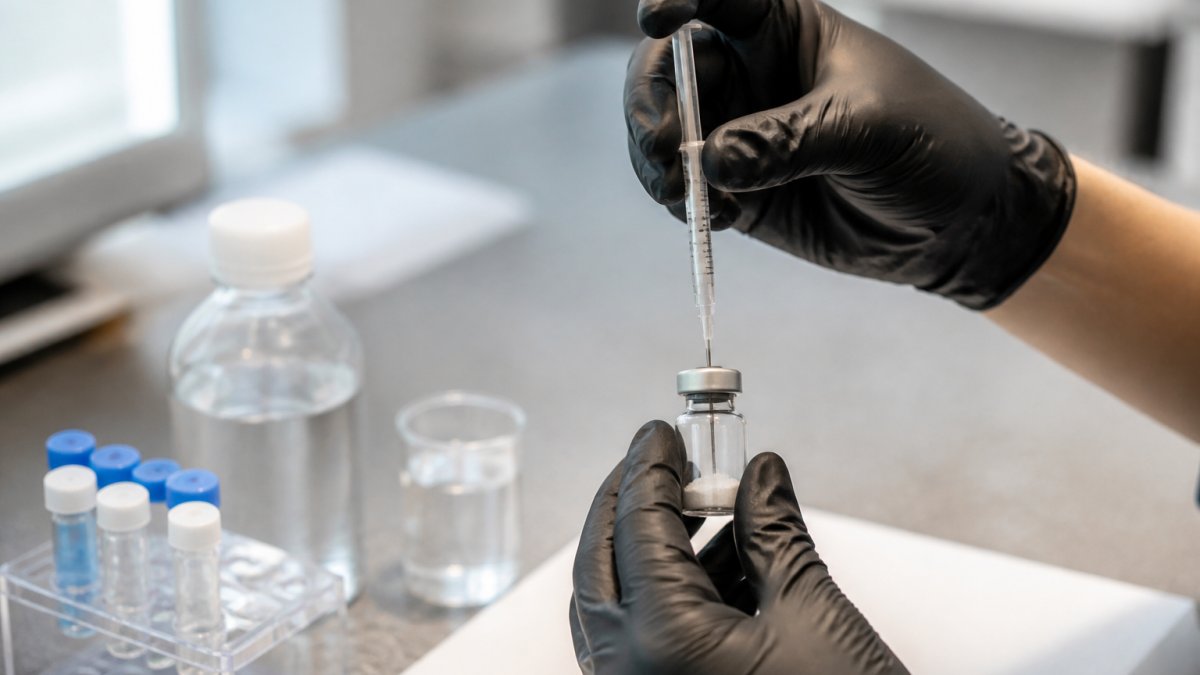
Swab the vial stopper with alcohol and let it dry before inserting the needle. Use a fresh needle for each entry. Never reuse a syringe between vials. These steps take seconds and prevent the contamination that ruins a whole batch.
Storage and Stability After Reconstitution
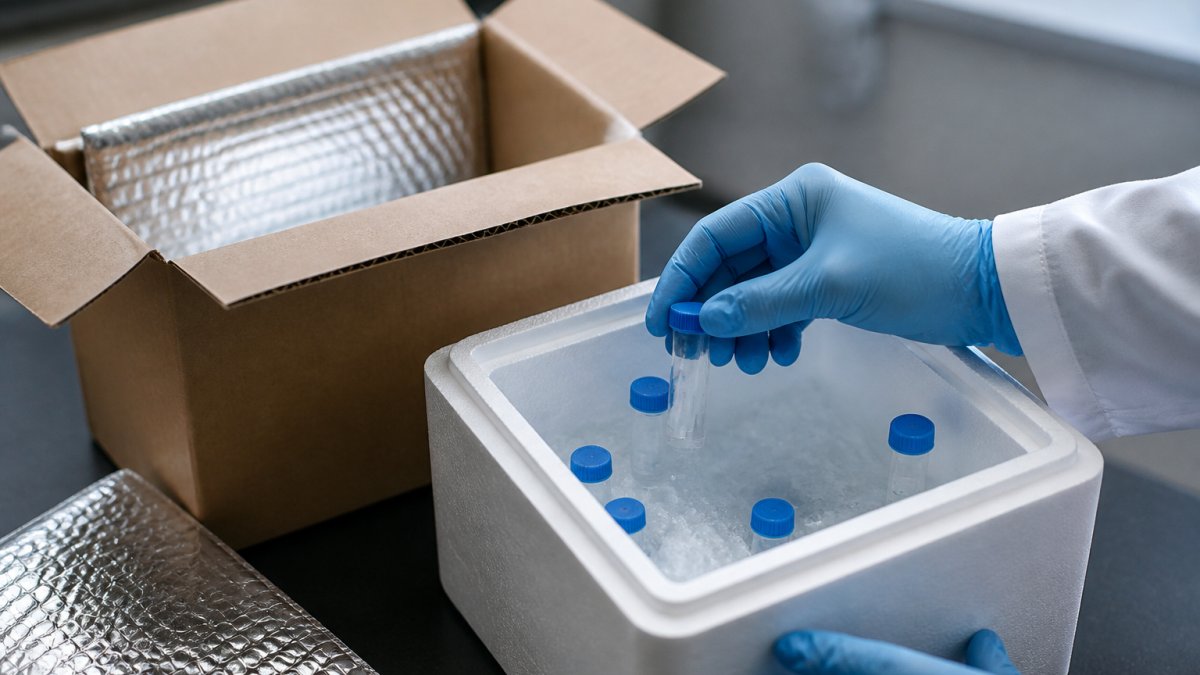
Reconstituted peptide is less stable than the lyophilized powder it came from. Store it cold, protect it from light, and follow the stability guidance for the specific compound.
Bluegrass Research supplies research-grade materials with lot-specific, third-party analytical documentation, so the purity record travels with the compound. That matters when your results get reviewed later.
Common Reconstitution Calculation Errors and How to Catch Them
Most errors fall into a handful of patterns. Learn them and you can catch them before they reach your data. The table below covers the frequent ones; the sections after it cover what to do when the numbers look wrong and you cannot immediately tell why.
| Error | What It Looks Like | How to Catch It |
|---|---|---|
| Unit mix-up | mg divided by mcg | Convert all units first |
| Decimal slip | 0.1 mL read as 1 mL | Recheck the decimal place |
| Wrong diluent volume | Added 2 mL, recorded 3 mL | Log volume at the bench |
| Syringe mismatch | Draw volume below readable mark | Resize diluent or syringe |
| Rounding drift | Rounded twice in one chain | Round once, at the end |
| Label misread | Vial strength taken from the wrong line | Confirm against the lot documentation |
Sanity Checks on the Result
Before you draw, run three quick checks that catch most errors without redoing the full calculation:
- Order of magnitude. A draw volume larger than the total diluent you added is impossible. A draw volume smaller than your syringe's finest mark is unmeasurable. Either one means an input is wrong.
- Direction of change. More diluent in the same vial means a lower concentration and a larger draw volume for the same dose. If your numbers move the other way, the equation is inverted.
- Dose count. Divide total vial mass by your target dose. If the result is a fraction of a dose or an implausibly large count, recheck the units on both numbers.
Troubleshooting Implausible Draw Volumes
When the calculated volume does not fit the syringe, work backward through the inputs rather than adjusting the answer.
- Volume exceeds the syringe capacity. The concentration is likely too low, meaning too much diluent was added or the vial strength was understated. Recheck the label and the volume you actually added.
- Volume is below the smallest readable mark. The concentration is likely too high. Adding more diluent lowers concentration and raises the draw volume into a readable range.
- Volume is off by a clean factor of 10 or 1,000. This is almost always a mg-to-mcg conversion applied in the wrong direction or skipped entirely.
Mismatched Vial Labels and Documentation
If the vial label and the accompanying documentation disagree on strength, stop. Do not average them or assume the label is correct. Set the vial aside, record the discrepancy, and resolve it against the lot-specific certificate of analysis before any reconstitution.
Incomplete Dissolution
Lyophilized powder that has not fully dissolved will not give a uniform concentration, which makes any draw volume unreliable. After adding diluent, swirl gently rather than shaking. Shaking introduces foam and can denature some peptides. If visible particles remain after gentle swirling and the time specified in the product documentation, do not proceed.
When to Stop and Verify Rather Than Guess
Stop and verify whenever any of the following is true:
- The two independent calculation methods disagree
- The draw volume is outside your syringe's readable range even after adjusting diluent
- The vial label and documentation conflict
Guessing at any of these points converts a math error into a measurement error, and a measurement error into an undocumented variable in your results. Verification costs minutes; an unresolved discrepancy can invalidate a batch.
Conclusion: Building a Repeatable Reconstitution Workflow
The calculation is simple. The discipline around it is not. Build a workflow where you record vial strength, diluent volume, and final concentration every time, and check units before you divide.
For labs that need verified purity and transparent documentation to back that workflow, Bluegrass Research provides lot-specific COAs, third-party analytical testing, and discreet shipping with no external branding.
Frequently Asked Questions
How do you calculate peptide concentration after adding diluent?
Divide the total peptide mass in the vial by the volume of diluent you added. For a 5 mg vial reconstituted with 2 mL of bacteriostatic water, the concentration is 2.5 mg/mL, or 2,500 mcg/mL. Always confirm the vial's stated peptide amount from its lot-specific certificate of analysis before calculating, since fill weights can vary slightly between production lots.
How much diluent should be added to a peptide vial?
The diluent volume depends on your target concentration and the sensitivity of your syringe. A common approach is to add enough bacteriostatic water to make each draw volume easy to measure accurately. For a 10 mg vial, adding 2 mL yields 5 mg/mL; adding 5 mL yields 2 mg/mL. Smaller diluent volumes produce more concentrated solutions that require smaller, harder-to-measure draws.
How do you convert a peptide concentration into a volume to draw?
Use the formula: volume to draw = target dose divided by concentration. If your concentration is 2,500 mcg/mL and your target dose is 250 mcg, you draw 0.1 mL. On a U-100 syringe (100 units per mL), that equals 10 units. Always verify your syringe's unit scale before drawing, since U-40 and U-100 syringes measure differently.
How should reconstitution calculations be documented for research records?
Record the lot number, vial strength, diluent type and volume, final concentration, date of reconstitution, and storage conditions in your lab notebook or electronic records system. Include the calculation itself so a reviewer can trace your math. Pair each entry with the lot-specific COA from your supplier. This documentation supports reproducibility and is essential if your results face internal or external scrutiny.