 listicle
7 Best Practices for Peptide Vial Handling
Table of Contents
- 1. Follow Peptide Storage and Handling Guidelines for Temperature and Light Protection
- 2. Warm Vials to Room Temperature Before Opening
- 3. Prevent Peptide Vial Contamination During Access
- 4. Avoid Common Peptide Reconstitution Mistakes
- 5. Handle Lyophilized and Reconstituted Peptides Differently
- 6. Maintain Peptide Handling Documentation and Lot Traceability
- 7. Troubleshoot Storage and Handling Problems
- Conclusion: Building Reliable Peptide Vial Handling Into Your Lab Workflow
- Frequently Asked Questions
Last Updated: October 5, 2026
1. Follow Peptide Storage and Handling Guidelines for Temperature and Light Protection
Peptide vial handling starts long before you draw a sample.
At Bluegrass Research, we ship every compound with lot-specific documentation, because the conditions a vial experiences in transit and on your shelf determine what your assay actually measures.
The research consensus is clear that optimal storage depends on the specific peptide sequence, as noted in peer-reviewed recommendations for peptide storage and handling.
Temperature Ranges: Cool, Refrigerated, or Frozen
Match the storage temperature to the peptide's form and the manufacturer's stated conditions.
- Lyophilized powder: Most freeze-dried peptides tolerate short-term storage at cool room temperature, but long-term stability usually improves under refrigeration or freezing.
- Reconstituted peptide: Store refrigerated and use within the timeframe the supplier specifies.
- Working aliquots: Freeze small portions to avoid repeated freeze-thaw cycles.
Protecting Vials from Light, Moisture, and Air
Light exposure breaks down susceptible residues, and humidity introduces moisture that can degrade a lyophilized cake before you ever open it. Keep vials in a cool, dark, dry place. A desiccator is the standard tool for this, and GenScript's peptide storage and handling guidelines recommend keeping lyophilized peptides desiccated with vials tightly capped.
2. Warm Vials to Room Temperature Before Opening
Cold vials pull moisture from the air.
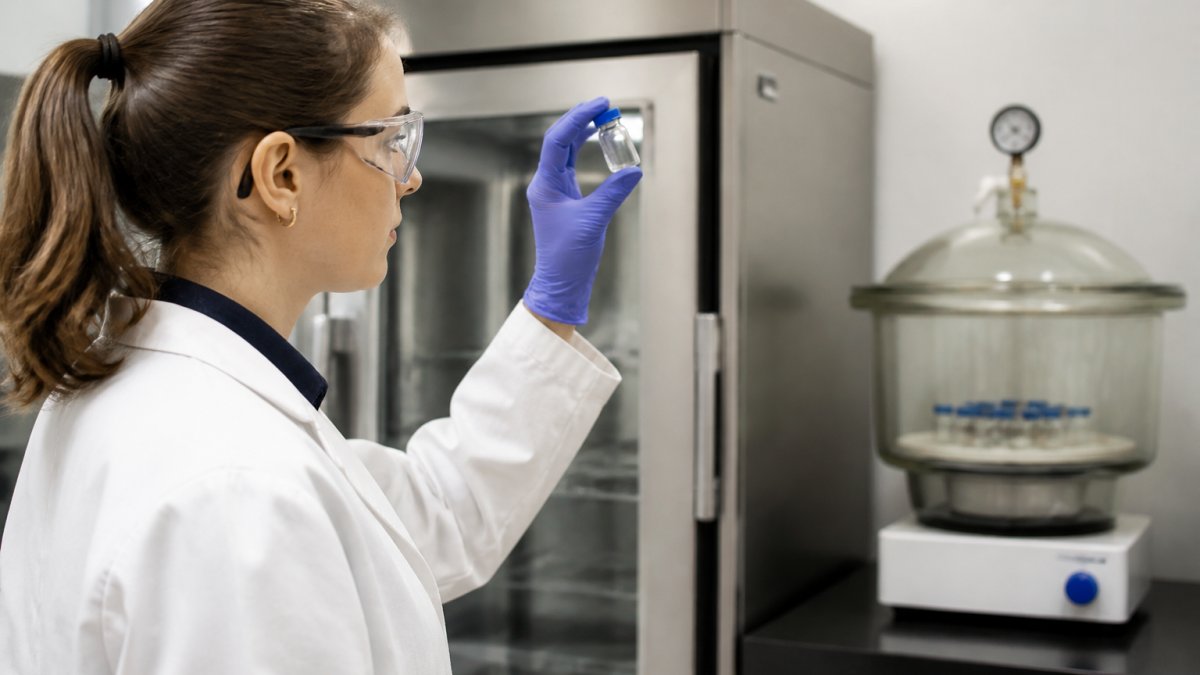
The fix is simple: let the sealed vial equilibrate to room temperature first. A common research-lab recommendation is to bring the vial to room temperature in a desiccator for 15 to 30 minutes before opening, as outlined in a research-lab peptide storage and handling guide.
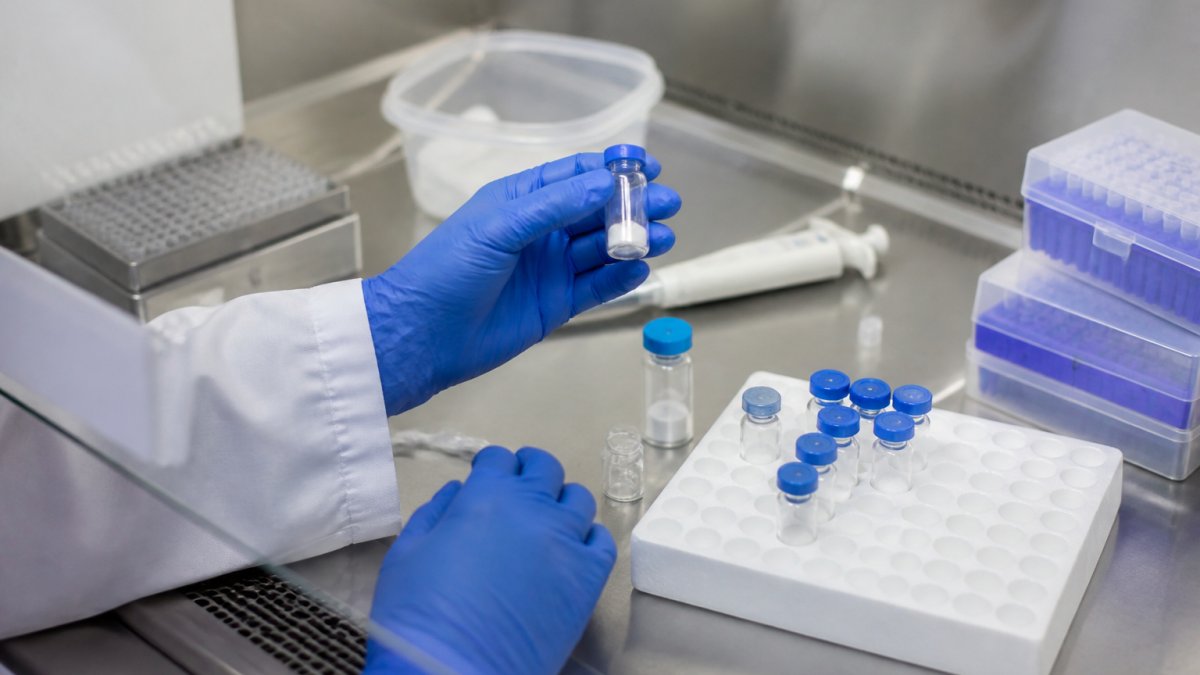
[IMAGE: A gloved researcher in a laboratory holding a small glass peptide vial up to the light, with a desiccator and a temperature-controlled storage unit visible in the background | section:2.
Do not rush this step with heat. Warming a vial under a hot tap or in an incubator can damage heat-sensitive sequences.
3. Prevent Peptide Vial Contamination During Access
Peptide vial contamination prevention comes down to two habits: sterile technique at the stopper and disciplined syringe use. Every time you puncture a stopper, you create a path for contaminants.
Sterile Technique for Stopper Access
Swab the stopper with an appropriate disinfectant and let it dry before every access. Work in a clean, sanitized environment. Keep the needle and the exposed stopper away from anything non-sterile, and never set a syringe down on an open bench.
Single-Use Syringes and Pressure Balance
Use a fresh syringe and needle for each access. Reusing them is the fastest route to cross-contamination. When you draw from a sealed vial, pressure balance matters: a vial under vacuum will fight the syringe, while an over-pressurized one can push liquid out around the needle. Equalizing pressure before withdrawal keeps the draw controlled and the contents clean.
4. Avoid Common Peptide Reconstitution Mistakes
Most peptide reconstitution mistakes trace back to two decisions: the solvent you choose and how you mix. Both are easy to get right once you know why they matter.
Choosing the Right Solvent: Sterile Water vs. Bacteriostatic Water
Sterile water is pure water with no preservative, suited to single-use reconstitution where the entire vial will be consumed quickly. Bacteriostatic water contains a preservative that slows microbial growth, which makes it the more common choice when a reconstituted vial will be accessed multiple times. The right pick depends on your timeline and how many draws you expect.
Gentle Swirling vs. Shaking
Never shake a peptide vial. Shaking introduces air and mechanical stress that can damage the peptide chain. Swirl the vial gently, or roll it between your palms, until the powder fully dissolves. If it dissolves slowly, give it time and keep swirling. Aggitation is not a shortcut; it is a way to lose material.
| Mistake | Why It Hurts | Better Practice |
|---|---|---|
| Shaking to dissolve faster | Damages peptide structure, adds air | Swirl gently or roll between palms |
| Opening a cold vial | Condensation introduces moisture | Warm to room temperature first |
| Reusing a syringe | Cross-contamination between vials | Fresh syringe per access |
| Guessing the solvent | Wrong choice shortens usable life | Match solvent to use timeline |
5. Handle Lyophilized and Reconstituted Peptides Differently
Lyophilized and reconstituted peptides have opposite handling priorities, and treating them the same is a quiet source of error. The table below is a decision aid, not a protocol: the product label, certificate of analysis, and any validated stability data supplied with your lot always take precedence over generic rules of thumb.
| Question | Lyophilized (powder) | Reconstituted (solution) |
|---|---|---|
| Primary degradation risk | Moisture uptake, oxidation, light | Hydrolysis, microbial growth, freeze-thaw stress |
| Default storage | Cool, dark, desiccated; refrigerated or frozen for long-term | Refrigerated, protected from light, capped between draws |
| Effect of repeated temperature cycling | Low if kept sealed and desiccated | High, each cycle stresses the peptide and can drive aggregation |
| Effect of air exposure | Cake can absorb humidity and clump or collapse | Headspace oxygen can oxidize susceptible residues |
| Typical working window | Months to years when stored as directed | Days to weeks refrigerated, depending on peptide and preservative |
| Best container practice | Keep the original vial, tightly capped, in a desiccator | Keep the original vial; do not transfer to an unlabeled tube |
Why the Form Changes the Plan
A lyophilized peptide is a freeze-dried cake with very low residual water. Its main enemies are moisture and air, so the goal is to keep the cake dry and the vial sealed.
That is why the storage plan should change the moment you reconstitute. Before, you are protecting a powder from humidity. After, you are protecting a solution from time, heat, and freeze-thaw stress.
Reconstituted Vials: Aliquoting and Freeze-Thaw
If your protocol calls for freezing a reconstituted solution, freeze it in single-use aliquots rather than freezing and thawing the whole vial. Each thaw cycle exposes the peptide to a temperature swing and to the headspace in the vial. Aliquoting limits both. Label each aliquot with the peptide name, lot, concentration, solvent, and freeze date before it goes into storage, an unlabeled aliquot is effectively an unknown sample.
When the Label Wins
If the supplier's documentation specifies a storage temperature, a solvent, a concentration, or a use-by window that differs from the general guidance above, follow the documentation. Generic rules are a starting point for planning; validated, product-specific data is what your results actually rest on.
6. Maintain Peptide Handling Documentation and Lot Traceability
Peptide handling documentation is what makes your results defensible.
At minimum, log the lot number, receipt date, storage location, reconstitution date, solvent used, and any freeze-thaw events. This is where sourcing transparency pays off.
Good records do two things: they protect your data, and they let you trace a problem back to a specific lot instead of scrapping an entire study.
7. Troubleshoot Storage and Handling Problems
When something looks off, work from the most likely cause to the least, and decide early whether the sample is still usable. The scenarios below cover the incidents that generic handling guides tend to skip: temperature excursions, moisture exposure, damaged seals, and uncertain storage history.
Temperature Excursion
If a vial arrived warm, sat on a bench overnight, or spent time outside its specified range, do not assume it is ruined, and do not assume it is fine. Record the approximate duration and the high and low temperatures if you know them. Inspect the powder or solution for visible change (clumping, discoloration, cloudiness, particulates).
Accidental Moisture Exposure
A lyophilized cake that has absorbed humidity may clump, stick to the vial wall, or fail to dissolve cleanly. If the vial was open to humid air for more than a brief moment, or if you see condensation inside a previously dry vial, the cake may have taken on water.
Damaged or Compromised Seal
A cracked vial, a stopper that no longer seats, a crimp that spins freely, or a punctured septum that will not reseal all break the sterile barrier. A vial with a compromised seal should not be used for sterile work, and a vial with visible cracks or leaks should be discarded.
Uncertain Storage History
If you cannot reconstruct where a vial has been, how long it was out, or whether it was ever reconstituted, treat it as an unknown. Unknown material is fine for practice runs and method development, but it should not feed into data you intend to publish or defend.
When Not to Use a Sample
Do not use a sample if any of the following is true: the seal is compromised, the powder or solution shows visible contamination or unexplained cloudiness, the storage history is unknown and the material is destined for quantitative work, or the supplier's documentation says the material is outside its use window.
Keep a Troubleshooting Log
A short troubleshooting log, kept alongside your handling records, turns guesswork into a process. Note the symptom, the suspected cause, the action taken, and whether the sample was used, quarantined, or discarded. That record is what lets the next person, or a reviewer, see exactly how a problem was handled.
Conclusion: Building Reliable Peptide Vial Handling Into Your Lab Workflow
Reliable peptide vial handling is not one skill; it is a set of habits that compound. Store correctly, warm before opening, access cleanly, reconstitute gently, and document everything.
When your materials arrive with verified purity and lot-specific documentation, those habits have a solid foundation to build on.
Frequently Asked Questions
What are common mistakes in peptide reconstitution?
The most frequent peptide reconstitution mistakes include shaking the vial instead of swirling gently, which can damage the peptide structure, and using the wrong solvent. Sterile water works for immediate use, while bacteriostatic water extends stability for multiple withdrawals. Another common error is failing to let the vial reach room temperature first, which causes condensation inside the vial and introduces moisture that degrades the peptide. Always add solvent slowly down the vial wall rather than directly onto the powder.
How should research peptide vials be stored?
Store lyophilized peptide vials in a desiccator at -20°C for long-term stability, keeping them tightly capped and protected from light. Reconstituted peptides generally need refrigeration at 4°C and should be used within the timeframe specified by the product's documentation. Avoid repeated freeze-thaw cycles by aliquoting before freezing. Always follow the product-specific instructions that come with your lot, since optimal storage conditions vary by peptide sequence and form.
How can you reduce contamination when handling peptide vials?
Peptide vial contamination prevention starts with a sanitized work surface and sterile technique. Wipe the stopper with an alcohol swab and let it dry before inserting a needle. Use a new sterile syringe and needle for each withdrawal, and never reuse them. Balance pressure in the vial before drawing to avoid pulling in air. Keep vials tightly capped between uses and work quickly to minimize air exposure. These steps protect both the peptide and your experimental results.
How should peptide vials be labeled and documented?
Peptide handling documentation should record the lot number, reconstitution date, solvent used, storage location, and any freeze-thaw events. Label each vial with the peptide name, concentration, and date of reconstitution. Keep a log that links each vial to its lot-specific certificate of analysis so you can trace purity and stability data. This documentation supports reproducibility and is essential if your results face scrutiny during peer review or regulatory audit.
What should you check before using a research peptide vial?
Before opening a research peptide vial, verify the lot number matches your certificate of analysis and check that the lyophilized powder looks uniform with no discoloration or clumping. Confirm the vial was stored at the correct temperature and has not exceeded its shelf life. Inspect the stopper for damage or signs of tampering. Once reconstituted, check that the solution is clear and free of particles. If anything looks unusual, document it and do not proceed.