 listicle
Sourcing High-Purity Metabolic Peptides: 2026 Guide
Table of Contents
- What High-Purity Metabolic Peptides Actually Means
- The 2026 Sourcing Checklist: Seven Suppliers Compared
- How to Read a Peptide Certificate of Analysis
- Buy Research Grade Semaglutide Online: Vetting the Vendor
- Research Peptide Storage and Handling Best Practices
- Chemical Stability, Degradation Kinetics, and Regulatory Compliance
- Conclusion: Building a Defensible Sourcing Protocol
- Frequently Asked Questions
Last Updated: September 11, 2026
What High-Purity Metabolic Peptides Actually Means
Sourcing high-purity metabolic peptides starts with one uncomfortable truth: a "99% pure" label tells you almost nothing until you see the underlying data. This guide from Bluegrass Research breaks down what purity claims measure, how to verify them, and which suppliers document their work.
High-purity metabolic peptides are research compounds, typically GLP-1 analogs and related sequences, whose purity and identity are confirmed by independent analytical testing. Two numbers matter most: HPLC purity percentage and mass spectrometry molecular weight confirmation.
Most vendor pages show a purity figure and stop there. The real question is what the remaining 1-2% contains.
Purity Thresholds: 98% vs 99% and What They Hide
A 98% purity result sounds strong until you calculate the remainder. In a 5 mg vial, 2% impurity means roughly 0.1 mg of unidentified material entering your experiment (peer-reviewed research).
That gap matters more for metabolic peptides: GLP-1 analogs are studied at low concentrations, so a small impurity can shift results. The 98% vs 99% distinction states how much unknown material accompanies your compound.
Impurity Profiles and Synthesis Quality
Impurity profile analysis separates legitimate suppliers from resellers. Solid-phase peptide synthesis produces predictable byproducts: deletion sequences, truncated chains, and oxidation products.
A useful COA reports individual impurity peaks, not just a total; a single aggregate number means the supplier is not running detailed analysis or not sharing it. Batch consistency across lots is the strongest signal of a controlled process.
The 2026 Sourcing Checklist: Seven Suppliers Compared
The table below summarizes how some suppliers document testing, shipping, and verification. Treat it as a starting filter, then read the profiles.
| Supplier | Testing Documentation | Shipping | Best For |
|---|---|---|---|
| Bluegrass Research | Lot-specific COAs, third-party analytical testing | Discreet US shipping, no external branding | Labs needing lot-level verification |
| Peptide Sciences | Third-party testing per batch | Secure domestic shipping | Established academic labs |
| Limitless Life Nootropics | Third-party protocols, sourcing docs | Fast domestic options | Researchers needing transparent sourcing |
| Ageless Vitality Peptides | Third-party purity and identity testing | Secure domestic distribution | Research-only applications |
| Core Peptides | Batch-specific third-party testing | Secure US handling | Consistent batch supply |
| 99 Purity Peptides | High-purity focus, kit formats | Direct-to-researcher | Bundled study supplies |
| Neuropept Labs | Transparent lab testing | Standard domestic | Educational plus material needs |
Comparison Table: Testing, Shipping, and Documentation
The comparison above reflects vendor-published information. Note that some suppliers provide lot-specific documentation rather than a representative sample COA.
Supplier Profiles and Pros/Cons
Bluegrass Research provides lot-specific COA documentation as standard. Every order ships with verification records tied to the actual batch, and third-party analytical testing is performed before release. Shipping is discreet with no external branding, which matters for institutional receiving.
Pros: Lot-specific documentation, third-party testing, discreet domestic shipping, research-first philosophy. Cons: Our catalog focuses on high-quality, verified research materials.
How to Read a Peptide Certificate of Analysis
A peptide Certificate of Analysis is a lot-specific document reporting the analytical results for one batch: purity by HPLC, identity by mass spectrometry, and often appearance, water content, and storage guidance. If it is not tied to your lot number, it is not a COA in any meaningful sense.
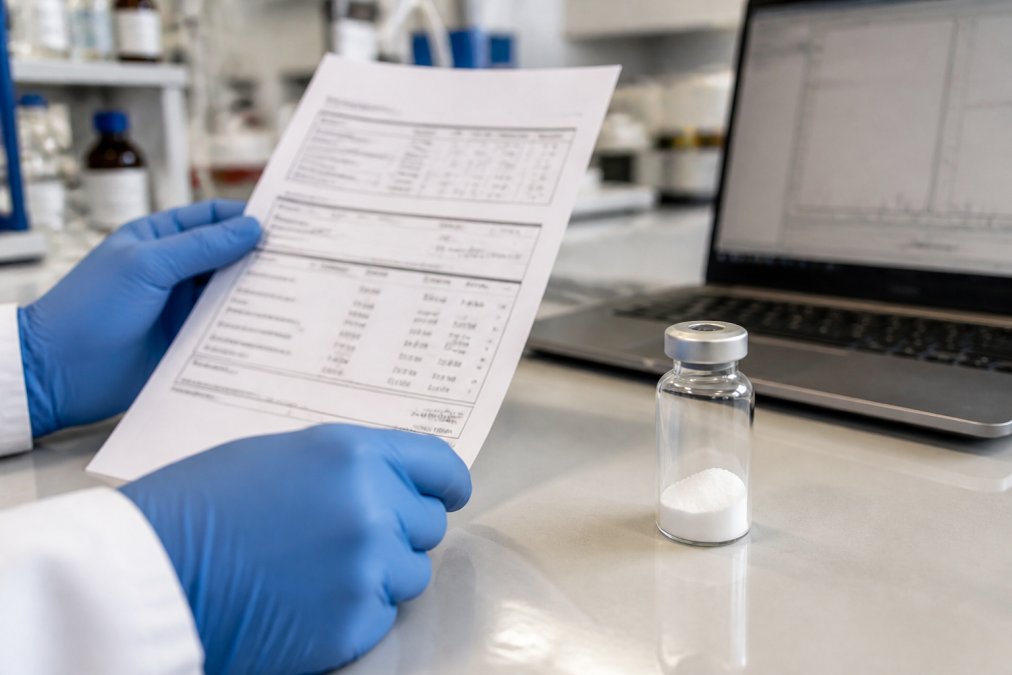
Start with the lot number, then the test date, then the method. A COA without a method description cannot be evaluated.
HPLC and Mass Spectrometry: What the Raw Data Shows
HPLC separates compounds by retention time and produces a chromatogram. A clean single peak at the expected retention time with a flat baseline indicates high purity. Shoulders, split peaks, or elevated baseline noise indicate impurities or degradation.
Mass spectrometry answers a different question: is this the right molecule? The observed mass must match the theoretical molecular weight of the peptide sequence within instrument tolerance. Sequence verification depends on this match.
Reading raw data means looking at both. A high purity percentage with a mismatched mass is a red flag.
Lot-Specific vs Generic COAs
Lot-specific COAs correspond to the exact batch shipped to you. Generic COAs are recycled documents that may describe a different synthesis run entirely.
Buy Research Grade Semaglutide Online: Vetting the Vendor
When you buy research grade semaglutide online, vendor vetting decides whether your results are defensible. The compound is only as reliable as the documentation behind it.
Run this sequence before any purchase:
- Request a lot-specific COA for the current batch.
- Confirm third-party testing, not in-house only.
- Verify the mass spectrometry result against the expected molecular weight.
- Check shipping method for temperature control.
- Confirm the vendor states Research Use Only status clearly.
- Ask about batch consistency across previous lots.
- Verify discreet, compliant packaging if your institution requires it.
Red Flags of Low-Quality Suppliers
Several patterns predict problems. The clearest signal is a supplier who cannot produce a lot-specific COA on request. Others include COAs with no method details, purity claims without chromatograms, prices far below market, and evasive answers about testing labs.
Watch for generic COAs shared across products, missing lot numbers, and pressure to buy before documentation is provided.
Research Peptide Storage and Handling Best Practices
Research peptide storage and handling best practices protect compound integrity from arrival. Most metabolic peptides ship as lyophilized powder, which is stable but not indestructible, the difference between a defensible result and a drifting baseline often comes down to how the vial was treated between arrival and assay.
Store lyophilized powder at -20°C for long-term stability, protected from light and moisture (peer-reviewed research). Once reconstituted with bacteriostatic water, store at 2-8°C and avoid repeated freeze-thaw cycles, which accelerate degradation.
- Keep vials sealed until use
- Use bacteriostatic water for reconstitution
- Avoid vigorous shaking; swirl gently
- Label reconstituted vials with date and concentration
- Log temperature exposure during storage
Degradation Kinetics: Why the Rules Exist
Most sourcing guides tell you what to do with a vial. Very few explain the chemistry behind the instructions, the part that lets you make judgment calls when a shipment arrives warm or a freezer fails overnight.
Peptide degradation in solution proceeds mainly through three pathways, each with its own rate dependence:
- Hydrolysis, cleavage of the peptide backbone, catalyzed by both acid and base. Rate rises steeply as pH moves away from the peptide's stability window, and roughly doubles for every 10°C increase in temperature (the familiar Q10 rule of thumb).
- Deamidation, conversion of asparagine and glutamine residues to aspartate and glutamate. This is the dominant degradation route for many GLP-1 analogs in aqueous solution, and it is strongly pH- and buffer-dependent. Phosphate buffers, common in lab settings, tend to accelerate it relative to other buffer systems.
- Oxidation, modification of methionine, cysteine, and tryptophan residues, driven by dissolved oxygen, trace metals, and light. A single oxidized methionine can shift the observed mass by +16 Da and quietly invalidate an identity check.
Aggregation is a fourth pathway that matters more at higher concentrations: peptides can self-associate into dimers and higher-order species that may not show up as a distinct HPLC impurity peak but will change bioactivity in a cell-based assay.
Cold Chain Shipping and Stability Testing
Cold chain shipping maintains temperature control from dispatch to delivery. For temperature-sensitive compounds, this is not optional, but "cold chain" is a spectrum, not a binary. Gel packs, dry ice, and phase-change panels each hold a different temperature band for a different duration, and the right choice depends on transit time and the peptide's sensitivity.
Stability testing data tells you how a compound behaves under defined conditions over time. Suppliers who publish it, even summarized, show they have characterized their product rather than simply packaged it. Look for the specific conditions tested (temperature, buffer, concentration, time points) rather than a single headline number. A stability claim without conditions is not a stability claim.
A practical storage protocol that pairs with the kinetics above:
- Aliquot reconstituted peptide into single-use volumes before freezing, so a thaw never forces a refreeze.
- Record arrival temperature and any excursion on the lot log.
- Reconstitute with bacteriostatic water unless the assay requires otherwise; the preservative slows microbial growth but does not stop hydrolysis.
- Keep reconstituted working stock at 2-8°C for short-term use and reserve -20°C or below for longer holds.
- Re-run a quick purity check on any lot that has been through a documented excursion before trusting it in a quantitative assay.
Chemical Stability, Degradation Kinetics, and Regulatory Compliance
Chemical stability and degradation kinetics explain why handling rules exist. Peptides degrade through hydrolysis, oxidation, and aggregation, each at a rate depending on temperature, pH, and concentration. Understanding those rates separates a researcher who follows a protocol from one who can adapt when conditions change.
Deamidation and oxidation are the most common degradation routes for metabolic peptides. Both accelerate with heat and moisture, which is why lyophilized powder stored cold outperforms reconstituted solution stored warm. Every hour a reconstituted vial spends at room temperature is an hour of measurable degradation, and the loss compounds across a multi-week study.
Sterility and Endotoxin Testing: The Overlooked Safety Layer
Most sourcing guides stop at HPLC purity. That is a mistake for any compound headed into cell-based work, because purity and sterility answer different questions. A peptide can be 99% pure by HPLC and still carry bacterial endotoxin at levels that confound an assay or trigger an inflammatory response in cultured cells.
Endotoxins are lipopolysaccharides from the outer membrane of gram-negative bacteria. They are heat-stable, so autoclaving does not reliably remove them, and they are measured in endotoxin units (EU) per milligram or per vial (the FDA). A COA reporting an endotoxin result, typically via the Limulus amebocyte lysate (LAL) method, shows the supplier considered the downstream application, not just the synthesis.
Sterility testing is the companion check, confirming the absence of viable microbial contamination, most important for any product reconstituted with non-bacteriostatic water or handled in a non-sterile environment. For cell-culture work, a supplier providing both an endotoxin figure and a sterility statement operates at a different tier than one who only ships an HPLC trace.
Regulatory Compliance and Research Use Only Status
Regulatory compliance for research compounds means clear Research Use Only labeling and no therapeutic claims. The FDA regulates drug products, not research reagents, and RUO status keeps the distinction explicit. Suppliers who blur that line, through dosing guidance, human-use framing, or therapeutic language, create risk for the labs that buy from them, because the documentation trail no longer matches the intended use.
For a research lab, RUO compliance is not just a legal formality, it is a documentation signal. A supplier who labels clearly, avoids therapeutic claims, and ships with a lot-specific COA shows that their internal controls extend past the synthesis bench. That consistency makes a vendor defensible in a methods section or an audit.
The strongest sourcing protocol combines lot-specific COAs, third-party testing, documented stability data, endotoxin and sterility results where applicable, and clear RUO compliance. Documentation, not price, is what makes results defensible.
Conclusion: Building a Defensible Sourcing Protocol
Sourcing high-purity metabolic peptides is a documentation problem before it is a purchasing decision. Every claim you cannot verify is a variable you cannot control.
Bluegrass Research built its process around that gap. Lot-specific COA documentation ties every result to your actual batch. Third-party analytical testing verifies purity and identity independently. Discreet US shipping with no external branding keeps institutional receiving simple, and our research-first approach means verification records ship with every order.
Get started with Bluegrass Research and give your next study the documentation trail it deserves.
Frequently Asked Questions
What documentation should accompany high-purity research peptides?
Every shipment should include a lot-specific Certificate of Analysis (COA) with HPLC chromatograms, mass spectrometry data, and the testing laboratory's name. Look for peptide sequence verification, molecular weight confirmation, and impurity profile. A generic COA that does not match your vial's lot number is a red flag. Reputable suppliers also provide endotoxin levels and sterility testing results when applicable.
How do I verify third-party testing results from a peptide supplier?
Request the raw analytical data, not just a summary. Check that the COA includes a unique lot number, testing date, and the name of an independent lab. You can contact the lab directly to confirm authenticity. Look for HPLC chromatograms that show a single sharp peak at the expected retention time. Mass spectrometry should confirm the molecular weight within 0.1%. If a supplier cannot provide raw data, treat the COA as unverified.
What are the risks of sourcing low-purity metabolic peptides for research?
Low-purity peptides contain synthesis byproducts, truncated sequences, and residual solvents that can skew experimental results. Impurities may cause off-target effects or cytotoxicity, invalidating your data. Without a lot-specific COA, you cannot prove what you administered or how it was stored. This undermines reproducibility and can lead to retractions or wasted grant funding. Always prioritize documented purity over lower upfront cost.
How can researchers ensure the integrity of research-grade peptides during shipping?
Choose suppliers that ship with cold chain packaging, such as insulated containers and gel packs, and provide tracking with temperature monitoring. Lyophilized powder is more stable than reconstituted peptide, so order in that form when possible. Upon arrival, inspect vials for cracks or discoloration and store immediately at -20°C or lower. If shipping delays occur, request a replacement or a new COA for the affected lot.
Why is lot-specific analytical documentation critical for metabolic studies?
Lot-specific COAs tie the analytical results directly to the vial you are using. In metabolic studies, small variations in purity or impurity profile can alter bioavailability and degradation rates. Without lot-level traceability, you cannot compare results across experiments or defend your findings if scrutinized. It also helps you identify batch consistency issues and ensures that what you publish is reproducible by other labs.