 blog
7 Things to Check in a Protide Health vs Midwest Peptide Review
Last Updated: October 26, 2026
Quick Summary
A useful peptide review of Protide Health vs Midwest Peptide should compare lot-specific certificates of analysis, independent third-party testing, and total cost rather than homepage polish or price per vial. Verify that the lot number on the vial matches the COA, that the named lab is independent, and that the purity figure is measured with a stated method.
- Read a COA in order: lot number, test method, purity figure, lab name, test date.
- Request COAs for two different lot numbers to confirm batch consistency.
- Normalize price per milligram and add documentation, shipping, and minimum-order costs.
- Send one pre-sale email requesting the lot-specific COA and time the response.
- Store lyophilized material frozen and protected from light, avoiding freeze-thaw cycles.
Table of Contents
- What a Protide Health vs Midwest Peptide Review Should Actually Compare
- Vendor Legitimacy and Supplier Reputation: What to Look For
- How to Verify Peptide Purity Before You Order
- Third-Party Testing, Batch Consistency, and Quality Control
- Pricing, Shipping, and Fulfillment: The Total-Cost Picture
- Research Peptide Storage Best Practices After Delivery
- How the Best Research Grade Peptide Suppliers Earn Trust
- Request Lot-Specific Documentation for Your Next Order
- Frequently Asked Questions
What a Protide Health vs Midwest Peptide Review Should Actually Compare
Most Protide Health vs Midwest Peptide reviews floating around the web compare the wrong things. They rank websites by how polished the homepage looks, not by whether the documentation behind each vial holds up under scrutiny.
A useful peptide review answers one question: can you verify what is in the vial before you commit a study to it? Everything else, including reputation, shipping speed, and price, flows from that.
Why Most Vendor Comparisons Fall Short
The typical vendor comparison stops at price per milligram and a star rating. That tells you almost nothing about batch consistency, testing methods, or whether the certificate of analysis matches the lot you actually receive.
A common mistake is treating a supplier's own purity claim as evidence. It isn't. What matters is who ran the test, what method they used, and whether the document ties to your specific lot number.
Vendor Legitimacy and Supplier Reputation: What to Look For
Supplier reputation is the sum of verifiable records, not forum chatter. A legitimate peptide supplier publishes who tests its compounds, how it handles a failed batch, and what happens when a shipment goes wrong.
Start with these checks:
- Does the vendor name the independent laboratory that performed testing?
- Is there a lot number on the label that matches the COA?
- Are contact details and a physical business address listed?
Community sentiment is useful as a starting point, never as a conclusion. A vendor with a hundred positive posts and no published testing data is less trustworthy than a quieter supplier with clean, lot-specific documentation.
How to Verify Peptide Purity Before You Order
Verifying peptide purity means matching three things: the lot number on the vial, the certificate of analysis for that lot, and the testing laboratory that issued it. If any one of those is missing, you cannot verify purity, no matter what the product page claims.
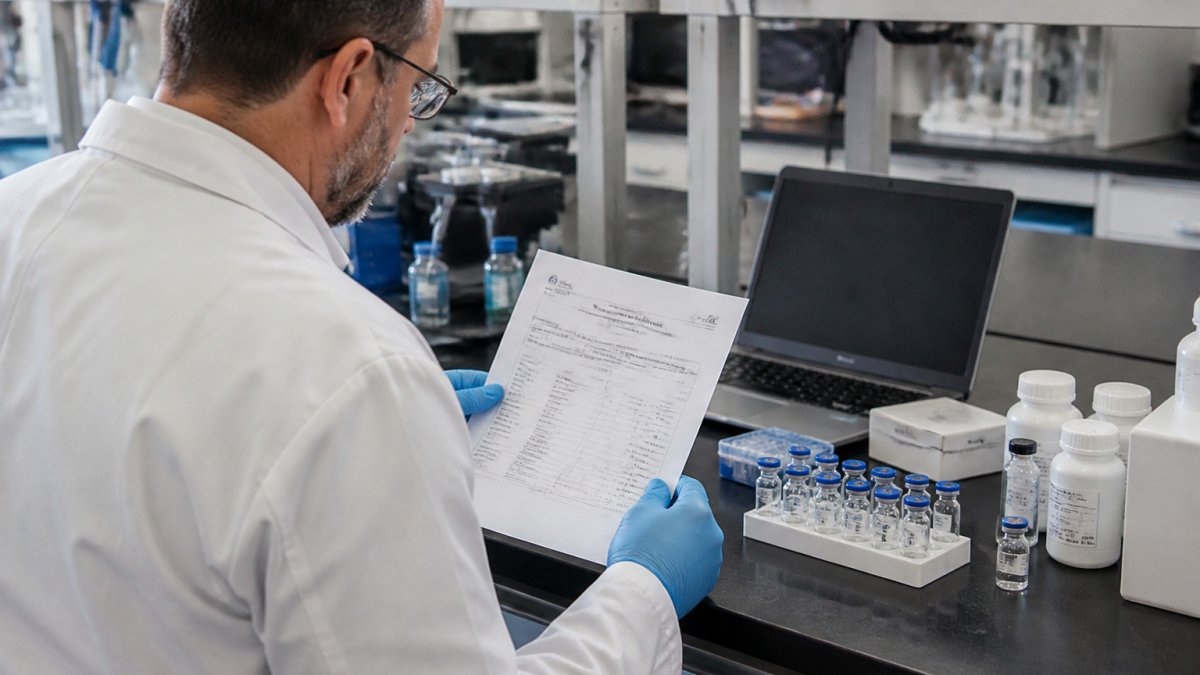
Ask the supplier for the COA before you pay. Then check that the document lists the analytical method used, the measured purity figure, and the identity confirmation result.
Reading a Certificate of Analysis Line by Line
A certificate of analysis is a lot-specific laboratory record that reports the identity, purity, and testing method for a single batch of material. Read it in this order:
- Lot number - must match the vial you receive
- Test method - HPLC for purity, mass spectrometry for identity
- Purity figure - the measured percentage, not a target
- Laboratory name - an identifiable, independent lab
- Test date - recent relative to the batch
For a deeper walkthrough, see our guide to identifying legitimate lot-specific COAs.
Third-Party Testing, Batch Consistency, and Quality Control
Third-party testing is the practice of sending samples to an independent laboratory that has no financial stake in the result. It is the single strongest signal of quality control a supplier can offer, but only if you can verify the test actually happened, on the batch you received, using a method that measures what you think it measures.
Most vendor comparisons stop at the phrase "third-party tested." That phrase is a claim, not evidence. The verification work is in the document.
Verifying a COA: Dates, Methods, and Batch Identifiers
A certificate of analysis is only useful if it ties to a specific lot and reports a specific method. When you receive a COA, verify it in this order:
- Batch identifier, the lot number on the COA must match the lot number on the vial label. A COA with no lot number is untraceable and could describe any batch the supplier has ever handled.
- Test date, the date should be recent relative to the batch and should precede the ship date. A COA dated after your shipment is a red flag.
- Analytical method, HPLC is the standard method for purity; mass spectrometry is the standard method for identity confirmation. A COA that reports a purity percentage without naming the method is a marketing document, not a quality record.
- Measured result, not a target, the purity figure should be a measured percentage, not a specification the supplier intended to meet.
- Laboratory identity, the issuing lab should be identifiable and independent of the vendor. If the lab name is missing or the "lab" is the vendor's own in-house facility, the test is not third-party.
Batch-to-Batch Consistency
Batch consistency matters just as much as a single clean result. A supplier that tests one lot thoroughly and ships the next one untested has no quality protocol at all, it has a marketing sample.
Ask how often batches are tested and whether results are published per lot. A consistent supplier can produce a COA for every lot number it has shipped, on request, without delay.
A practical test: request COAs for two different lot numbers of the same compound. If both documents are lot-specific, method-specific, and dated, the supplier has a real quality-control process. If one is missing or generic, the process is inconsistent.
Independent Laboratory Credentials
Independence is the whole point of third-party testing, so verify it. Look for a laboratory that:
- Is named on the COA and is not owned by or affiliated with the vendor
- Publishes its analytical methods and instrumentation
- Can be contacted directly to confirm a report
You do not need to audit the lab to benefit from this. You need to confirm that the lab exists, is independent, and stands behind the report. A supplier that will not name its lab is asking you to trust a claim rather than a record.
Quality-Control Procedures Worth Asking About
Beyond the COA itself, a few procedural questions separate a real QC program from a documentation veneer:
- What happens when a batch fails a test? Is it destroyed, reworked, or shipped anyway?
- Are out-of-spec results disclosed to buyers, or only clean results published?
- Is there a written protocol for sampling, storage, and release of each lot?
A supplier with a stated out-of-spec policy is more trustworthy than one that has never mentioned the possibility. The willingness to describe a failure process is itself evidence of a process.
If you need to source independent analysis yourself, our guide on where to test peptides for purity covers the practical options.
Pricing, Shipping, and Fulfillment: The Total-Cost Picture
Price per vial is the least useful number in a vendor comparison, but that does not mean price should be ignored. It means price has to be normalized before it can be compared. A $40 vial and a $65 vial are not comparable until you account for compound, quantity, documentation depth, shipping terms, and the cost of a failed experiment caused by degraded material.
Normalizing Price Before You Compare
To compare like with like, build a simple cost worksheet for each vendor. Most researchers find that four inputs do most of the work:
- Compound and quantity, price per milligram, not price per vial, so different fill sizes can be compared.
- Documentation included, is a lot-specific COA included at no charge, or is it an add-on?
- Shipping and handling, flat rate, weight-based, or free above a threshold?
- Minimum order and bulk tiers, what is the smallest order accepted, and at what quantity does the per-milligram price step down?
A common pattern is that the lowest sticker price loses once shipping, minimum-order requirements, and documentation fees are added back in. Ask each vendor for a current, dated quote rather than trusting a comparison table built months ago, research peptide pricing moves with supply, and a table without a date is a guess.
Shipping, Packaging, and Transit Risk
Fulfillment quality shows up in the details long before it shows up in a review. Ask three questions before ordering:
- How is the shipment packaged, and is temperature control used in transit? Lyophilized material is generally more tolerant of ambient transit than reconstituted material, but packaging quality still determines whether a vial arrives intact.
- Is the outer packaging discreet and free of branding? This matters for institutional receiving departments and for any setting where package contents should not be advertised.
- What is the policy if a shipment arrives compromised? A stated replacement or resolution policy is a quality signal; silence is not.
A low sticker price with poor transit handling is not value. It is a reorder waiting to happen, and a reorder that may arrive after your study timeline has already slipped.
Returns, Replacements, and Customer Service
Return and replacement policies are where vendor comparisons usually go quiet, because the policies are hard to find and rarely advertised. Look for a written policy that covers:
- Damaged or compromised shipments
- Out-of-spec or undocumented lots
- Turnaround time for a resolution
Customer service is the practical test of all of this. Send one pre-sale question, for example, a request for the lot-specific COA for the batch that would ship, and time the response. A vendor that answers quickly and completely before the sale is telling you how it will behave after one.
The Total-Cost Worksheet
Put the four inputs together and the comparison becomes arithmetic rather than impression:
| Cost line | What to record |
|---|---|
| Material | Price per milligram at your target quantity |
| Documentation | COA included or add-on, and whether lot-specific |
| Shipping | Rate, threshold for free shipping, temperature control |
| Minimum order | Smallest accepted order and bulk tier breakpoints |
| Risk | Stated replacement policy and response time |
A vendor that wins on all five lines is a better value than a vendor that wins only on the first. That is the total-cost picture, and it is the one worth acting on.
Research Peptide Storage Best Practices After Delivery
Storage decisions start the moment a shipment arrives. Lyophilized peptides generally tolerate short periods at ambient temperature, but stability depends on the specific compound, so check the supplier's documentation rather than assuming.
Practical steps for most research settings:
- Inspect vials on arrival for damage or seal failure
- Store lyophilized material frozen and protected from light
- Keep reconstituted material refrigerated and use it within the documented window
Our research peptide storage guide walks through temperature ranges and handling in more detail. Good storage protects the integrity you paid for.
How the Best Research Grade Peptide Suppliers Earn Trust
The best research grade peptide suppliers earn trust the same way a good laboratory does: through documentation, consistency, and a willingness to show their work.
That means lot-specific COAs for every batch, testing performed by an identifiable independent laboratory, and a stated policy for handling out-of-spec results.
Transparency is the differentiator. When a supplier publishes verification records without being asked, the vendor comparison gets simple.
Request Lot-Specific Documentation for Your Next Order
Before your next purchase, send one email: request the lot-specific COA for the exact batch being shipped, plus the name of the testing laboratory. A supplier that answers quickly and completely is telling you something about how it operates.
Bluegrass Research supplies research-grade peptide materials with lot-specific, third-party analytical documentation, discreet shipping with no external branding, and professional storage solutions. Read more on why lot-specific COAs matter in peptide research, then get started with Bluegrass Research and order with verification records in hand.
Frequently Asked Questions
What criteria should be used to evaluate peptide supplier legitimacy?
Start with documentation. Check whether the supplier provides lot-specific certificates of analysis and third-party analytical documentation. A peptide review that skips documentation tells you very little about the supplier's verification records.
How do third-party analytical reports verify peptide purity?
Third-party analytical documentation can provide records for evaluating a supplier's verification practices. When reviewing a supplier, check whether its documentation is lot-specific and identifies the testing laboratory.
What should researchers look for in a certificate of analysis?
For Bluegrass Research, the verified facts describe lot-specific, third-party analytical documentation. Review the available documentation for the information it provides.
What are the risks of buying research-grade peptides from unverified vendors?
The verified facts about Bluegrass Research include lot-specific, third-party analytical documentation, discreet shipping with no external branding, and professional storage solutions.
The documentation gap in this market is real, and it is your problem to close. Bluegrass Research built its process around lot-specific COAs, independent analytical testing, and discreet shipping so your records hold up when results are scrutinized. Get started with Bluegrass Research and make your next order fully traceable.