 blog
High Purity Semaglutide for Research: 2026 Guide
Table of Contents
- What High Purity Semaglutide for Research Actually Means
- Semaglutide Certificate of Analysis: What Each Document Should Show
- Semaglutide Purity Testing: HPLC, Identity, and Endotoxin Checks
- Third-Party Tested Semaglutide: Verifying the Lab Behind the Report
- Storage, Stability, and Shipping Evidence for Lyophilized Vials
- How to Evaluate a Semaglutide Peptide Supplier
- Research-Use-Only Boundaries and Regulatory Reality
- Frequently Asked Questions
Last Updated: October 21, 2026
What High Purity Semaglutide for Research Actually Means
High purity semaglutide for research is a synthetic GLP-1 receptor agonist peptide supplied as a lyophilized powder, where "high purity" means the compound is separated from synthesis byproducts, truncated sequences, and residual solvents to a degree the supplier can document.
Semaglutide is engineered to resist DPP-4 breakdown, extending its activity versus native GLP-1. Researchers studying incretin signaling, receptor biology, and metabolic pathways rely on it as a reference compound, but a purity percentage is only as good as the analytical work behind it.
Why Purity Percentages Alone Mislead
A stated 99% purity is one number from one method on one aliquot; it does not tell you what the 1% contains.
Most suppliers lead with the percentage because it is easiest to market. The useful questions are which method produced the number, whether it could distinguish the target from its nearest impurity, and whether the sample came from your lot.
Semaglutide Certificate of Analysis: What Each Document Should Show
A semaglutide certificate of analysis is a lot-specific record tying a batch identifier to the analytical results generated from that batch. Generic, non-lot COAs are the most common weakness in peptide sourcing, easy to spot once you know the fields to check and how to verify them.
Here is what a defensible COA should contain:
- Lot or batch number that matches the vial label exactly
- Compound name and sequence confirming identity
- Test method named for each result (RP-HPLC, mass spectrometry, endotoxin assay)
That list is the floor, not the ceiling. The harder question is how a researcher confirms the document is real, current, and actually about the vial in hand.
Verifying a COA Instead of Just Reading It
A COA is only useful if it survives three checks: authenticity, lot match, and method fit.
Authenticity. Confirm the testing laboratory named on the report exists as an operating analytical lab reachable independently of the supplier.
Lot match. The batch number on the COA must match the vial label character for character.
Method fit. The method named on the COA must be capable of answering the question the result claims to answer.
What a COA Does Not Establish
A complete COA is a release document, not a guarantee of fitness for every experiment. It typically does not establish:
- Potency or biological activity. Purity and identity do not confirm expected behavior in a receptor assay; activity testing is a separate question most research-grade COAs omit.
- Sterility. Endotoxin screening is not a sterility test. A low-endotoxin lot can still be non-sterile, which matters for any work where microbial contamination would confound results.
- Stability through your storage conditions. The COA describes the lot at release; what happens after you open the vial depends on your storage and handling.
Read the COA as answers to specific questions, and note which were never asked. That gap analysis is often more informative than the purity number at the top of the page.
If a supplier cannot produce a COA keyed to your lot, and cannot answer the authenticity, lot-match, and method-fit questions in writing, the purity claim has no traceable source.
Semaglutide Purity Testing: HPLC, Identity, and Endotoxin Checks
Semaglutide purity testing combines reversed-phase HPLC for purity, mass spectrometry for identity, and a bacterial endotoxin assay for safety screening. Each answers a different question, and a complete release package needs all three.
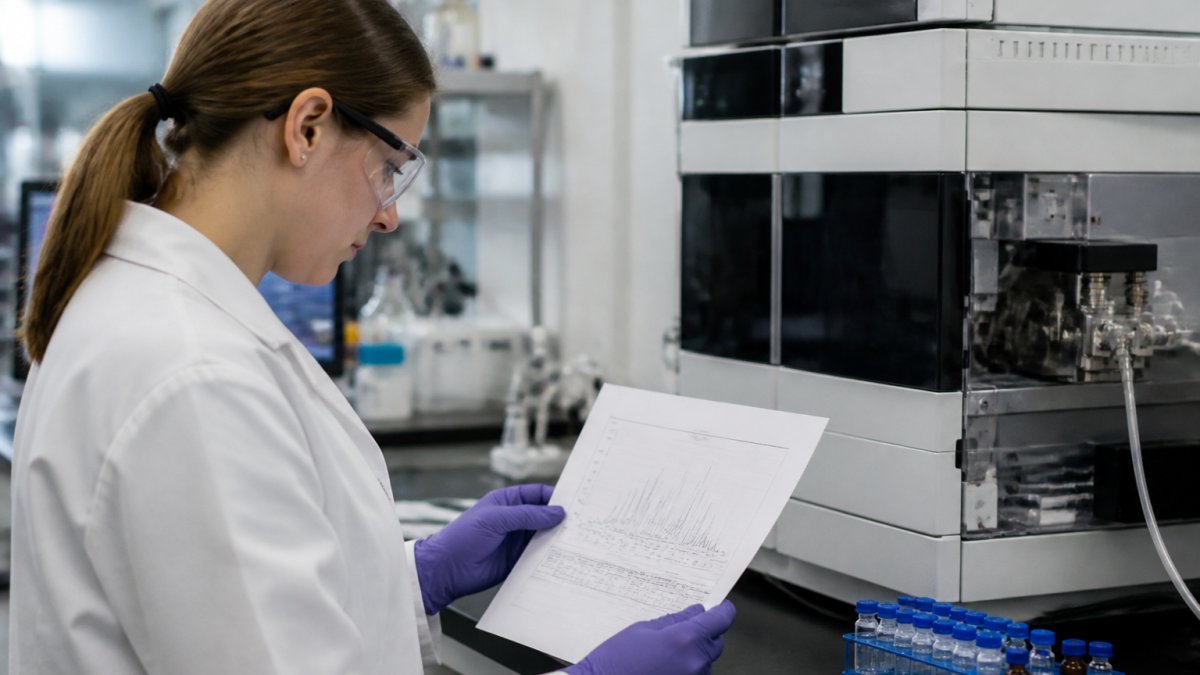
RP-HPLC separates the target peptide from related impurities by hydrophobicity; the main peak's area percentage becomes the purity figure. Mass spectrometry confirms the mass matches the expected sequence, catching cases where a high-purity peak is the wrong peptide.
Reading a Chromatogram Without Overreading It
A chromatogram is a snapshot of one separation, not a certificate of identity. Look for a single, well-defined main peak with clean baseline separation and minimal fronting or tailing.
The trace cannot tell you whether the peak is the right molecule, whether the sample was representative, or whether the method was validated for this compound. Those answers live in the method description and identity data.
Third-Party Tested Semaglutide: Verifying the Lab Behind the Report
Third-party tested semaglutide means the analytical work was performed by a laboratory independent of the supplier. Independence removes the obvious conflict of interest, but "third-party" is a claim, not a credential. Verify it.
Ask three questions: Is the testing laboratory named on the COA, and does it exist as an operating analytical lab? Does the report include method, instrument type, and detection limits rather than a bare result?
A growing number of suppliers publish lot-specific documentation as standard practice, and independent verification is becoming a differentiator rather than an extra. If you want to understand how analytical laboratories document method validation, the FDA guidance on analytical procedures and methods validation outlines the expectations regulators apply to method development and validation records.
Storage, Stability, and Shipping Evidence for Lyophilized Vials
Lyophilized semaglutide should arrive as a stable powder, and the cold chain is where good documentation often breaks down. Stability data and shipping controls are the two pieces of evidence that tell you whether the compound survived transit, and most supplier pages mention both without showing either.
Lyophilization removes water to slow degradation, but the powder remains sensitive to moisture, heat, and repeated freeze-thaw cycles. Suppliers should state recommended storage conditions, typically frozen or refrigerated, protected from light, kept dry, and provide stability data supporting the claimed shelf life. Ask specific questions:
- What formulation was studied? Stability data generated on a different buffer, counterion, or fill volume does not transfer to the vial you are buying. Ask whether the study used the same formulation and container closure.
- What conditions were tested? A shelf-life claim should name the temperature and humidity conditions of the study. "Stable for 24 months" means little without knowing whether that was at -20 °C, 2-8 °C, or ambient.
- What endpoints were measured? Purity by HPLC over time is the common endpoint; identity and water content at intervals are stronger. A study reporting only a starting and ending purity number is thinner than one with a time course.
Shipping Specifications That Actually Protect the Compound
Shipping is the practical test of whether stability claims survive contact with a carrier. Temperature-controlled transit with phase-change materials, insulated packaging, and tracking that confirms the cold chain held protect compound integrity. Ask for:
- Packaging configuration. What insulation and phase-change material (gel packs, dry ice, or conditioned panels) are used, and for what expected transit time?
- Temperature range in transit. What range does the packaging hold, and for how long? A configuration validated for 48 hours is not the same as one validated for 96.
- Seasonal handling. Does the shipping configuration change in summer or winter? A supplier who ships the same way year-round across climates is either over-packaging or under-protecting.
- Arrival verification. Is there a temperature indicator or data logger in the box, and does the shipment include instructions for what to do if the indicator shows an excursion?
Discreet, unbranded packaging does not conflict with institutional procurement: the outer label can carry required shipping documentation while the inner contents stay neutral, as long as discretion does not come at the cost of cold-chain evidence.
Handling After Arrival
Stability evidence covers transit and shelf life, not bench handling. Once reconstituted, repeated freeze-thaw cycles, light exposure, and adsorption to plastic can degrade the peptide in ways the release COA never sees. Aliquot before freezing, protect working solutions from light, and record the reconstitution date alongside the lot number so later results trace to a specific handling history.
How to Evaluate a Semaglutide Peptide Supplier
A semaglutide peptide supplier should be judged on documentation quality, testing independence, and supply reliability, in that order.
Start with the documentation package: lot-specific COA, method detail, identity confirmation, endotoxin results. Then check independence: who ran the tests, and can you confirm the lab exists.
A supplier who cannot answer the documentation questions in writing is not worth qualifying, regardless of the purity number on the page.
A Side-by-Side Supplier Comparison Method
Score each candidate on the same criteria and weight documentation heaviest.
| Criterion | What to Check | Weight | Red Flag |
|---|---|---|---|
| Lot-specific COA | Matches your vial's batch number | High | Generic COA reused across lots |
| Method detail | HPLC method, column, detection stated | High | Purity number with no method |
| Identity testing | Mass spec observed vs expected mass | High | No identity data at all |
| Endotoxin data | Assay type and detection limit | Medium | "Not tested" with no explanation |
| Testing independence | Named third-party lab | Medium | Unnamed or in-house only |
| Stability evidence | Shelf life and storage conditions | Medium | No stability data provided |
| Shipping controls | Temperature control and tracking | Medium | No cold-chain specification |
| Commercial terms | MOQ, lead time, procurement fit | Low | Vague or shifting lead times |
Score each row from 1 to 3, multiply by the weight, and total. A supplier strong on the top three rows but weak on shipping still beats one with a strong headline percentage and no documentation.
Research-Use-Only Boundaries and Regulatory Reality
Semaglutide sold for laboratory research is labeled research use only, not intended for human or veterinary use, diagnosis, or treatment.
The compound's approved therapeutic forms are prescription products regulated as drugs. The NIH Office of Science Policy publishes guidance on research conduct and dual-use considerations that many institutional review boards reference.
Labeling, storage, and disposal should follow your facility's chemical handling procedures, and the COA should be retained with experimental records so results remain defensible under scrutiny.
U.S. Pharmacopeia general chapters on peptide analysis
The hard part of sourcing high purity semaglutide for research is not finding a supplier who claims a high percentage.
Frequently Asked Questions
What does high purity mean for research-grade semaglutide?
High purity means the semaglutide content in a vial meets a stated percentage, commonly 98% or 99%, as measured by HPLC, with the remainder being related peptides, water content, or counterions. The number tells you how much of the material is the target peptide, not whether it is the correct peptide or free of endotoxins. That is why purity should always be read alongside identity testing, endotoxin quantification, and a lot-specific certificate of analysis for the batch you actually receive.
Does an HPLC purity result confirm a peptide's identity?
No. HPLC separates compounds by how they travel through a column, so a single sharp peak shows the sample is largely one substance, not that the substance is semaglutide. Identity needs a separate method, typically mass spectrometry, which confirms molecular weight against the expected value. A defensible semaglutide certificate of analysis reports both: the chromatogram with a purity percentage and a mass spec result matching the theoretical mass of the peptide.
How should research-grade semaglutide be stored after delivery?
Lyophilized semaglutide vials should go into a freezer at -20°C or colder on arrival, kept dry and protected from light, and left sealed until use. Let a vial reach room temperature before opening to stop condensation forming on the powder. Once reconstituted, follow the solvent and storage conditions your protocol specifies and avoid repeated freeze-thaw cycles, which degrade peptide structure. Log the lot number and arrival date so storage conditions stay traceable to the batch.
Is research-grade semaglutide approved for human use?
No. Semaglutide sold as a research compound is labeled research use only and is not FDA-approved for human or veterinary use in that form. Approved semaglutide products reach patients through licensed prescribing channels, not research suppliers. Researchers should keep documentation showing the material was acquired for laboratory work, follow institutional safety and disposal rules, and never represent a research-grade vial as a therapeutic product.