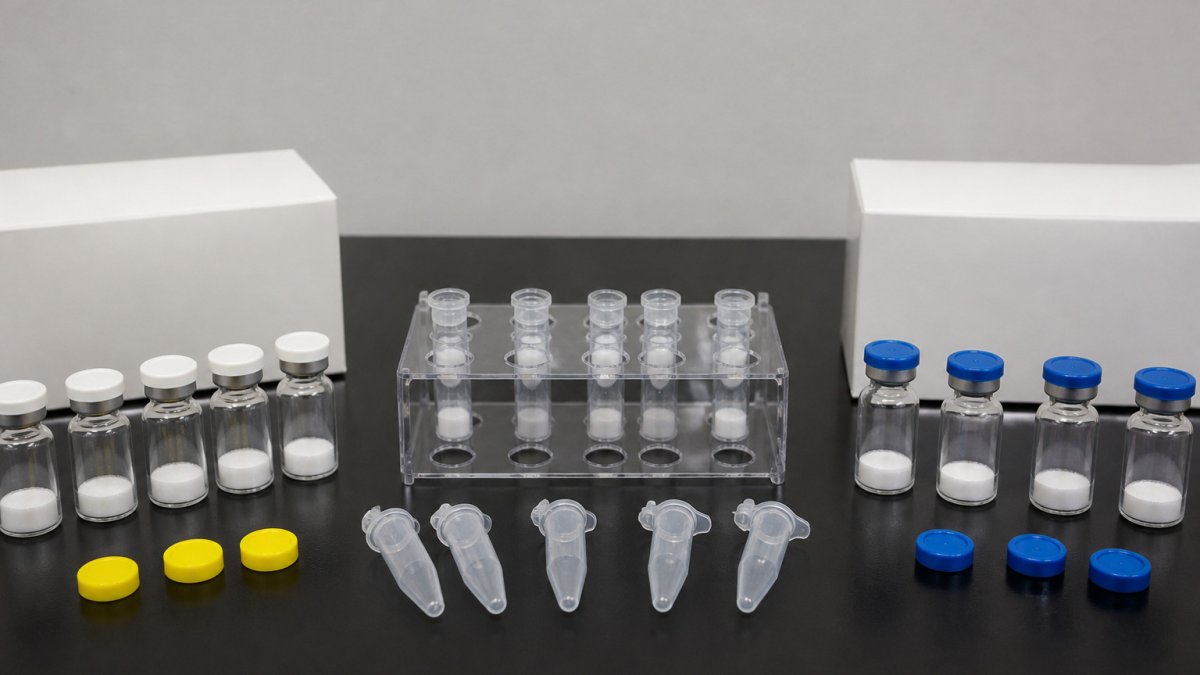
 comparison
Tirzepatide vs Semaglutide: Research Comparison Guide
Last Updated: November 3, 2026
Quick Summary
The tirzepatide vs semaglutide research comparison shows tirzepatide produces larger average reductions in body weight and hemoglobin A1C than semaglutide in head-to-head trials. Tirzepatide is a dual GIP and GLP-1 receptor agonist, while semaglutide activates only GLP-1. These results describe trial averages, not guarantees for any single protocol.
- Tirzepatide activates GIP and GLP-1 receptors; semaglutide activates only GLP-1.
- A larger share of tirzepatide participants reached the 15% weight loss threshold.
- GI adverse events were the leading cause of discontinuation in both arms.
- Weight regain after stopping treatment is a consistent finding for both drugs.
- Verify lot number, HPLC chromatogram, and mass spectrometry results on every certificate of analysis.
Table of Contents
- Tirzepatide vs Semaglutide: What the Head-to-Head Data Shows
- Evidence Quality and Comparability in Tirzepatide vs Semaglutide Studies
- Research Grade Peptide Purity Standards for Metabolic Studies
- Third-Party Analytical Documentation for Peptides: What to Verify
- Peptide Storage and Stability Best Practices for Laboratory Use
- Safety Profile, Tolerability, and Long-Term Outcomes After Stopping
- Sourcing Research-Grade Tirzepatide and Semaglutide Materials
- Frequently Asked Questions
Tirzepatide vs Semaglutide: What the Head-to-Head Data Shows
The tirzepatide vs semaglutide research comparison is one of the most active debates in metabolic science, and the peer-reviewed literature now gives us a clear picture: tirzepatide produces larger average reductions in both body weight and hemoglobin A1C than semaglutide in direct trials. At Bluegrass Research, we supply both compounds to laboratories running these exact studies, and we see how much the answer depends on which trial you cite and how carefully you read it.
Here is the part most summaries skip. A head-to-head result describes an average across a trial population, not a guarantee for any single protocol. Below, we break down the mechanism differences, the efficacy numbers, the quality of the underlying evidence, and the practical standards that determine whether your own comparative study will hold up to scrutiny.
Tirzepatide is a dual GIP and GLP-1 receptor agonist. Semaglutide is a GLP-1 receptor agonist. That single mechanistic difference drives most of what follows.
Mechanism Differences: Dual GIP/GLP-1 Agonism vs GLP-1 Alone
Tirzepatide activates two incretin receptors, GIP and GLP-1, while semaglutide activates only GLP-1. The GIP receptor agonist component is what separates a dual incretin agonist from a pure GLP-1 receptor agonist, and researchers generally attribute the larger weight-loss effect to that added pathway.
Both compounds slow gastric emptying and reduce appetite signaling through GLP-1. Tirzepatide adds GIP-driven effects on adipose tissue and insulin sensitivity that semaglutide does not engage. In practice, this means a study designed to isolate mechanism must control for the dual action, not just the GLP-1 arm.
Efficacy, A1C Reduction, and Body-Weight Change
Tirzepatide wins on average efficacy in the published head-to-head data. Trial results reported in the New England Journal of Medicine research archive show greater mean percentage weight change and deeper A1C reduction with tirzepatide than with semaglutide at matched follow-up points.
The headline pattern across randomized controlled trials:
- A larger share of tirzepatide participants reaching 15% weight loss thresholds
- Greater absolute A1C reduction in type 2 diabetes populations
- Consistent direction of effect across dose escalation schedules
What most guides miss is the dose question. Semaglutide's maintenance dose and tirzepatide's dose escalation schedule are not directly interchangeable, so a comparison that ignores dose equivalence overstates or understates the gap. Read the trial's dosing table before you quote a percentage.
The key differences between the two compounds, as the published head-to-head data describes them.
| Feature | Tirzepatide | Semaglutide |
|---|---|---|
| Receptor activity | Dual GIP and GLP-1 receptor agonist | GLP-1 receptor agonist only |
| Mean weight change | Greater mean percentage weight change | Smaller mean percentage weight change |
| A1C reduction | Greater absolute A1C reduction | Smaller absolute A1C reduction |
| 15% weight loss threshold | Larger share of participants reaching it | Smaller share of participants reaching it |
| GI adverse events | Leading cause of discontinuation | Leading cause of discontinuation |
| Discontinuation due to adverse events | Broadly similar to semaglutide | Broadly similar to tirzepatide |
| Weight regain after stopping | Consistent finding in published literature | Consistent finding in published literature |
Evidence Quality and Comparability in Tirzepatide vs Semaglutide Studies
Comparability is the weak point of most tirzepatide vs semaglutide comparisons, and it deserves more attention than the efficacy headlines. A head-to-head trial with a fixed protocol is strong evidence. A pooled analysis that stitches together separate trials with different populations is weaker, even when the numbers look cleaner.
Ask three questions of any comparison you cite:
- Was the trial randomized and head-to-head, or an observational study?
- Were follow-up durations matched between arms?
- Did the analysis report confidence intervals and hazard ratios, or only point estimates?
The Obesity Medicine Association clinical resources frame these distinctions for practitioners, and the difference matters. An observational study can suggest comparative effectiveness in real-world populations, but it cannot control for the selection effects that a randomized controlled trial eliminates. When you build a literature review, label each source by design before you compare its numbers.
Research Grade Peptide Purity Standards for Metabolic Studies
Research grade peptide purity standards for metabolic work start with a documented purity figure from an independent lab, typically expressed as a percentage by HPLC, plus a mass confirmation by mass spectrometry. Without both, a purity claim is unverifiable.
For metabolic peptide studies, acceptance criteria should be set before materials arrive, not after. Our guidance is to define a minimum purity threshold in your protocol, require lot-specific documentation that meets it, and reject any lot that arrives without matching records. Researchers setting up metabolic work can review the specific thresholds in this guide to metabolic peptide study purity requirements before finalizing their acceptance criteria.
Contamination is the quiet failure mode. A compound that is 95% pure by one method may carry residual trifluoroacetate salts or truncated sequences that interfere with a sensitive metabolic assay. Specify the analytical method, not just the number.
Third-Party Analytical Documentation for Peptides: What to Verify
Third-party analytical documentation for peptides is only as good as the lab behind it, and fraudulent certificates of analysis circulate widely enough that verification is now a core research skill. A legitimate COA names the testing laboratory, the lot number, the analytical methods used, and the results for each method.
Check these elements on every certificate:
- Lot number that matches the vial label exactly
- Testing lab identified by name, not a generic logo
- HPLC chromatogram with retention time and purity percentage
- Mass spectrometry result confirming molecular weight
- Date of analysis and a method reference
If you are unsure how to read one, this walkthrough on how to spot a legitimate certificate of analysis covers the structure line by line. The reverse skill matters just as much, and this guide to spotting fraudulent peptide certificates of analysis explains the red flags, from missing chromatograms to lot numbers that do not reconcile.
Peptide Storage and Stability Best Practices for Laboratory Use
Peptide storage and stability best practices for laboratory use come down to temperature, moisture, and light control, documented at every transfer. Lyophilized peptide should be held at the temperature your stability data supports, protected from light, and kept dry until reconstitution.

A common mistake is repeated freeze-thaw cycling of reconstituted material. Aliquot before freezing so each working portion is thawed once. Record the date, temperature, and handling at each step, because a stability claim without a handling log is not defensible. For full protocols on temperature ranges and reconstitution handling, see this complete guide to peptide storage protocols for labs.
Watch out: storing lyophilized vials in a frost-free freezer without a desiccant can introduce moisture cycling that degrades the compound before you ever open it.
Safety Profile, Tolerability, and Long-Term Outcomes After Stopping
Gastrointestinal adverse events dominate the safety profile for both compounds. Nausea, vomiting, diarrhea, and constipation are the most frequently reported events, and tolerability generally improves as dose escalation proceeds. The Drugs.com medical database summarizes the comparative side-effect data in a standardized format that is useful for a quick reference.
Incidence and discontinuation. In the head-to-head trials, GI events were mostly mild to moderate and transient, but they were the leading cause of discontinuation in both arms. Discontinuation rates due to adverse events were broadly similar between tirzepatide and semaglutide in SURMOUNT-5 and SURPASS-2, which matters: a larger average weight-loss effect does not come at the cost of a meaningfully worse tolerability profile in the trial data. Report the discontinuation rate and the reason for discontinuation in your own protocol, not just the adverse-event list.
Serious and class-level risks. Researchers should consult current prescribing information for each compound regarding its labeled warnings and contraindications, and build screening criteria accordingly.
Long-term outcomes after stopping treatment. This is where the evidence is thinnest. Weight regain after discontinuation is a consistent finding across both drugs. Weight regain after discontinuation is reported across these drugs in the published literature. The practical implication for a research protocol is that a study ending at the last dose captures only part of the picture, design follow-up that extends past treatment discontinuation if your protocol allows it, and report the follow-up duration explicitly.
Maintenance strategies. The evidence on maintenance dosing after weight loss is still emerging. Some clinicians use lower maintenance doses, intermittent dosing, or transition to a different agent, but these strategies are not yet supported by large randomized trials. Treat any maintenance protocol as an area of active investigation rather than an established standard.
Real-world persistence. Trial tolerability and real-world persistence are not the same thing. If your literature review draws on observational data, separate trial discontinuation from real-world discontinuation and state which one you are citing.
Sourcing Research-Grade Tirzepatide and Semaglutide Materials
Sourcing research-grade tirzepatide and semaglutide materials comes down to documentation you can defend when your results are scrutinized. Bluegrass Research offers lot-specific COA documentation and third-party analytical testing records, so the verification trail travels with the material.
Discreet US shipping with no external branding is offered for research deliveries, and our research-first philosophy centers on transparent verification records. If you are comparing sources, this guide to the best tirzepatide research grade suppliers lays out the criteria to score each one against.
Pricing depends on quantity, dates, and delivery, so check our site for current details. What we will say plainly: the documentation is the product.
Frequently Asked Questions
Is tirzepatide actually better than semaglutide?
In head-to-head clinical trial data, tirzepatide has shown greater mean body-weight reduction and larger A1C decreases than semaglutide. However, better on average does not mean better for every protocol. Differences in trial design, follow-up duration, and population characteristics affect comparability. Researchers should review the primary manuscripts, check confidence intervals rather than headline percentages, and match the compound to the specific metabolic endpoint their study is designed to measure.
How do the mechanisms of action differ between tirzepatide and semaglutide?
Semaglutide is a GLP-1 receptor agonist, acting on a single incretin pathway. Tirzepatide is a dual incretin agonist, binding both GIP and GLP-1 receptors. That dual activity is the mechanistic reason tirzepatide trials report larger mean weight change and A1C reduction. For laboratory work, the distinction matters because receptor specificity shapes the endpoints you can defensibly measure, so confirm the compound's documented identity and purity before designing around either mechanism.
Are there significant differences in the side effect profiles of these two peptides?
Both compounds carry gastrointestinal adverse events as the dominant tolerability signal: nausea, vomiting, diarrhea, and constipation appear in trial data for each. Reporting rates vary by dose escalation schedule and maintenance dose, which complicates direct comparison across studies. Researchers should read tolerability data alongside discontinuation rates, since treatment discontinuation often reflects GI effects more clearly than raw event percentages do.
What should researchers verify in third-party analytical documentation for peptides?
Look for lot-specific certificates of analysis rather than generic specification sheets. The documentation should identify the testing laboratory, the analytical methods used, and the results for the specific batch you receive. Purity figures without a lot number cannot be tied to your material. Pair that with research grade peptide purity standards and a storage protocol that protects compound integrity from arrival through analysis.
The gap between a defensible comparative study and an unusable one usually comes down to documentation. Bluegrass Research supplies research-grade tirzepatide and semaglutide with lot-specific COA documentation, third-party analytical testing, and discreet US shipping with no external branding. Get started with Bluegrass Research and build your next metabolic study on materials whose integrity you can verify.