 how-to
Reliable Compound Integrity for Life Sciences Retail
Table of Contents
- What Reliable Compound Integrity Means for Life Sciences Retail
- Peptide Certificate of Analysis Verification: What to Check Before You Accept a Lot
- Third-Party Peptide Testing: Why In-House Claims Are Not Enough
- Peptide Identity and Purity Testing: The Analytical Methods That Confirm What Is in the Vial
- Research Peptide Storage Best Practices: Preserving Compound Integrity From Receipt to Bench
- Retail Controls and Chain of Custody for Compound Integrity
- Conclusion
- Frequently Asked Questions
Last Updated: October 14, 2026
What Reliable Compound Integrity Means for Life Sciences Retail
Reliable compound integrity for life sciences retail means keeping a research compound's identity, purity, and physical condition intact from production to the lab.
Data integrity is the accuracy, completeness, and consistency of a compound's records. Physical compound integrity is the vial's actual condition: identity, purity, and stability.
The two depend on each other. A perfect COA means nothing if the vial sat in a hot truck for three days.
Data Integrity vs. Physical Compound Integrity
Data integrity covers the records, lot numbers, audit trails, test results, chain of custody, and answers one question: can you prove what this vial contains?
Physical compound integrity covers the material, cold storage, sealed vials, protection from light and heat, and answers a different question: is the material still good?
A supplier can pass one check and fail the other. You need both.
Peptide Certificate of Analysis Verification: What to Check Before You Accept a Lot
Peptide certificate of analysis verification means matching the COA in your inbox to the lot number on the vial in your hand. If they do not match, stop and contact the supplier before opening anything.
A lot-specific COA should show:
- The exact lot number on the vial
- Purity percentage from HPLC
- Molecular weight from mass spectrometry
Generic COAs covering a whole product line rather than one batch tell you almost nothing. Ask for the lot-specific document every time.
Red Flags in a Lot-Specific COA
Watch for these warning signs:
- No lot number, or a lot number that does not match the vial
- Purity listed as "greater than 98%" with no decimal or method noted
- No testing lab named
Any one of these is a reason to hold the lot and ask questions.
Third-Party Peptide Testing: Why In-House Claims Are Not Enough
Third-party peptide testing sends a sample to a lab with no stake in the result.
Independent labs test for identity, purity, and contaminants. According to FDA guidance on laboratory data integrity, records must be attributable, legible, and contemporaneous, the same standard research labs are held to under 21 CFR Part 11.
When you buy, ask which lab ran the test. A real answer comes with a lab name and a report number.
Peptide Identity and Purity Testing: The Analytical Methods That Confirm What Is in the Vial
Peptide identity and purity testing uses two core methods: HPLC for purity and mass spectrometry for identity. HPLC separates a sample's components and shows how much is the target compound; mass spectrometry confirms the molecular weight matches.
Together, they answer the two questions that matter: is this the right molecule, and how much of it is intact?
Reading HPLC and Mass Spectrometry Results
On an HPLC report, the main peak percentage is your purity figure; a second peak means an impurity.
On a mass spectrometry report, compare observed mass to theoretical mass. They should match within a small margin; a mismatch means the wrong or damaged compound.
Research Peptide Storage Best Practices: Preserving Compound Integrity From Receipt to Bench

Storage is where physical compound integrity is won or lost, and most retail-facing teams lose it at the receiving dock, not the bench.
Receiving: The First Ten Minutes Decide the Lot
A receiving dock is a controlled environment for packages, not compounds. Build a short receiving procedure and run it every time:
- Photograph the outer packaging before opening, condition, seals, any visible damage.
- Check the cold-chain indicator or data logger if one is included. Record the maximum and minimum temperatures shown.
- Confirm the lot number on the vial matches the lot number on the COA.
- Confirm the quantity received matches the packing slip.
- Move the compound to its designated storage location within the timeframe the COA specifies.
- Log receipt date, lot number, receiving temperature, and the name of the person who received it.
If the logger shows an excursion, quarantine the lot: do not open the vial, move it to general inventory, or use it in a study until the supplier responds in writing. Suppliers often replace an excursion lot if the logger data is preserved, but not if the vial has been opened.
Storage Parameters by Compound Type
Most research peptides ship as lyophilized powder, the more stable form. The table below reflects common practice; the COA always overrides it.
| Form | Typical storage | Key risks |
|---|---|---|
| Lyophilized powder, short term | 2-8 °C (refrigerated) | Humidity ingress if vials are opened warm |
| Lyophilized powder, long term | −20 °C or colder | Repeated freeze-thaw cycles |
| Reconstituted solution | 2-8 °C, per COA | Microbial growth, hydrolysis, aggregation |
| Light-sensitive compounds | Amber vial or foil wrap, 2-8 °C | Photodegradation |
Two rules matter more than the exact numbers: let a cold vial reach room temperature before opening so condensation does not form inside, and never refreeze a reconstituted solution unless the COA explicitly permits it.
Monitoring, Excursions, and What to Do When the Freezer Fails
A temperature log is only useful if it is continuous; manual once-a-day checks miss overnight failures. A continuous data logger with a documented calibration interval is the minimum defensible setup for any storage location holding study material.
When an excursion occurs:
- Record the start time, end time, and maximum deviation from the target range.
- Quarantine the affected lots and label them clearly.
- Notify the supplier and, if the compound is on a study protocol, the responsible investigator.
Excursion rate, the percentage of lots with a documented out-of-range event, is one of the most useful KPIs a retail-facing team can track. A rising rate usually points to a shipping or receiving problem, not storage.
Shipping and Transit Controls
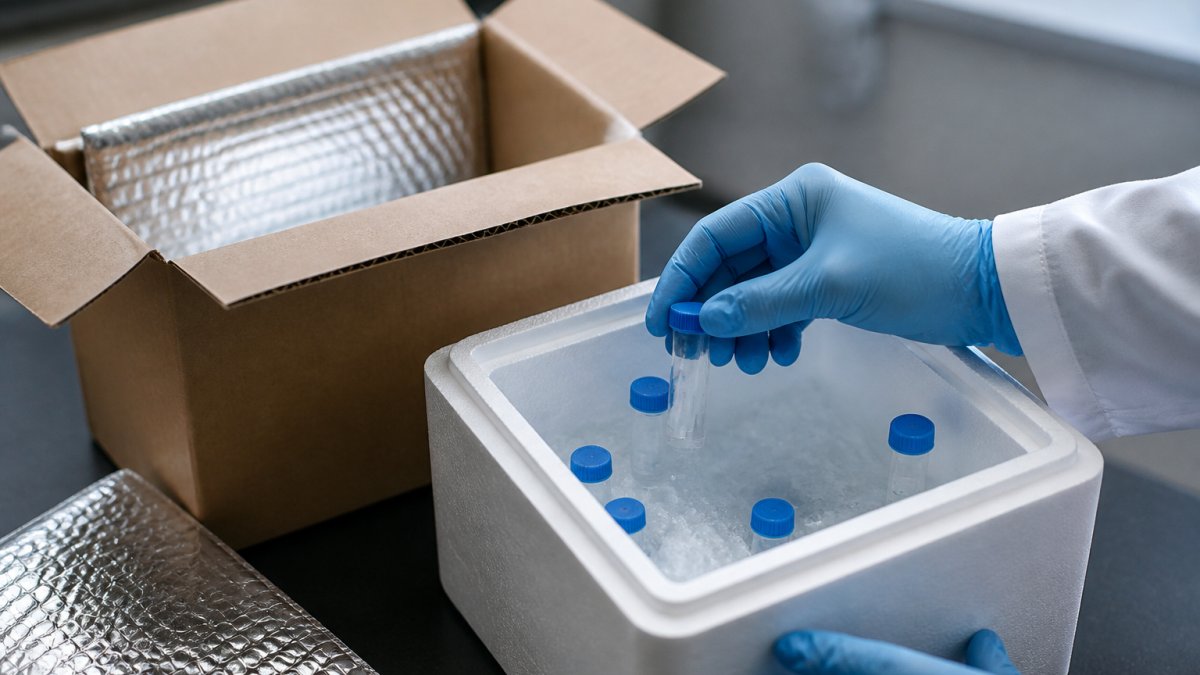
Before a recurring order, ask the supplier three questions: what temperature range is maintained in transit, what evidence of that range ships in the package, and what the replacement policy is for an excursion lot. Bluegrass Research ships with no external branding.
Retail Controls and Chain of Custody for Compound Integrity
Chain of custody is the documented record of who handled a compound and when. In a retail-facing operation it runs from supplier to bench, and every handoff, receiving, put-away, picking, dispensing, return, final transfer, needs a name, a date, and a condition check. The gap most guides leave open is the retail middle: the steps between dock and lab that no one documents because they feel routine.
The Retail Handoff Map
Map every point where a vial changes hands or changes location, then assign a control to each one:
| Handoff | Control | Record produced |
|---|---|---|
| Carrier to receiving | Package condition and logger check | Receiving log entry |
| Receiving to storage | Lot-to-COA match, temperature check | Inventory record |
| Storage to picking | Access control, pick confirmation | Pick ticket |
| Picking to dispensing or fulfillment | Second-person verification for controlled items | Dispensing record |
| Fulfillment to researcher | Sealed packaging, no external branding | Shipment record |
| Researcher to bench | Receipt confirmation and condition check | Bench log entry |
| Any return | Quarantine, condition assessment, disposition decision | Return authorization |
If a step is not on this map, it is not in the chain of custody, and a reviewer will treat it as an unaccounted gap.
Access Controls and Segregation of Duties
Access controls on storage areas are the baseline; the stronger control is segregation of duties. The person who picks a lot should not be the only one who verifies it, and the person who logs an excursion should not be the only one who decides whether the lot is usable. In small operations this is impractical for every transaction, so apply it selectively, always for new lots, lots with an excursion, and returns.
Returns, Recalls, and Deviations
Returns are the weakest link in most retail compound operations: a returned vial has unknown temperature and handling histories. Treat every return as quarantined until proven otherwise:
- Do not return the vial to general inventory on receipt.
- Record the return authorization number, the reason for return, and the condition of the packaging.
- If the compound is temperature-sensitive and no logger data is available, the default disposition is destruction, not restocking.
- Document the disposition decision and the name of the person who made it.
A deviation is any departure from procedure, a missed temperature check, a lot number mismatch, an unlogged handoff. Every deviation needs a documented corrective and preventive action (CAPA): what happened, why, what changed, and how the change will be verified. The CAPA need not be long, but it must exist, be dated, and be signed.
KPIs and Response Thresholds
Retail-facing teams get more value from a small set of tracked measures than a long list. These five cover most of the risk:
| KPI | What it detects | Suggested response threshold |
|---|---|---|
| Excursion rate | Cold-chain or storage failure | Any single excursion triggers quarantine; a rising monthly rate triggers a supplier review |
| Inventory discrepancy rate | Theft, mis-pick, or unlogged handoff | Any discrepancy above zero triggers a same-day reconciliation |
| Rejected lot rate | Supplier quality drift | A rising rate triggers a supplier qualification review |
| Traceability completeness | Missing records at any handoff | Any missing field on a receipt or handoff record is a deviation |
| Time to investigate deviations | Delayed response to a known problem | Set an internal target and track against it |
These thresholds are starting points, not standards. Set them in writing, review them at least annually, and adjust when the data shows they are too loose or too tight.
What a Reviewer Will Ask For
If a study result is challenged, the reviewer will ask four questions: where did this lot come from, who handled it, what were the storage conditions, and what happened when something went wrong. An operation that can answer all four in writing, with dates, names, and lot numbers, has a defensible chain of custody. One that cannot has a result that will not survive scrutiny, however good the analytical data looks.
Conclusion
The hard part of compound integrity is not the science. It is the discipline of checking every lot, logging every handoff, and refusing a generic COA, the discipline that makes a result stand up to scrutiny.
Bluegrass Research supplies research-grade peptides with lot-specific COAs, third-party analytical testing, and discreet shipping with no external branding. Every order comes with the transparent verification records your lab needs. Shop Now
Frequently Asked Questions
How can researchers verify a peptide certificate of analysis?
Start by confirming the COA is lot-specific, not a generic document reused across batches. Check that it names the testing laboratory, the analytical methods used (HPLC and mass spectrometry at minimum), the purity percentage, and the date of analysis. Then verify the testing lab exists and is independent of the supplier. A legitimate COA will include a unique lot number that matches the vial label. If any of these elements are missing, treat the document as unverified.
What should a lot-specific certificate of analysis include?
A lot-specific COA should list the compound name, lot number, molecular weight, purity percentage from HPLC, identity confirmation from mass spectrometry, the testing laboratory's name and contact information, and the analysis date. It should also state the storage recommendation and retest date. The lot number on the COA must match the lot number on the vial you receive. Without that match, the document does not prove anything about your specific material.
How should research peptides be stored to preserve compound integrity?
Lyophilized peptides should be stored at -20°C or lower, protected from light and moisture. Once reconstituted, most peptides require refrigeration at 2-8°C and should be used within a defined window, often 2-4 weeks depending on the compound. Avoid repeated freeze-thaw cycles, which degrade the peptide. Use sterile technique when aliquoting, and label every vial with the lot number, reconstitution date, and concentration. A logged storage system with temperature monitoring gives you documentation if results are ever questioned.
What analytical tests can help confirm peptide identity and purity?
High-performance liquid chromatography (HPLC) separates the peptide from impurities and gives a purity percentage. Mass spectrometry confirms molecular weight, which verifies identity. Some labs also use amino acid analysis or peptide mapping for additional confirmation. For research-grade material, a COA showing both HPLC purity above 95% and a mass spectrometry result matching the expected molecular weight is the standard. Third-party testing adds independence, meaning the supplier did not grade their own material.
What are common causes of compound integrity failure in retail distribution?
Temperature excursions during shipping, prolonged exposure to light, and moisture ingress are the most frequent causes. Poor chain of custody documentation also creates integrity gaps, because you cannot prove the material was handled correctly. In retail settings, improper storage at the point of sale, such as room-temperature shelving for compounds that require cold storage, is a recurring problem. Each of these failures is preventable with temperature-controlled shipping, opaque packaging, desiccant use, and logged handling records.