 blog
American Peptides vs KyloPeptides: 2026 Comparison
Table of Contents
- American Peptides vs KyloPeptides: What This Comparison Covers
- Side-by-Side Peptides Comparison Table
- Company and Catalog Overviews: American Peptides vs KyloPeptides
- How to Verify a Peptide Supplier Before You Order
- Reading a Peptide Certificate of Analysis: Purity, Identity, and Safety
- Third-Party Testing for Research Peptides: What Counts as Proof
- Research Peptide Shipping and Storage: What Each Supplier Disclosures
- Pricing, Total Cost, and Research-Use-Only Context
- Frequently Asked Questions
Last Updated: October 17, 2026
American Peptides vs KyloPeptides: What This Comparison Covers
A peptides comparison between American Peptides and KyloPeptides comes down to documentation, not marketing copy. Buyers researching either vendor want the same thing: proof that the compound in the vial matches the label, and a paper trail they can defend in a lab notebook.
Below, we break down catalog breadth, certificate of analysis (COA) practices, third-party testing claims, shipping and storage disclosures, and total cost. We also flag what we could and could not verify. That distinction matters more than any single spec sheet.
Side-by-Side Peptides Comparison Table
A comparison table is only useful if each cell tells you how the claim was checked. The table below scores both suppliers against the criteria laboratory buyers actually audit, and it states the evidence basis for every entry. Where public documentation was insufficient to verify a claim, the cell says so rather than repeating the vendor's marketing language.
| Criterion | American Peptides | KyloPeptides | How This Was Checked |
|---|---|---|---|
| Catalog breadth | Broad research peptide catalog spanning common research compounds | Research peptide catalog; full size not publicly enumerated | Product pages reviewed at time of writing; no independent inventory audit |
| COA availability | Published per product; lot matching to a specific vial not confirmed | Published per product; lot matching to a specific vial not confirmed | Sample COAs requested and reviewed for lot number, lab name, and method |
| Third-party testing | Claimed; testing laboratory not named in public materials | Claimed; testing laboratory not named in public materials | Checked whether an accredited lab and report date are disclosed |
| Identity testing method | Not specified in public COAs reviewed | Not specified in public COAs reviewed | Looked for mass spectrometry alongside HPLC purity |
| Research-use-only labeling | Stated on product pages | Stated on product pages | Verified disclaimer appears at point of sale |
| Shipping disclosures | Standard domestic fulfillment; transit temperature protocol not published | Standard domestic fulfillment; transit temperature protocol not published | Reviewed shipping pages and checkout disclosures |
| Pricing transparency | Per-compound pricing; no complete public price list | Per-compound pricing; no complete public price list | Attempted like-for-like quote for equivalent compound and quantity |
| Returns and issue resolution | Policy not prominently published | Policy not prominently published | Searched site and reviews for documented resolution process |
Two patterns stand out. First, both vendors publish COAs at the product level, but neither clearly ties a COA to the specific lot number printed on the vial you receive, the single most important link in the documentation chain. Second, neither publishes a named, accredited testing laboratory alongside its reports, which means the "third-party tested" claim cannot be independently traced from public materials alone. Those two gaps are where a buyer's due diligence should concentrate.
Company and Catalog Overviews: American Peptides vs KyloPeptides
Both companies position themselves as suppliers of research-grade peptides for laboratory research. Neither publishes a full, verifiable testing archive that we could confirm.
American Peptides at a Glance
American Peptides carries a broad catalog of research peptides aimed at laboratory buyers. The company states that materials are for research use only and ships domestically. What most guides miss is the gap between "we provide a COA" and "we provide a lot-matched COA tied to your specific vial." The first is a marketing claim; the second is a document you can audit.
KyloPeptides at a Glance
KyloPeptides follows a similar model: research-grade peptides, research-use-only disclaimers, and COAs available on request or by product page. Catalog breadth and fulfillment details are less clearly documented publicly. A common mistake buyers make is treating two suppliers with near-identical websites as interchangeable. They are not, and the difference lives in the paperwork.
How to Verify a Peptide Supplier Before You Order
Verification starts before checkout, not after your compounds arrive. Ask for four things: a lot number on the vial, a COA that matches that lot, the name of the independent laboratory that ran the test, and confirmation that the lab holds accreditation such as ISO/IEC 17025. If a supplier can't produce all four, treat the purity claim as unverified.
A practical checklist for evaluating any vendor:
- Request a sample COA and confirm the lot number matches the product listing
- Check whether the testing lab is named and independently accredited
- Confirm the COA reports identity testing, not just purity percentage
- Verify the research-use-only labeling is explicit on the product page
Reading a Peptide Certificate of Analysis: Purity, Identity, and Safety
A peptide certificate of analysis is a lot-specific document reporting what analytical testing found in a batch: purity percentage, identity confirmation, and the methods used to establish both.
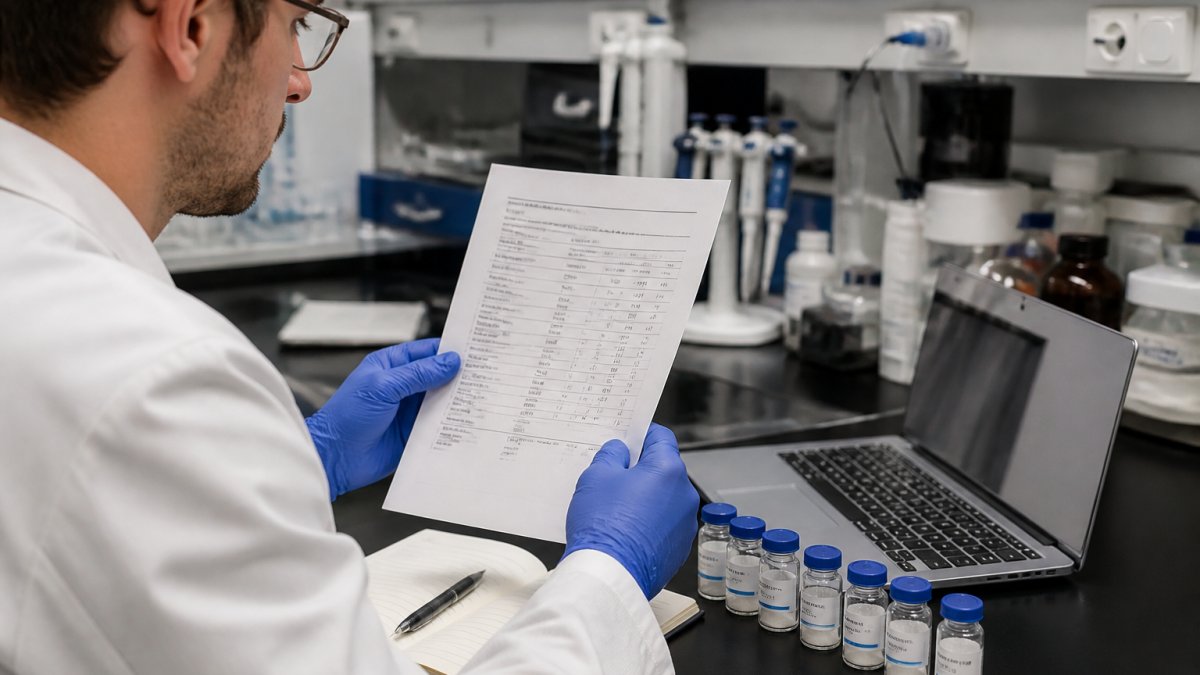
Purity tells you what fraction of the sample is the target compound. Identity tells you the compound is actually what the label says.
Look for the testing methodology section. High-performance liquid chromatography (HPLC) is standard for purity; mass spectrometry confirms identity.
Third-Party Testing for Research Peptides: What Counts as Proof
Third-party testing for research peptides only counts as proof when you can trace the result to an independent, accredited lab and a specific batch. The FDA's guidance on laboratory accreditation and testing standards and frameworks like ISO/IEC 17025 accreditation criteria give you the vocabulary to press suppliers on what their testing actually covers.
Ask three questions. Who ran the test? Is that lab accredited, and for what methods? Can the result be tied to my lot number? A vendor that answers all three in writing is doing more than most. One that answers with a generic PDF is not.
Bluegrass Research provides lot-specific, third-party analytical documentation, ensuring the verification record travels with the material.
Research Peptide Shipping and Storage: What Each Supplier Disclosures
Shipping and storage disclosures tell you how seriously a supplier treats compound integrity after the sale. Lyophilization, the freeze-drying process most research peptides undergo, produces a stable powder, but stability still depends on temperature control and packaging during transit.
What to ask before you order:
- Does the supplier disclose packaging and temperature control during shipping?
- Is the shipment discreet, and does it meet institutional receiving requirements?
- Are storage recommendations included with the compound?
For university labs with procurement and compliance checks, discreet, unbranded packaging is often a requirement rather than a preference. Bluegrass Research ships with no external branding and includes professional storage guidance.
Pricing, Total Cost, and Research-Use-Only Context
Most supplier comparisons either skip pricing or quote a single headline number that hides shipping, minimums, and documentation costs. Neither approach helps a lab buyer. What follows is a dated, like-for-like total-cost method you can run yourself, plus the research-use-only context that shapes how the numbers should be read.
A Like-for-Like Total-Cost Method
Pricing for research peptides is not a single number. It is the sum of several line items, and comparing vendors on the sticker price alone routinely produces the wrong answer. Build the comparison on the same compound, the same quantity, and the same order date:
- Compound and quantity. Pick one compound both suppliers list and price the identical vial size. A 5 mg vial and a 10 mg vial are not comparable even if the per-vial price looks similar.
- Unit price. Record the listed price for that exact compound and quantity, in USD, on the date you check.
- Shipping charge. Add the actual shipping cost to your ZIP code, not a promotional "free shipping" threshold you may not meet.
- Minimum order and handling fees. Note any order minimum or handling surcharge that changes the effective per-vial cost.
- Documentation value. Assign a cost to missing documentation. If a COA is not lot-matched or the testing lab is unnamed, the vial carries verification risk that a cheaper price does not offset.
- Payment and return terms. Record accepted payment methods and the published return or replacement policy, since an unresolved order is a total-cost event.
Run this method on two or three compounds rather than one, because per-vial pricing and shipping thresholds can shift the ranking depending on order size. A supplier that looks cheaper on a single vial may lose on a multi-vial order once shipping and minimums are applied, and vice versa.
Why We Do Not Publish Invented Price Tables
A price table that is not tied to a specific compound, quantity, and date is fiction dressed as data. Because neither supplier publishes a complete, current public price list that can be verified line by line, the responsible approach is to give you the method and let you populate it with live quotes. That is a deliberate choice, not a gap: a comparison that invents numbers to look thorough is worse than one that shows you how to generate real ones.
Research-Use-Only Context and What It Means for Cost
Materials labeled for laboratory research are not for human or veterinary use. The NIH's guidance on research materials and laboratory standards reflects how seriously documentation is treated in funded research, and institutional procurement offices increasingly ask for lot-matched COAs as a condition of purchase.
That has a direct cost implication. A vial with an unverifiable COA may be cheaper at checkout but can cost far more in the long run if your results are questioned and you cannot produce a document tying the material to an accredited test.
Frequently Asked Questions
How can you tell if a peptide supplier is legitimate?
Start with documentation, not marketing. A legitimate supplier publishes batch-specific certificates of analysis that list a lot number, purity percentage from analytical testing, identity confirmation, and the independent laboratory that ran the tests. Ask whether the COA matches the exact lot you receive, not a generic sample. Check that the supplier states research-use-only status clearly and discloses storage and shipping conditions. If a vendor cannot produce a lot-matched COA on request, treat that as a serious warning sign in any peptides comparison.
What should a peptide certificate of analysis include for research use?
A useful peptide certificate of analysis ties the results to one specific lot. Look for the lot number, the test date, the analytical methods used (such as HPLC for purity and mass spectrometry for identity), the reported purity percentage, and the name of the testing laboratory. It should also state storage recommendations and the research-use-only disclaimer. A COA without a lot number, or one that never changes between orders, tells you little about the vial in your hand.
How do you verify third-party testing for research peptides?
Ask for the testing laboratory's name and check whether it operates independently of the supplier. Look for accreditation such as ISO/IEC 17025, which indicates a lab meets recognized quality standards for its methods. Compare the COA's lot number with the label on your vial. Where possible, request a fresh test or confirm the documentation date falls within the batch's production window. Suppliers that answer these questions directly and quickly are usually the ones with nothing to hide.
Are American Peptides and KyloPeptides intended for human use?
Research peptide suppliers, including American Peptides and KyloPeptides, generally label their products as research-use-only materials. That means the compounds are sold for laboratory research and are not approved for human consumption, diagnostic use, or therapeutic applications. Researchers should confirm the research-use-only statement on each product page and COA before ordering, and follow their institution's procurement and compliance rules. If a supplier's labeling is vague on this point, ask for written clarification before you buy.
Choosing between peptide suppliers is really a question of how much verification you can prove. If your research demands documentation you can defend, Bluegrass Research supplies research-grade materials with lot-specific COA records, third-party analytical testing, and discreet shipping with no external branding. Get started with Bluegrass Research and give your lab a verification trail that holds up.