 blog
American Peptides vs Kylo Peptides: 2026 Lab Comparison
Table of Contents
- American Peptides vs Kylo Peptides: What Researchers Need to Compare in 2026
- Side-by-Side Comparison: Documentation, Testing, and Transparency
- How to Verify Peptide Purity Before You Order
- What Separates the Best Research Grade Peptide Suppliers
- Cost-Per-Milligram and Stability: The Angles Most Comparisons Skip
- Shipping Integrity and Storage Protocols for Lyophilized Peptides
- Pros and Cons: American Peptides vs Kylo Peptides vs a Research-First Alternative
- Frequently Asked Questions
Last Updated: September 10, 2026
American Peptides vs Kylo Peptides: What Researchers Need to Compare in 2026
American Peptides vs Kylo Peptides is not a contest between two brand names. It is a test of which supplier can hand you documentation that survives scrutiny. At Bluegrass Research, we hear the same question from lab managers every week: how do you know the vial matches the COA? Below, we break down the verification gap, show you how to read analytical data yourself, and cover the angles most comparisons skip entirely.
Here is the uncomfortable truth. Most supplier comparisons rank vendors on catalog size and marketing polish. Almost none ask whether the certificate of analysis is lot-matched, whether the peptide sequence was confirmed by mass spectrometry, or whether the vial was tested by a lab the supplier does not own. Those three questions decide whether your results are defensible.
Why the Verification Gap Matters More Than Brand Names
Brand recognition is a poor proxy for analytical rigor. A supplier with a polished storefront can still ship vials backed by a single batch test run months earlier, while a quieter vendor may document every lot independently. The verification gap is the distance between what a label claims and what third-party testing actually confirms.
That gap shows up in three places:
- Purity figures quoted from an old batch rather than your lot
- Molecular weight listed without a matching mass spectrometry trace
- No contaminant screening beyond a standard purity percentage
Closing it starts with demanding lot-specific documentation, not brand reputation.
Side-by-Side Comparison: Documentation, Testing, and Transparency
The table below summarizes what to check before you commit to any supplier, including how a research-first vendor should stack up.
| What to Check | Weak Signal | Strong Signal |
|---|---|---|
| COA scope | Generic, batch-level | Lot-matched to your vial |
| Testing lab | Supplier's own facility | Independent third party |
| Identity confirmation | Purity % only | HPLC plus mass spectrometry |
| Contaminant screening | Not reported | Documented per lot |
| Shipping | Standard mail | Temperature-controlled, discreet |
A supplier that clears every row on the right is rare. When you find one, the documentation does more work than any brand name ever could.
How to Verify Peptide Purity Before You Order
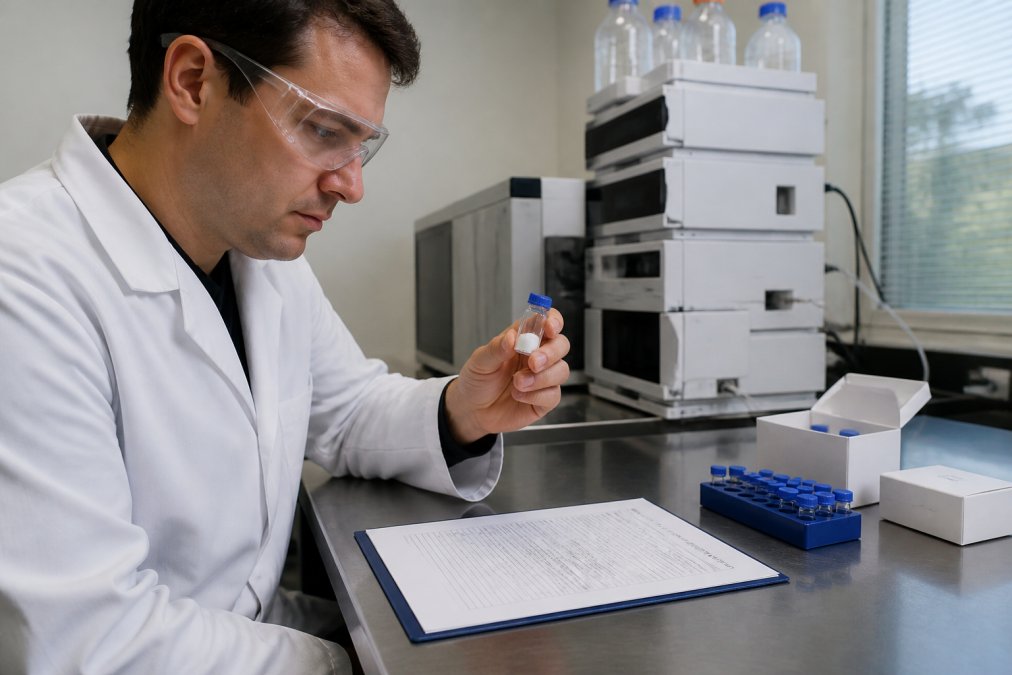
Verifying peptide purity means matching three documents to one physical vial: the lot number, the HPLC trace, and the mass spectrometry result. If any of the three is missing or mismatched, you cannot confirm what you received. This is the single most useful skill in supplier evaluation, and most buyers never learn it.
Reading HPLC and Mass Spectrometry Data
HPLC (high-performance liquid chromatography) separates the components in a sample and reports purity as the area under the main peak. A clean trace shows one dominant peak with minimal shoulders. Mass spectrometry confirms molecular weight, which verifies the peptide sequence is what the label claims. Purity without identity confirmation is only half a verification.
Lot-Matched COAs and What They Should Contain
A lot-matched COA should list the lot number, test date, method used, purity percentage, molecular weight, and the name of the independent lab that ran the analysis. If the lot number on the certificate does not match the vial, treat the document as decorative.
What Separates the Best Research Grade Peptide Suppliers
The best research grade peptide suppliers share one habit: they publish verification records a stranger can audit. Research-grade quality assurance is not a marketing tier, it is a documented process. Look for independent testing, batch-level traceability, and supply chain transparency that names the testing laboratory.
Three traits separate the strong from the weak:
- Independent analytical testing on every lot
- Full molecular weight and sequence documentation
- Contaminant screening reported alongside purity
Suppliers who meet all three tend to cost more, and the premium buys defensibility, not prestige.
Cost-Per-Milligram and Stability: The Angles Most Comparisons Skip
Comparative cost-per-milligram analysis is where most comparisons quietly fail. A lower sticker price often reflects a smaller vial, a lower purity grade, or a batch that has been sitting in storage. Divide total cost by milligrams of verified compound, and the cheap option frequently stops looking cheap.
How to Run the Math Yourself
The formula is simple, but the inputs are where buyers go wrong:
- Verified milligrams, not labeled milligrams. If a 5 mg vial tests at 92% purity, you have roughly 4.6 mg of target compound. A 5 mg vial at 98% gives you about 4.9 mg. That 6% difference compounds across a full research program.
- Cost per verified milligram = total cost ÷ (labeled mg × purity %). Run this on every quote before you compare sticker prices.
- Add shipping and cold-chain cost. A cheaper vial that ships warm and arrives degraded costs you the full price plus the experiment.
A common pattern: a supplier lists a 10 mg vial at a lower unit price than a competitor's 5 mg vial, but the 10 mg vial is a lower purity grade with a generic COA. Once you divide by verified milligrams, the "cheaper" option is often 20-40% more expensive per usable milligram. Most practitioners find the gap widens further when you factor in failed runs caused by degraded material.
Why Stability Changes the Cost Equation
Stability is not a separate topic from cost, it is the second half of the same calculation. A peptide that degrades in storage is a peptide you paid for twice.
Lyophilized peptides degrade through three main pathways:
- Hydrolysis, residual moisture catalyzes backbone cleavage. Vials lyophilized to low residual moisture (typically under 1%) resist this far better than poorly dried batches.
- Oxidation, methionine, cysteine, and tryptophan residues are vulnerable. Exposure to oxygen and light accelerates it.
- Aggregation, repeated freeze-thaw cycles and temperature swings promote misfolding, which can render a compound unusable even when the purity figure on the COA still looks acceptable.
Synthesis method matters here. Solid-phase peptide synthesis (SPPS) with proper cleavage and purification tends to yield a more stable lyophilized cake than crude or under-purified batches. A supplier that documents residual moisture, counter-ion content (typically trifluoroacetate, or TFA), and salt form is giving you the inputs you need to predict shelf life, not just a purity percentage.
FDA guidance on drug quality and analytical testing standards
What to Ask Before You Compare Prices
- What is the verified purity for this specific lot, not the catalog average?
- What is the residual moisture and salt form?
- How was the compound synthesized and purified?
- What storage temperature does the COA specify, and how long is the material stable at that temperature?
A vial that arrives degraded costs you the full price plus the experiment. When you run the cost-per-verified-milligram math and factor in stability, the cheapest sticker price is rarely the cheapest research decision.
Shipping Integrity and Storage Protocols for Lyophilized Peptides
Shipping integrity is the variable most buyers ignore until a shipment arrives warm. Lyophilized peptides are stable in transit only when temperature and handling are controlled. Ask how the supplier packs, whether cold packs are used, and how transit time is managed.
What Actually Happens to a Vial in Transit
Lyophilized (freeze-dried) peptides are not indestructible. The low residual moisture that makes them shelf-stable also makes them hygroscopic, they pull moisture from the air. A vial that sits in a hot mail truck or a humid warehouse can absorb enough atmospheric water to trigger the same hydrolysis pathways that degrade reconstituted peptide, only slower and less visibly.
The damage is often invisible. A vial can arrive with an intact cake, a clean label, and a COA that still reads 98% purity, and still have lost a meaningful fraction of its activity to moisture uptake and temperature cycling. This is why shipping integrity is a documentation question, not just a packaging question.
Cold-Chain vs. Ambient Shipping
Not every lyophilized peptide needs dry ice, but the decision should be deliberate:
- Ambient shipping is acceptable for short transit times (typically 2-3 days) in moderate climates, provided the vial is sealed with a desiccant and protected from light.
- Cold packs extend the safe window and are appropriate when transit crosses warm regions or exceeds a few days.
- Dry ice is generally reserved for reconstituted or especially labile compounds, not standard lyophilized vials.
A supplier that ships everything ambient regardless of season or destination is optimizing for cost, not integrity. A supplier that ships everything on dry ice is often over-packaging to mask a lack of stability data. The right answer depends on the compound, the route, and the season, and a transparent supplier will tell you which they use and why.
Storage Protocols Once the Vial Reaches Your Bench
Storage protocols matter just as much once the vial reaches your bench:
- Store lyophilized vials at the temperature the COA specifies. Most lyophilized peptides are stable at -20°C; some are stable at 2-8°C for shorter periods. Follow the COA, not a generic rule of thumb.
- Avoid repeated freeze-thaw cycles by aliquoting before reconstitution. Every temperature swing is a stress event. Aliquot once, then leave aliquots undisturbed.
- Keep vials protected from light. Amber vials or foil wrapping reduce oxidation of light-sensitive residues.
- Control humidity during handling. Work quickly, reseal vials with desiccant, and avoid leaving the cake exposed to room air.
- Log storage conditions alongside your lot numbers. Temperature excursions, opening dates, and reconstitution dates belong in the same record as the COA. If your results are ever questioned, that log is your defense.
NIH research on peptide stability and storage conditions
The Procurement Angle
For labs with institutional purchasing requirements, discreet unbranded shipping also matters. Packaging that does not advertise contents clears procurement and compliance checks more smoothly. Ask the supplier to confirm, in writing, that outer packaging carries no compound names, no vendor branding, and no customs descriptors that identify the material.
Shipping and storage are not afterthoughts. They are the last mile of the verification chain, and the point where a well-documented vial either holds its integrity or quietly loses it.
Pros and Cons: American Peptides vs Kylo Peptides vs a Research-First Alternative
Judging American Peptides vs Kylo Peptides purely on brand reputation misses the point. What matters is documentation depth, testing independence, and shipping reliability. Here is how the categories compare.
American Peptides
- Pros: Established catalog, recognizable name in research circles
- Cons: Documentation depth varies by lot, verify each COA individually
Kylo Peptides
- Pros: Broad product listing, accessible ordering
- Cons: Confirm whether testing is independent before committing
Bluegrass Research (research-first alternative)
- Pros: Lot-specific COA documentation, third-party analytical testing, discreet US shipping with no external branding, transparent verification records, and professional storage solutions
USP standards for pharmaceutical analysis and reference materials
For labs that need defensible documentation, the trade-off favors verification over speed.
Frequently Asked Questions
How do American Peptides and Kylo Peptides compare in terms of purity?
Purity comparisons hinge on whether each supplier provides lot-matched COAs from independent labs. A certificate listing only a generic purity percentage, without a matching lot number, HPLC chromatogram, or mass spectrometry confirmation, cannot verify what is actually in the vial. Researchers should request the specific lot documentation before ordering from either supplier and check that the molecular weight and peptide sequence match the catalog listing.
Are American Peptides and Kylo Peptides verified by third-party labs?
Third-party validation means an independent analytical lab, not the supplier's own facility, ran the testing. Ask each supplier for the testing lab's name and the report date on the COA. If the documentation does not name an outside lab or the results cannot be tied to your specific lot, treat the purity claim as unverified. This is the single fastest way to separate research-grade suppliers from resellers.
What should researchers look for when comparing peptide suppliers?
Start with lot-matched COAs, independent HPLC and mass spectrometry results, and contaminant screening data. Then check supply chain transparency: where the compound was synthesized, how it was lyophilized, and how it ships. Storage stability matters too, since lyophilized peptides degrade with heat and moisture exposure. Finally, confirm the supplier provides safety documentation and can answer technical questions about molecular weight and peptide sequence.
Is it safe to purchase research-grade peptides online?
Research peptides are sold for laboratory use, not human consumption, and the regulatory landscape around them has tightened. Safety for your research depends on verified documentation: a lot-matched COA, independent purity verification, and contaminant screening. Suppliers that ship discreetly, control temperature during transit, and provide complete analytical records reduce the risk of receiving degraded or mislabeled material that could compromise your experimental results.
The challenge is simple: most suppliers cannot prove what is in the vial. Bluegrass Research was built to close that gap, supplying research-grade peptide materials with lot-specific COA documentation, third-party analytical testing, discreet US shipping with no external branding, and professional storage solutions. If your results need to survive scrutiny, get started with Bluegrass Research and order compounds backed by transparent verification records.