 how-to
How to Verify Peptide Sequence Integrity in Small Labs
Table of Contents
- Step 1: Define What You Are Verifying Before You Test
- Step 2: Peptide Sample Preparation for Analysis
- Step 3: HPLC Peptide Purity Testing in Your Lab
- Step 4: Peptide Identity Testing by Mass Spectrometry
- Step 5: How to Read a Peptide Certificate of Analysis
- Step 6: When to Send Samples for Third-Party Testing
- Common Mistakes That Undermine Peptide Sequence Integrity
- Frequently Asked Questions
Last Updated: October 6, 2026
Step 1: Define What You Are Verifying Before You Test
Peptide sequence integrity is the confirmation that a peptide's amino acids appear in the correct order, at the correct length, with no deletions or substitutions.
That assumption is where projects go wrong.
A peptide can be 98% pure and still be the wrong molecule. The FDA guidance on analytical procedures and methods validation makes this distinction clear: identity, strength, and purity are separate quality attributes, each needing its own evidence.
Identity, Purity, Sequence Integrity, and Structural Integrity Are Not the Same
These four terms get used interchangeably. They should not be.
- Identity answers: is this the right peptide?
- Purity answers: how much of the sample is that peptide?
- Sequence integrity answers: are the amino acids in the right order?
A peptide can pass identity and purity tests while failing sequence integrity. Truncated peptides and deletion sequences often co-elute with the target, hiding inside a "pure" result.
Step 2: Peptide Sample Preparation for Analysis
Peptide sample preparation for analysis decides whether your results mean anything. Poor prep creates artifacts that look like real findings.
Start with these steps:
- Work in a clean, dedicated area with no other peptides open.
- Use fresh, HPLC-grade solvents and clean glassware.
- Dissolve your sample fully before you inject it.
- Label every vial with lot, date, and concentration.
- Run a blank between samples to catch carryover.
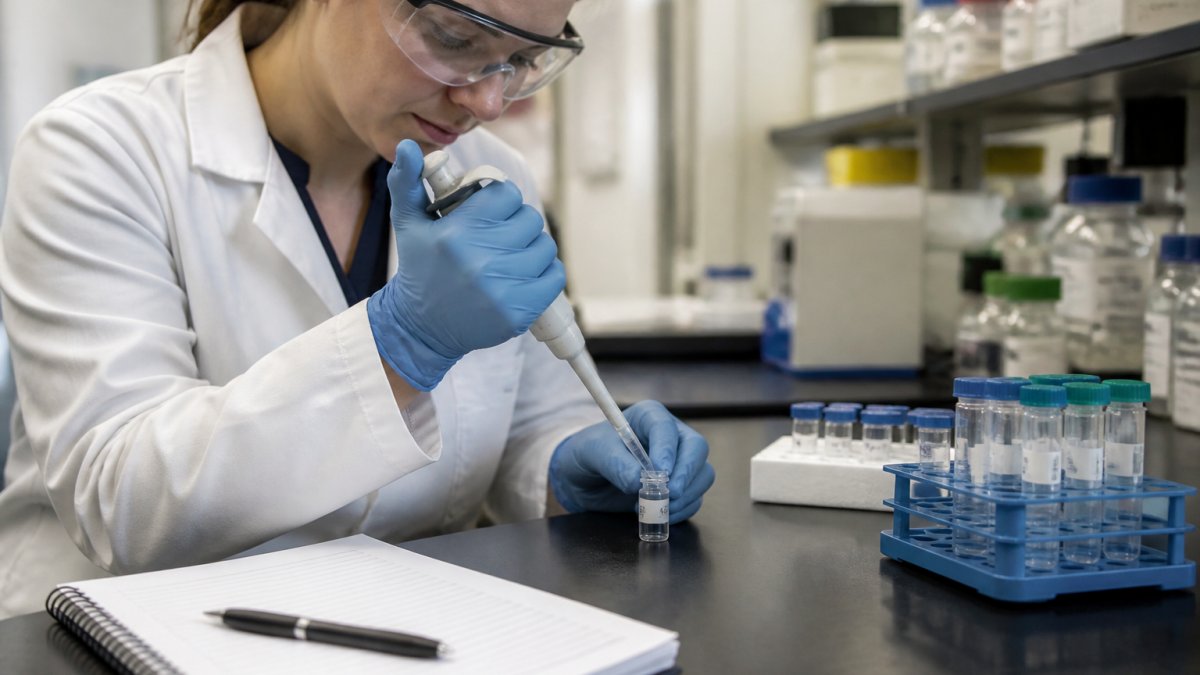
Contamination Control at the Bench
A common mistake is reusing tips or sharing solvent bottles across peptide lots. Trace amounts of one peptide carry into the next run, creating a false impurity peak.
Change tips between every sample, keep separate solvent bottles per project, and wipe the bench between lots to prevent false peaks.
Step 3: HPLC Peptide Purity Testing in Your Lab
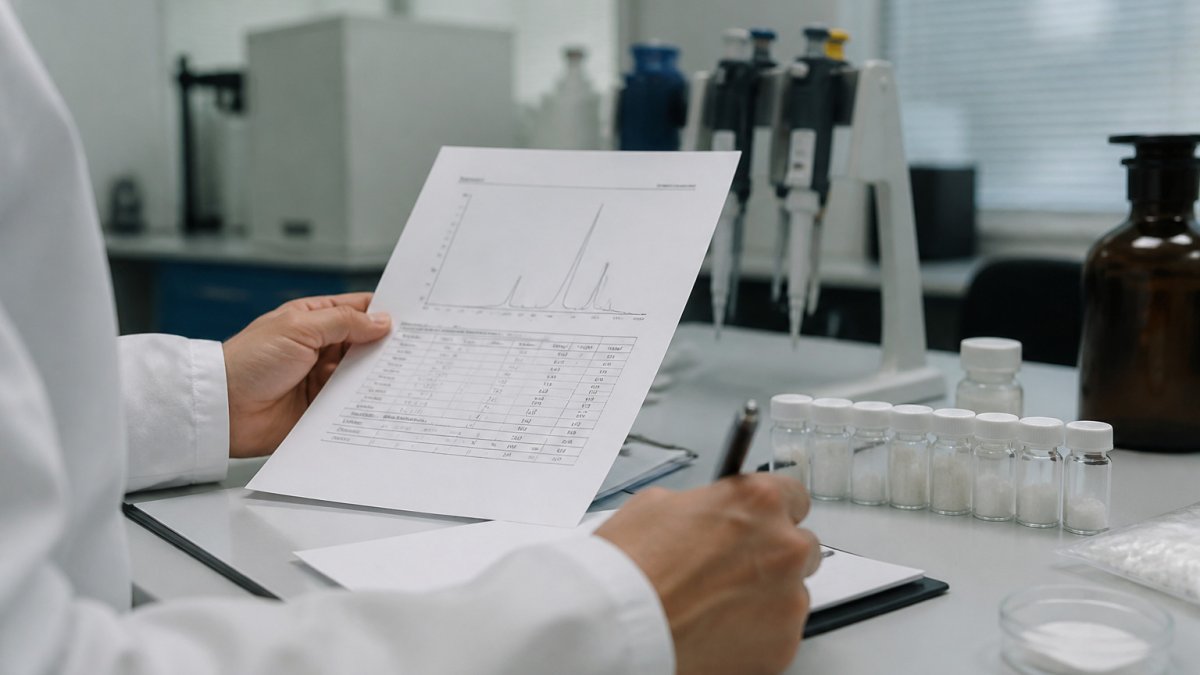
HPLC peptide purity testing separates your sample by how its components interact with a column, producing a chromatogram: a graph of peaks, each representing a component.
Reverse-phase HPLC is the standard for most peptides. It uses a nonpolar column and a water-and-acetonitrile gradient.
What to read in the result:
- Retention time shows when a peak elutes.
- Peak area shows how much of the sample that peak represents.
- Purity percentage is the main peak's area divided by the total.
Here is the catch. HPLC separates by chemistry, not by sequence. Two peptides with the same amino-acid makeup but different order can share a retention time.
According to USP general chapter guidance on chromatographic methods, a single method is rarely enough to confirm a peptide's full profile.
Step 4: Peptide Identity Testing by Mass Spectrometry
Peptide identity testing by mass spectrometry confirms the molecule's mass. It measures the mass-to-charge ratio of ionized peptides and is the only common bench technique that can catch a sequence-level error hiding inside a clean HPLC peak.
For a small peptide, an intact mass measurement gives you the molecular weight.
Tandem mass spectrometry goes further: it fragments the peptide and reads the fragment ions, revealing the order of amino acids, this is where sequence confirmation actually happens.
When Intact Mass Is Not Enough
Intact mass is a coarse filter, not a sequence proof. It answers one question: does the total mass match? Several failure modes slip past it.
- Isobaric substitutions. Leucine and isoleucine share the same mass. So do some other residue pairs. A swap between them changes the sequence but not the intact mass.
- Compensating errors. A deletion plus an insertion elsewhere can leave the total mass nearly unchanged while scrambling the order.
- Positional isomers. The same residues in a different order can produce an identical molecular formula and therefore an identical intact mass.
A common pattern in small labs is to run intact mass, see a match within a few daltons, and stop. That is where overclaiming begins. Intact mass confirms composition, not order.
Building an Orthogonal Verification Strategy
Orthogonal means the second method works on a different physical principle than the first. If two orthogonal methods agree, confidence rises sharply; if they disagree, you have found a real problem.
A practical escalation ladder for sequence-level confidence:
- Intact mass (LC-MS). Confirms molecular weight and flags gross errors. Fast, cheap, widely available.
- Tandem MS (MS/MS) with fragmentation. Confirms the order of residues by reading b- and y-ion series. This is the workhorse for sequence confirmation on peptides up to roughly 30-40 residues.
- Peptide mapping by enzymatic digestion. Digest with trypsin or another site-specific protease, separate the fragments by HPLC, and confirm each fragment by MS. This is the standard approach for larger peptides and small proteins where intact fragmentation is impractical.
- Amino-acid analysis (AAA). Hydrolyzes the peptide to free amino acids and quantifies composition. AAA confirms which residues are present and in what ratio, but it destroys sequence order, it is a composition check, not a sequence check.
Each rung adds evidence; none alone proves everything.
Reading Mass Error Against Acceptance Criteria
Mass accuracy is reported in parts per million (ppm):
ppm = (observed mass − theoretical mass) / theoretical mass × 1,000,000
A common working threshold for high-resolution MS is about 5 ppm for a confident match, with tighter tolerances (1-2 ppm) when the instrument and calibration support it. Lower-resolution instruments may only reach 50-100 ppm, enough to catch a missing residue, not enough to distinguish isobaric substitutions.
Practical guidance for reviewing a result:
- Calculate ppm error against the theoretical monoisotopic mass, not the average mass.
- Confirm the isotope envelope matches the expected charge state.
- Check that no adduct peaks (sodium, potassium, ammonium) are being mistaken for the molecular ion.
Troubleshooting Ambiguous MS Results
- Mass matches but you still doubt the sequence. Escalate to MS/MS or peptide mapping.
- Mass is off by roughly one residue's mass. Suspect a deletion or insertion. Recheck the theoretical mass calculation before assuming a synthesis error.
- Mass is off by a small, non-integer amount. Suspect a modification (oxidation, deamidation, acetylation) or a salt/adduct.
Mass spectrometry is your best tool for sequence-level errors: HPLC cannot see them, and MS often can, but only if you pick the right experiment for the question you are asking.
Step 5: How to Read a Peptide Certificate of Analysis
Learning how to read a peptide certificate of analysis takes ten minutes and saves months of wasted work. A Certificate of Analysis (COA) reports a lot's test results.
Check these items:
| Section | What to Look For |
|---|---|
| Lot number | Matches your vial exactly |
| Test method | Names HPLC, MS, or both |
| Purity result | States the percentage and method |
| Molecular weight | Matches the expected value |
| Sequence | Confirms the amino-acid order |
| Date | Recent and tied to your lot |
A generic COA with no lot number is a red flag. So is a purity number with no method listed. If the document does not say how a result was obtained, you cannot judge it.
Step 6: When to Send Samples for Third-Party Testing
Third-party testing is worth it when your in-house methods cannot answer the question. Small labs often lack tandem MS or amino-acid analysis equipment, and no small lab should pretend otherwise. The useful question is not "should I outsource?" but "which test, at which confidence level, can I run in-house versus send out?"
A Small-Lab Decision Framework
Work through these four inputs before you pick a test.
1. What confidence level does the work require?
- Routine reagent screening. Intact mass plus HPLC is usually enough. In-house is fine.
- Publishing or regulatory submission. Sequence-level confirmation is expected. Plan for MS/MS or peptide mapping, in-house or outsourced.
- Supplier qualification or dispute. Independent, orthogonal data is the point. Outsource.
2. What equipment do you actually have?
- HPLC with UV detection only: purity, not sequence.
- LC-MS with intact mass: composition, not order.
- LC-MS/MS with fragmentation: sequence confirmation for smaller peptides.
If your instrument list stops at the first or second line, sequence-level questions go out the door.
3. How much sample can you spare?
This is the constraint small labs underestimate.
4. What is your budget and turnaround tolerance?
Contract labs price by method and sample. Intact mass is the cheapest MS service; MS/MS and peptide mapping cost more for instrument time and analyst attention; amino-acid analysis sits in a similar range to mapping.
What to Send Out Versus What to Keep In-House
| Question | In-House Feasible? | Typical Outsourced Method |
|---|---|---|
| Is the sample pure? | Yes, with HPLC-UV | Rarely needed |
| Does the mass match? | Yes, with LC-MS | Intact mass if no MS on site |
| Are the residues in order? | Only with MS/MS | MS/MS or peptide mapping |
| Which residues are present, in what ratio? | No | Amino-acid analysis |
| Does an independent lab agree with the COA? | No | Full orthogonal panel |
Preparing a Sample for Shipment
Outsourcing fails more often at the shipping step than at the instrument.
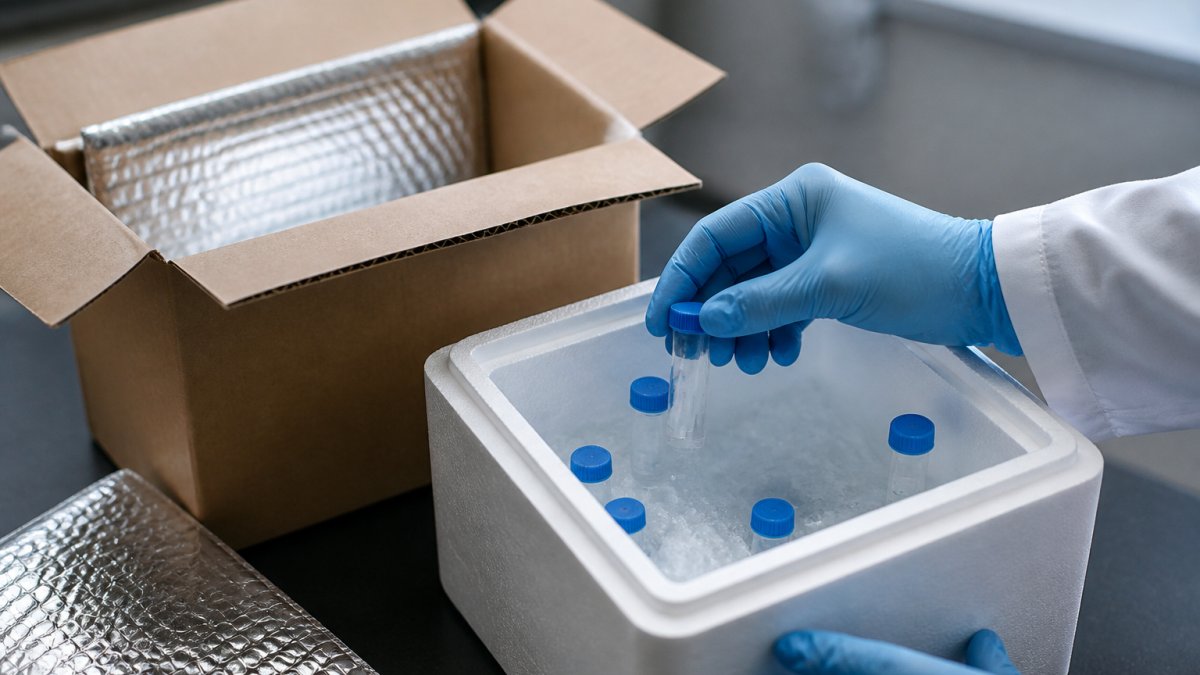
- Aliquot before you ship. Keep a retained portion in your freezer so you can repeat or dispute a result.
- Label each vial with lot, peptide name, concentration, solvent, and date.
- Use the lab's preferred sample format, dry powder, lyophilized, or solution, and confirm it in writing.
How to Read an Outsourced Report
When the report comes back, check what you would check on a supplier COA: method named, lot matched, raw data available on request, and a clear statement of what the method can and cannot establish.
Independent laboratory testing adds an orthogonal method. If HPLC and MS agree, your confidence rises sharply. If they disagree, you have learned something worth knowing before the experiment, not after.
Bluegrass Research supplies high-quality, research-grade peptide materials, meticulously verified through lot-specific, third-party analytical documentation for unparalleled transparency and trust. This verification trail travels with each order and supports the review and reproducibility steps that follow.
Common Mistakes That Undermine Peptide Sequence Integrity
The same errors show up again and again in small labs, each weakening confidence in the result.
- Trusting purity alone and skipping sequence confirmation.
- Using one method and calling it verified.
- Ignoring the blank run and carryover peaks.
A deletion sequence is the quietest failure. It often looks clean on HPLC and only appears when you check mass. If your peptide is one residue short, the intact mass will not match.
The fix is simple in principle: separate identity from purity, use orthogonal methods, and keep records at every step.
Frequently Asked Questions
Can HPLC confirm a peptide sequence?
No. HPLC separates compounds by hydrophobicity and tells you how pure a sample is, but it cannot confirm the order of amino acids. A peptide with a deletion or substitution can have the same retention time as the correct sequence. To verify peptide sequence integrity, you need mass spectrometry for molecular weight confirmation, and ideally tandem MS or peptide mapping for sequence-level errors. Use HPLC for purity and MS for identity, then combine both results for a complete picture.
What is the most accurate lab test for confirming peptide identity?
Mass spectrometry is the most accurate single method for confirming peptide identity because it measures the intact molecular weight and can detect mass shifts from sequence errors. For full sequence confirmation, tandem mass spectrometry (MS/MS) combined with enzymatic digestion provides fragment ion data that maps the amino acid order. No single test covers everything, so an orthogonal approach using HPLC for purity, MS for mass, and MS/MS for sequence gives the strongest verification.
What should a peptide certificate of analysis include?
A defensible COA should list the peptide sequence, molecular weight (theoretical and observed), HPLC purity percentage with the method used, mass spectrometry data, batch or lot number, and the date of analysis. It should also name the testing laboratory and include a chromatogram and mass spectrum. If a COA only shows a purity number without raw data or method details, treat it as incomplete. Lot-specific documentation tied to your actual sample is what makes results reproducible.
When should a small lab send a peptide sample to a third-party laboratory?
Send a sample out when your in-house HPLC or MS results disagree with the supplier COA, when you need sequence-level confirmation for publication or regulatory scrutiny, or when you lack the instrumentation for orthogonal verification. Small labs often outsource MS/MS and amino-acid analysis while running HPLC in-house. Budget for this on critical batches, especially for metabolic peptides like Semaglutide analogs where sequence errors can invalidate study results.
Verifying peptide sequence integrity takes the right methods, clean samples, and documentation you can defend. Bluegrass Research supports that work with lot-specific COA documentation, third-party analytical testing, and discreet shipping with no external branding, plus storage solutions that keep materials organized. Get started with Bluegrass Research and give every lot a verification trail you can stand behind.