 blog
Best American Peptides Alternatives 2026: A Research Guide
Table of Contents
- Why Researchers Are Looking for American Peptides Alternatives in 2026
- Research Peptide Supplier Comparison: What to Evaluate Before Switching
- How to Verify a Peptide Supplier: A Step-by-Step Checklist
- The Peptide Supplier Certificate of Analysis: What a Real COA Must Include
- Research Peptide Storage Requirements: Protecting Compound Integrity After Delivery
- Bluegrass Research as an American Peptides Alternative: Pros, Cons, and Pricing
- Common Mistakes When Evaluating American Peptides Alternatives
- Frequently Asked Questions
Last Updated: October 17, 2026
Why Researchers Are Looking for American Peptides Alternatives in 2026
Supply continuity is the quiet crisis in research procurement. Labs that built protocols around a single vendor are now auditing documentation, shipping reliability, and lot traceability before their next order.
The core tension is simple. Switching suppliers disrupts a supply chain your study depends on. Staying with a vendor whose documentation you cannot independently verify puts your results at risk. Neither option is comfortable, which is why a structured comparison beats a gut decision.
Below, we break down what to evaluate, how to verify a peptide supplier, and how Bluegrass Research compares as an alternative. FDA guidance on drug quality and research use
Research Peptide Supplier Comparison: What to Evaluate Before Switching
A research peptide supplier comparison should score documentation, pricing, and fulfillment on equal weight. Most buyers weight price first. That is backwards. A cheaper vial with a generic COA costs more in the long run when your results get scrutinized.
To make the comparison defensible, use a documented method rather than a gut ranking. The framework below is the one we apply when evaluating any supplier, including our own. State your review date, the products you checked, the evidence sources you used, and what you could not verify. A comparison without those four elements is an opinion, not an evaluation.
Documentation and Testing
Ask for lot-matched documentation, not a catalog-wide sample. A real certificate ties to the specific lot number on your vial. Third-party testing should come from an independent laboratory, and ISO/IEC 17025 accreditation is the standard to look for in an analytical lab. Purity percentage alone is not enough; identity testing and testing methodology matter just as much.
Score documentation on four questions: Is the COA lot-specific? Does the lot number match the vial label? Was testing performed by an independent lab? Does the report name the method and the sample identity? A supplier that answers all four in writing is ahead of most of the market.
Pricing and Total Cost
Total cost includes shipping, storage materials, and the time spent chasing documentation. A supplier that answers COA requests in hours is cheaper than one that takes days, even at a higher sticker price. We do not publish fixed pricing because it depends on compound, quantity, and delivery; current rates are listed on our site.
For a like-for-like comparison, price the same compound, the same quantity, and the same shipping tier across suppliers on the same date. Record the unit price, shipping charge, any discount applied, and whether the COA is included or sold separately.
Fulfillment, Support, and Issue Resolution
Fulfillment is more than transit time. Ask where the product ships from, whether tracking is provided, and how packaging protects the compound. Support matters too: response time on COA requests, a direct contact channel, and a written policy for failed batches or disputed results. A supplier that answers clearly in writing is telling you something about how they operate. One that deflects is telling you something too.
| Evaluation Area | What to Ask For | Red Flag |
|---|---|---|
| Documentation | Lot-specific COA, lot number on vial | Generic or undated COA |
| Testing | Independent lab, ISO/IEC 17025 | In-house testing only |
| Pricing | Same compound, quantity, and shipping tier priced on the same date | Unit price quoted without shipping or documentation terms |
| Fulfillment | US shipping, tracking, discreet packaging | Vague transit times |
| Support | Response time on COA requests | No direct contact |
| Issue resolution | Written policy for failed batches and disputes | Verbal assurances only |
Documented Methodology and Limitations
State the review date, the products checked, the evidence sources, and the scoring criteria. Note what you could not verify, for example, whether a published certificate matches the lot you would actually receive. That limitation is not a weakness in the comparison; it is the honest boundary of what any outside reviewer can confirm. Readers should be able to reproduce your comparison rather than rely on an unsupported ranking.
FDA guidance on drug quality and research use
How to Verify a Peptide Supplier: A Step-by-Step Checklist
Verification is a process, not a single check. Work through this checklist before you commit a budget line to any vendor:
- Request the COA for the exact lot you will receive, not a sample
- Confirm the lot number on the COA matches the vial label
- Check that testing was performed by an independent laboratory
- Confirm the lab's ISO/IEC 17025 status where claimed
- Review purity and identity results separately, not as one number
- Ask how the supplier handles a failed batch or a disputed result
- Test shipping: order a small quantity and inspect on arrival
- Confirm return and issue-resolution terms in writing
A common mistake is accepting a COA that lists a different lot than the one shipped. In practice, this is the single most common documentation gap we see researchers flag. NIST quality standards for reference materials
The Peptide Supplier Certificate of Analysis: What a Real COA Must Include
A peptide supplier certificate of analysis is a lot-specific document reporting the analytical results for one batch. It is not a marketing sheet.
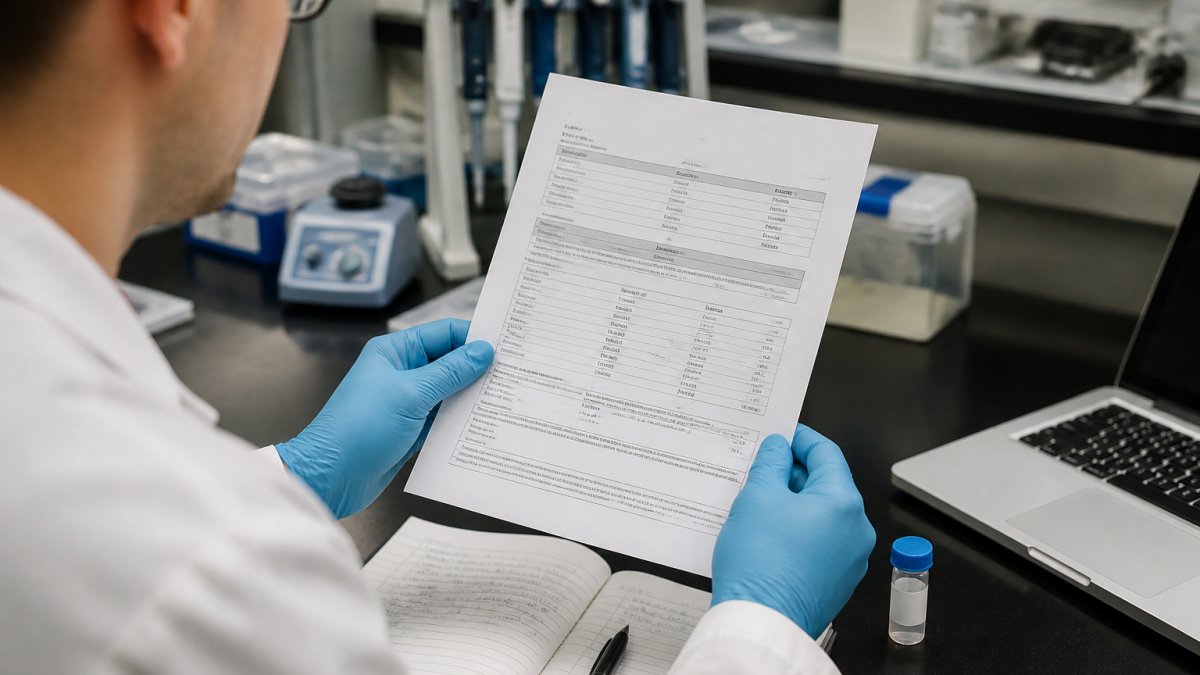
Watch for COAs that report purity without naming the method, or that omit identity testing entirely. Purity tells you how much of the sample is the target compound. Identity tells you the compound is what the label claims.
How to Verify a COA Instead of Trusting It
A published certificate is a claim, not proof. Verification means checking the document against independent evidence. Work through these steps for any COA you receive:
- Accreditation: If the lab claims ISO/IEC 17025, confirm the accreditation scope covers the test performed. Accreditation is lab- and method-specific, not a blanket status.
- Report date: Check that the report date is recent relative to the lot and that it precedes the shipment. An undated or stale report cannot be tied to the batch you received.
- Method: Confirm the analytical method is named, for example, high-performance liquid chromatography for purity and mass spectrometry for identity. A purity number without a method is not verifiable.
- Sample identity: Check that the sample described on the report matches the compound, lot, and quantity you ordered.
- Lot match: Compare the lot number on the COA to the lot number on the vial label. This is the single most common documentation gap researchers flag.
- Independence: Confirm the testing laboratory is separate from the supplier. In-house testing can be useful but is not independent verification.
What Analytical Results Can and Cannot Establish
Purity and identity results describe the sample that was tested. They do not establish safety, sterility, endotoxin levels, or suitability for human use. A high purity percentage is not a quality guarantee, and research-use-only status is a labeling and compliance category, not a purity signal. Keep the three questions separate: purity (how much of the sample is the target compound), identity (whether the compound is what the label claims), and safety (a separate question governed by handling requirements and research-use-only status).
NIST quality standards for reference materials
Research Peptide Storage Requirements: Protecting Compound Integrity After Delivery
Research peptide storage requirements depend on the compound, but the general rules are consistent. Most lyophilized peptides should be stored cold and dry, protected from light, and reconstituted only when needed. Degradation usually starts with moisture and temperature swings, not with time alone.
Document arrival condition the day your order lands. Photograph the packaging, check for temperature excursions, and log the lot number before storage. If a shipment arrives warm or damaged, raise it with the supplier immediately rather than after reconstitution.
Bluegrass Research as an American Peptides Alternative: Pros, Cons, and Pricing
Bluegrass Research is a research-grade peptide supplier built around lot-specific, third-party analytical documentation. Every compound ships with transparent verification records, and orders go out in discreet US packaging with no external branding. For labs that need documentation they can defend, that combination is the differentiator.
Pros
- Lot-specific COA documentation tied to each batch
- Third-party analytical testing from independent laboratories
- Discreet US shipping with no external branding
- Professional storage solutions to support their critical work
- Research-first philosophy with transparent verification records
Cons
- Pricing runs higher than budget suppliers, reflecting the testing and documentation overhead
- No published price list; you request current rates per compound and quantity
- Smaller catalog than mass-market vendors, so niche compounds may need a direct inquiry
On the pricing objection we hear often: the extra cost buys documentation you can hand to a reviewer. For a small lab ordering a few times a year, there are no minimum order requirements that we impose beyond standard order handling, and current pricing is available on request.
Common Mistakes When Evaluating American Peptides Alternatives
The biggest mistake is treating all COAs as equal. A generic certificate with no lot number is not documentation; it is decoration. The second is skipping a small test order before switching a full protocol, which turns a manageable risk into a supply disruption.
Researchers also overlook issue resolution. Ask directly: what happens if a batch fails testing or a shipment arrives compromised? A supplier that answers clearly in writing is telling you something about how they operate. One that deflects is telling you something too.
Finally, do not confuse research-use-only status with a quality signal. It is a labeling and compliance category, not proof of purity. Purity, identity, and safety are three separate checks, and a credible supplier documents all three.
Frequently Asked Questions
How can you tell whether a research peptide supplier is legitimate?
A legitimate supplier provides batch-specific documentation you can verify. Ask for a lot-matched certificate of analysis that lists a unique lot number, the testing laboratory, and the analytical methods used. Confirm the COA matches the lot number on the vial you receive. Check whether the supplier publishes purity and identity results rather than generic specifications. A supplier that cannot or will not provide lot-specific records is a risk, regardless of marketing claims.
What should researchers look for in a peptide supplier's certificate of analysis?
Look for the lot number, the date of testing, the name and location of the testing laboratory, and the specific methods used, such as HPLC for purity and mass spectrometry for identity. The COA should state a purity percentage and confirm the molecular weight matches the expected compound. Third-party testing through a laboratory independent of the supplier carries more weight than in-house results. A COA that lists only a generic purity figure without a lot number is not batch-specific documentation.
How do American Peptides alternatives compare on lot-specific testing?
The comparison hinges on documentation, not marketing. Ask each supplier whether testing is performed by an independent laboratory and whether the COA is tied to a specific lot number. Some suppliers provide only a general certificate covering a product line, which does not verify the vial you receive. Others provide lot-matched records with purity and identity results. Request a sample COA before ordering and confirm the lot number on arrival matches the documentation.
Are research peptides intended for human use?
No. Research-grade peptides are sold for laboratory research only and are not intended for human or veterinary use. They are not approved drugs, and suppliers label them accordingly. Researchers should follow institutional requirements for procurement, storage, and handling. This research-use-only status is a standard part of supplier documentation and should appear clearly on product labels and certificates of analysis.
Switching suppliers is a documentation decision before it is a price decision. If your current vendor cannot produce a lot-matched COA on request, the risk sits with your study, not theirs. Bluegrass Research supplies research-grade peptides with lot-specific COA documentation, third-party analytical testing, and discreet US shipping, so your verification records hold up when results are questioned. Get started with Bluegrass Research and order with documentation you can defend.