 blog
ProtideHealth vs PeptidesSource: Researcher's Guide
Table of Contents
- Why Researchers Compare ProtideHealth vs PeptidesSource
- ProtideHealth vs PeptidesSource at a Glance
- What a Research Peptide Certificate of Analysis Should Prove
- Third-Party Peptide Testing: What Independent Verification Means
- A Research Peptide Supplier Checklist for Vetting Vendors
- Peptide Supplier Shipping and Storage: What Arrives Matters
- Research-Use Compliance and Documentation Limits
- Bottom Line for Researchers Choosing Between the Two
- Frequently Asked Questions
Last Updated: October 18, 2026
Why Researchers Compare ProtideHealth vs PeptidesSource
The protidehealth vs peptidessource for researchers question comes up because both suppliers sit in the same crowded research peptide market, and neither publishes the kind of documentation that makes a decision easy.
The answer is less about the catalog and more about what arrives with the vial.
A research peptide certificate of analysis is a lot-specific document that reports the identity, purity, and test method for a specific batch of material.
Below, we break down how the two suppliers differ, what independent verification actually means, and the checklist we would use to vet any vendor.
ProtideHealth vs PeptidesSource at a Glance
A side-by-side comparison is only useful if you can reproduce it. Most published comparisons of these two suppliers repeat marketing language instead of showing the underlying evidence, so the table below is built around what a researcher can actually verify before a purchase order, not what each vendor says about itself.
Use this as a scoring sheet, not a verdict. Fill in each cell from documents you obtain directly, and treat any blank cell as a reason to ask a follow-up question rather than a reason to assume the worst.
| Criterion | What to request from ProtideHealth | What to request from PeptidesSource | How to verify it independently |
|---|---|---|---|
| Research-use-only labeling | The exact disclaimer text on the product page and packing slip | The exact disclaimer text on the product page and packing slip | Confirm the wording matches your institution's vendor-qualification language |
| Public COA access | A lot-specific COA for the batch you will receive, before ordering | A lot-specific COA for the batch you will receive, before ordering | Check that the batch number on the COA matches the vial label |
| Third-party testing disclosure | The testing laboratory's name and the analytical method used | The testing laboratory's name and the analytical method used | Look up the lab's public record and confirm it is not the supplier's own bench |
| Lot-level traceability | The batch number printed on the vial and on the COA | The batch number printed on the vial and on the COA | Match the two documents and log both in your inventory |
| Identity confirmation | Whether mass spectrometry (LC-MS or LC-MS/MS) was run, not just HPLC | Whether mass spectrometry (LC-MS or LC-MS/MS) was run, not just HPLC | A purity figure alone does not confirm identity; ask for the method |
| Shipping and handling detail | Transit temperature, packaging, and post-delivery handling window | Transit temperature, packaging, and post-delivery handling window | Compare the stated conditions against your protocol's storage requirements |
| Catalog breadth | The compounds you need from a single vendor | The compounds you need from a single vendor | Fewer vendors means fewer packing slips and fewer COA formats to reconcile |
Where Each Supplier Wins
ProtideHealth tends to appeal to researchers who want a narrower, more curated catalog and a simpler ordering process. PeptidesSource wins on catalog breadth, which matters if you need several compounds from one vendor to keep procurement tidy and to reduce the number of separate COA formats your lab has to file.
What neither wins on, based on public information, is documentation transparency. That is the gap to press hardest on before committing a lab budget, and it is the one place where a short, specific email to each supplier will tell you more than any product page.
A common pattern is that one supplier replies with a generic COA that has no batch number while the other replies with a lot-specific document. That single difference is more decision-relevant than catalog size, because it tells you whether the documentation can be tied to the vial in your hand.
What a Research Peptide Certificate of Analysis Should Prove
A useful COA proves three things: that the material is what the label says, that its purity was measured by a named method, and that the document maps to the exact batch you received. Anything short of that is a marketing sheet.
Here is what to look for on the page itself:
- Compound name and lot or batch number matching the vial label
- Purity figure with the analytical method named, typically HPLC
- Identity confirmation, usually by mass spectrometry
- Testing laboratory name, ideally a third party rather than the supplier's own bench
- Date of analysis that is recent relative to the batch
A COA without a batch number is the most common failure we see. It tells you a compound was tested once, not that your vial was.
Third-Party Peptide Testing: What Independent Verification Means
Third-party peptide testing means an outside laboratory, not the supplier, ran the analysis and signed the report.
Two methods carry most of the weight. HPLC separates compounds and quantifies purity. LC-MS and LC-MS/MS combine separation with mass measurement to confirm molecular identity, not just cleanliness.
Independent verification also means you can check the lab. A named testing laboratory with a findable record is worth more than an anonymous report header.
As documented in FDA guidance on analytical procedures and methods validation, method validation and documented analytical procedures are foundational to defensible laboratory results. The same principle applies to the documents your supplier hands you.
A Research Peptide Supplier Checklist for Vetting Vendors
Use this checklist before any first order. It is the same sequence we would run for any new vendor, including the two in this comparison.
- Request a lot-specific COA before ordering, not after
- Confirm the batch number on the COA matches the vial label
- Verify the testing laboratory is named and independent
- Check that both purity (HPLC) and identity (mass spectrometry) are reported
- Ask how long the compound has been in inventory
- Confirm shipping method and temperature handling in transit
- Read the research-use-only disclaimer and confirm it fits your institution's rules
- Ask whether unbranded packaging will clear your procurement process

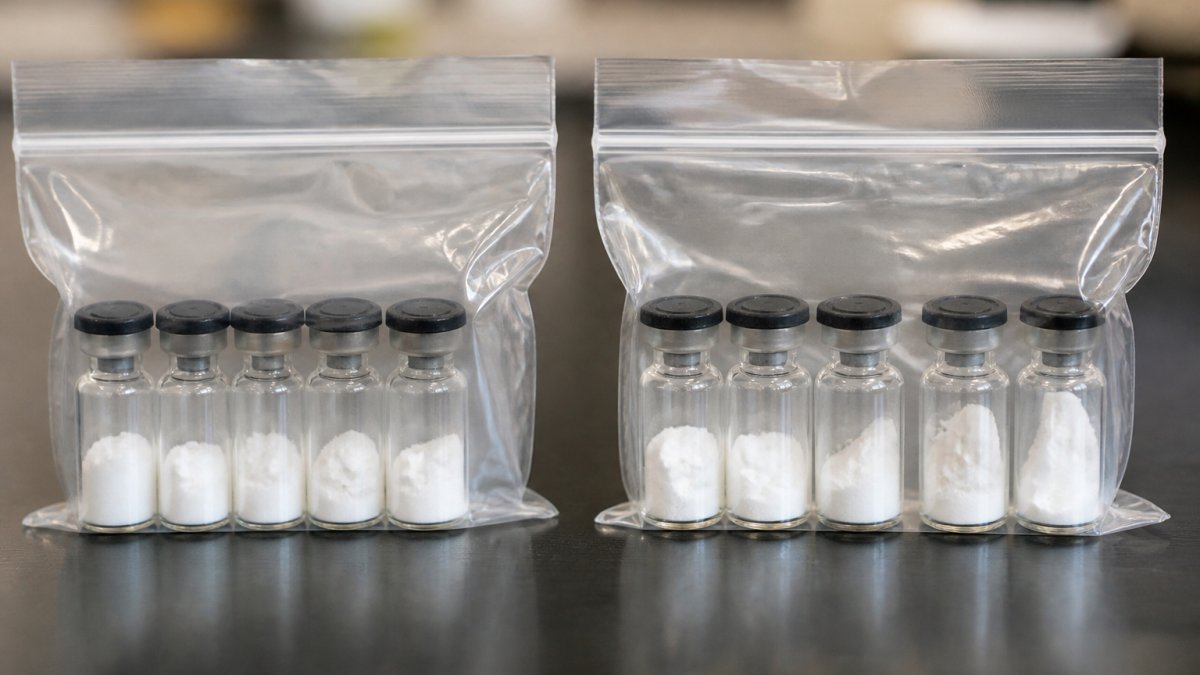
That last item trips up university labs more than any other. Discreet, unbranded shipping is a genuine benefit for some buyers, but institutional purchasing departments often need a packing slip and vendor identity that matches the PO.
Peptide Supplier Shipping and Storage: What Arrives Matters
Shipping and storage decide whether the purity on the COA survives the trip. A compound that tested clean at the lab can still arrive degraded if temperature and handling were wrong in transit, and a degraded vial invalidates the very documentation you paid for.
Ask three questions of any vendor, and ask them in writing before the first order:
- What temperature is the shipment held at in transit, and is that temperature documented on the packing slip?
- How is the material packaged, and is the packaging labeled with the batch number that matches the COA?
- What is the stated handling window after delivery, and what storage conditions does the supplier recommend for this specific compound?
For storage, follow the supplier's stated conditions for the specific compound and log the arrival date and batch number in your inventory records. Lot tracking starts the day the box lands, not the day the experiment begins.
What to Check When the Box Arrives
- Confirm the batch number on the vial label matches the batch number on the COA.
- Note the arrival date and the transit temperature indicator, if one is included.
- Photograph the packaging and label before opening, so the chain-of-custody record is complete.
- Record the storage location and the date the material was placed into inventory.
According to NIH guidance on research materials and biospecimen handling, documented handling and chain-of-custody records are part of responsible research material management. Treat your peptide inventory the same way: the COA, the packing slip, and the batch number should live in one file, not three.
The Procurement Detail Competitors Skip
Discreet, unbranded shipping is a genuine benefit for some buyers, but institutional purchasing departments often need a packing slip and vendor identity that matches the purchase order. Ask before you order, not when the box arrives. A supplier that can provide both a discreet outer package and a compliant packing slip inside is easier to route through university procurement than one that forces you to choose.
Research-Use Compliance and Documentation Limits
Research-use-only labeling is a legal and procedural boundary, not a marketing phrase. These materials are sold for laboratory research, and the documentation that accompanies them supports that use, not clinical or diagnostic application.
That boundary has practical consequences for how you file records. Keep the COA, the packing slip, and the batch number together so an auditor or reviewer can trace the material from order to experiment.
A supplier that is vague about its research-use positioning is a supplier to skip. Clarity here is a proxy for how the rest of the documentation is handled.
Bottom Line for Researchers Choosing Between the Two
On public information alone, neither ProtideHealth nor PeptidesSource gives researchers enough to make a confident call. Both sit in the same place: research-use positioning, general quality claims, and COAs available on request rather than published per lot.
That means your decision should rest on the documentation you can actually obtain before ordering.
At Bluegrass Research, we built our process around exactly that gap: lot-specific COA documentation, third-party analytical testing, and discreet US shipping with no external branding, all backed by a research-first philosophy.
Frequently Asked Questions
How should researchers compare ProtideHealth and PeptidesSource?
Start with documentation, not price. Request a lot-specific certificate of analysis for the exact batch you would receive, confirm the testing method (HPLC and LC-MS or LC-MS/MS), and check whether the lot number on the COA matches the vial. Then compare shipping terms, storage guidance, and how quickly each supplier answers technical questions. A supplier that cannot produce batch-level records on request fails the comparison regardless of catalog size.
What should a research peptide certificate of analysis include?
A usable research peptide certificate of analysis should list the compound name, lot or batch number, purity result with the analytical method used, molecular weight confirmation, and the date of testing. It should identify the third-party laboratory, not just the supplier. Without a lot number that matches your vial, the document proves nothing about your material. Ask for the COA before ordering and verify the lot after delivery.
How do research peptide suppliers differ in shipping and storage?
Differences usually show up in packaging and temperature control. Some suppliers ship lyophilized peptides at ambient temperature with desiccant, while others use cold packs for heat-sensitive compounds. Ask how each vendor handles transit in warm months, whether packaging is discreet, and what storage guidance arrives with the order. Peptide supplier shipping and storage practices affect compound integrity as much as purity at the factory does.
Are research-grade peptides intended for human use?
No. Research-grade peptides are sold for laboratory investigation only and are not approved for human consumption, diagnosis, or treatment. Suppliers label them research-use-only for that reason. Researchers should confirm institutional rules before ordering and keep documentation on file. A supplier that blurs this line in its marketing is a warning sign, because research-use-only positioning is a basic compliance requirement, not a formality.
The hardest part of vendor selection is not finding a supplier with a catalog. It is finding one whose documentation holds up when your results are reviewed. Bluegrass Research supplies research-grade peptide materials with lot-specific COAs, independent third-party testing, and secure, discreet shipping, so every compound arrives with a verification record you can file and defend. Get started with Bluegrass Research and put your next order behind documentation you can trace.