 ultimate-guide
Standardizing Peptide Research Protocols: 2026 Guide
Table of Contents
- Why Standardized Peptide Research Protocols Matter in 2026
- Core Elements of a Standardized Peptide Protocol
- Peptide Research Documentation Best Practices
- Peptide Study Protocol Templates: What to Include
- Analytical Verification for Research Peptides
- Troubleshooting Failed Protocols and Reporting Metrics
- Regulatory Compliance and Long-Term Safety Data in 2026
- Conclusion
- Frequently Asked Questions
Last Updated: September 20, 2026
Why Standardized Peptide Research Protocols Matter in 2026
Standardizing peptide research protocols means applying one documented, repeatable method to every stage of a study: acquisition, reconstitution, storage, dosing, analysis, and reporting. Without that framework, two labs can run the same experiment and produce results that cannot be compared, reproduced, or defended under review. This guide from Bluegrass Research breaks down the core elements of a defensible protocol.
Core Elements of a Standardized Peptide Protocol
A standardized peptide protocol contains six non-negotiable components: compound identity and purity records, reconstitution and storage documentation, a titration schedule with dose-response tracking, analytical verification, adverse event monitoring, and a reporting format another lab could follow. Miss one and reproducibility collapses.
Reconstitution, Storage, and Stability Documentation
Reconstitution is dissolving lyophilized powder in a suitable solvent, typically bacteriostatic water, to create a working solution of known concentration. Document the solvent volume, final concentration, date and time of reconstitution, and the handler's initials, in a log, not a margin note.
Titration Schedules and Dose-Response Documentation
A titration schedule is the predefined sequence of dose increments a study uses to move from a starting dose to a target dose while monitoring response. Standardizing it means every subject or sample follows the same step-up logic, hold periods, and escalation criteria. For a dose-response curve, record the starting dose, each increment, the interval between steps, and the observed response at each level.
| Protocol Element | What to Record | Why It Matters |
|---|---|---|
| Starting dose | Amount, units, route | Establishes baseline for comparison |
| Increment steps | Size and interval of each step | Shows titration logic was consistent |
| Hold period | Duration at each dose | Prevents confounding from carryover |
| Response measure | Metric, method, timing | Enables dose-response curve construction |
| Escalation criteria | Threshold to advance or stop | Documents safety decision points |
Peptide Research Documentation Best Practices
Peptide research documentation best practices come down to one principle: a researcher who was never in the room should be able to repeat your study exactly. That means contemporaneous records, unique lot identifiers, and a chain of custody for every vial. Write entries as you work, not at week's end, and use a version-controlled SOP for each recurring task so you can show which SOP was in force on which date.
- Assign a unique internal ID to every vial on arrival, tied to the supplier's lot number
- Log receipt date, storage location, and condition on arrival
- Record every withdrawal from a vial, including volume and purpose
- Note any deviation from the SOP, with the reason and the approver
- Keep raw instrument output alongside summarized results
Peptide Study Protocol Templates: What to Include
A peptide study protocol template should contain a title and version, the research question, compound details with lot and purity records, the reconstitution and storage plan, the titration and dosing schedule, the analytical methods, the adverse event monitoring plan, and the reporting format. Templates force consistency: when every protocol uses the same headings and fields, comparing results across experiments becomes routine instead of forensic.
Analytical Verification for Research Peptides
Analytical verification for research peptides confirms, through independent testing, that a compound's identity, purity, and concentration match the supplier's claims. It converts a supplier's assertion into a measurement you can cite. Verification typically combines chromatographic purity assessment with mass confirmation of molecular identity, producing a certificate of analysis tied to a specific lot.

The Three Tests That Actually Matter
Most research-grade verification rests on three orthogonal methods, each answering a different question.
- Reverse-phase HPLC (RP-HPLC) answers how pure is it. The peptide elutes off a C18 column under a water/acetonitrile gradient with trifluoroacetic acid as an ion-pairing agent, and the area under the main peak is reported as a percentage of total peak area, the number most COAs quote as "purity."
- Mass spectrometry (ESI-MS or MALDI-TOF) answers is it the right molecule. The observed mass-to-charge spectrum is deconvoluted to a molecular weight and compared against the theoretical mass calculated from the peptide's elemental formula. A match within a few parts per million confirms identity; a mismatch means the sequence, a truncation, or a modification is wrong.
- Peptide content or net peptide analysis answers how much of the powder is actually peptide. Lyophilized material contains counterions, residual water, and salts, so a vial labeled 5 mg may contain meaningfully less than 5 mg of peptide. Nitrogen or amino acid analysis gives the true peptide mass your concentration calculations should be based on.
Reading a Lot-Specific COA Like a Reviewer
A lot-specific COA reports results for one identified production lot, not a representative sample or historical average. Match the lot number on the vial to the lot number on the certificate, if they don't match, the documentation doesn't apply to your material. Check these fields in order:
| Field | What to Look For | Red Flag |
|---|---|---|
| Lot number | Matches the vial label exactly | "Representative" or missing lot |
| Purity method | Named method (RP-HPLC) with wavelength | "Purity: 99%" with no method |
| Purity result | Reported as area percent, with chromatogram | A single number, no trace |
| Identity method | MS with observed vs. theoretical mass | No mass data at all |
| Peptide content | Net peptide mass or % | Labeled mass only |
| Test date | Recent relative to receipt | Undated or stale |
| Testing lab | Named, independent of supplier | Supplier's own lab only |
Third-Party Testing and Sampling Logic
Third-party testing means the analysis was performed by a laboratory independent of the supplier: in-house results describe what a supplier believes, while independent results describe what an outside lab measured. Independence alone isn't enough, ask how the sample was drawn. A certificate run on a single hand-picked vial describes that vial, not the lot.
In-House Verification: What a Lab Can Do Without a Full Analytical Suite
Not every lab has an HPLC and a mass spectrometer. Verification is still possible, the protocol just has to state what was and wasn't verified, and by whom.
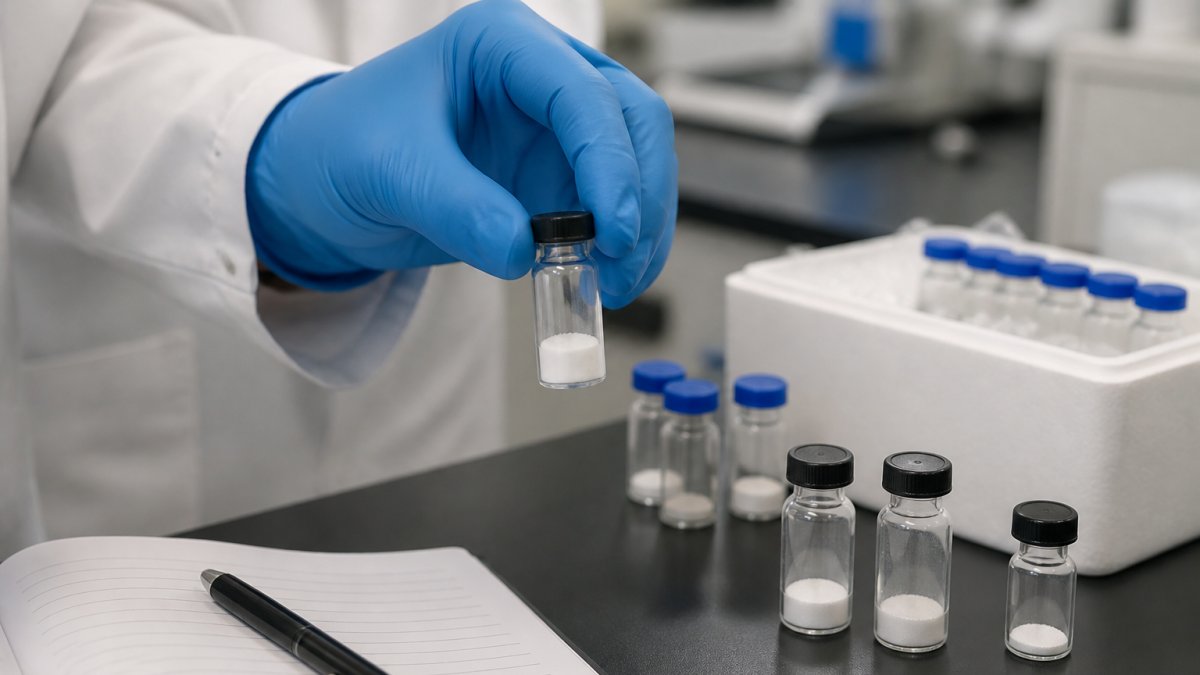
- Visual inspection on receipt. Lyophilized peptide should be a uniform cake or powder. Discoloration, clumping, or a melted appearance suggests a cold-chain failure. Photograph and log it.
- Reconstitution behavior. Most peptides dissolve readily in bacteriostatic water or the specified solvent. Persistent cloudiness or undissolved material is a deviation worth recording.
- pH check. A calibrated pH meter or pH strips on the reconstituted solution catches gross formulation errors.
- Retain samples. Keep a small aliquot of every lot in a labeled, frozen retain vial. If a result looks anomalous months later, you have material to send out for confirmatory testing.
Acceptance Criteria: Write Them Before You Order
Standardization means the pass/fail threshold is defined in the protocol, not negotiated after the COA arrives. A common pattern: minimum HPLC purity, a mass match within a stated tolerance, and documented peptide content, with thresholds set by the study's sensitivity, a binding assay may tolerate more impurity than a receptor-kinetics study. The point isn't a universal number; it's that your number is written down, applied consistently, and cited in the methods section.
Troubleshooting Failed Protocols and Reporting Metrics
Failed protocols usually trace back to four causes: degraded material, inconsistent reconstitution, a titration schedule that skipped a step, or a documentation gap that makes the failure impossible to diagnose. Work through them in that order: check the lot record and COA against the material on hand, review the reconstitution log for solvent, concentration, and timing errors, then confirm the titration schedule was followed exactly.
Regulatory Compliance and Long-Term Safety Data in 2026
Regulatory compliance frameworks for peptide research rest on documentation, not intention. The framework depends on what the study is, bench research on research-grade materials, animal work, or human subjects research, and the protocol should name the one in force before the first vial is opened.
Which Framework Applies to Your Study
- Bench and in vitro research. No IRB or FDA oversight of the research itself, but institutional chemical-hygiene and biosafety rules apply, and funders increasingly require material traceability. The FDA guidance on drug development and clinical research standards is the reference point for how study materials should be characterized when results are intended to support later development.
- Animal research. Institutional Animal Care and Use Committee (IACUC) review, protocol approval, and post-approval monitoring. Peptide dose, route, and frequency must be justified in the protocol, and adverse events must be reported to the committee.
- Human subjects research. Institutional Review Board (IRB) approval under the Common Rule, informed consent, and, for any study involving an investigational drug, an Investigational New Drug (IND) application to the FDA. The NIH guidelines on human subjects research and safety monitoring describe the data and safety monitoring expectations that IRBs apply.
The practical failure mode is retrofitting: a study designed as bench work that later feeds into a human-subjects protocol often lacks the consent language, adverse-event definitions, and monitoring schedule the IRB requires. Building those fields into the template from the start costs little; adding them after enrollment begins can invalidate data.
What a Data and Safety Monitoring Plan Actually Contains
A monitoring plan is not a sentence in the protocol, it's a defined structure. Reviewers look for these elements:
| Element | What It Specifies | Why It Matters |
|---|---|---|
| Monitoring body | Who reviews the data (PI, independent monitor, DSMB) | Determines independence of safety judgments |
| Monitoring intervals | How often data are reviewed | Sets the cadence for catching signals |
| Adverse event definitions | What counts as an AE vs. a serious AE | Makes reporting consistent across sites |
| Escalation criteria | Thresholds that trigger a report or a pause | Removes discretion from the moment of crisis |
| Stopping rules | Conditions that halt the study | Prevents open-ended exposure after a signal |
| Reporting pathway | Who is notified, in what timeframe | Meets IRB and sponsor requirements |
Long-Term Safety Data: The Field's Biggest Gap
Most published peptide work covers short observation windows, making adverse event monitoring across extended studies a genuine differentiator. The gap is structural: long-term studies are expensive, attrition is high, and the endpoints that matter, metabolic, endocrine, and cardiovascular changes, develop slowly. A protocol that wants to contribute long-term safety data must plan for it at design time:
- Define the observation window in advance. State the primary window and any extension, with the criteria for continuing past the primary endpoint.
- Pre-specify the safety endpoints. Weight, blood pressure, metabolic markers, and any organ-system measures you intend to track, with the method and timing for each.
- Build in retention mechanics. Scheduled contact points, a defined withdrawal process, and a plan for capturing data on participants who discontinue.
- Separate safety analysis from efficacy analysis. A study powered for an efficacy endpoint is usually underpowered for rare safety events; say so, and report the safety data as descriptive rather than inferential.
- Archive the raw data. Long-term comparability across studies depends on the same fields being recorded the same way. This is where standardized reporting metrics and safety monitoring meet.
Standardized Reporting Metrics Close the Loop
Compliance and safety data are only useful if they can be compared. Define in advance which variables you report, in what units, and at what timepoints, purity percentage, concentration, response magnitude, time to response, and adverse event frequency and severity are common choices. When every study reports the same fields, longitudinal comparison becomes possible, exactly what the field currently lacks, and what a 2026-era protocol should deliver.
Conclusion
The hardest part of peptide research isn't running the experiment, it's producing results that hold up when someone else asks how you got them. Standardized protocols, lot-specific verification, and disciplined documentation make that possible.
Frequently Asked Questions
What are the changes in peptide regulations for 2026?
In 2026, the FDA continues to refine its oversight of peptides, with increased scrutiny on sourcing and documentation for research-grade materials. Researchers should expect stricter requirements for lot-specific certificates of analysis (COAs), purity verification, and chain-of-custody records. To stay compliant, labs should source from suppliers who provide third-party analytical testing and maintain detailed records of peptide synthesis and stability. Always check the latest FDA guidance and institutional review board (IRB) policies before starting a study.
How do standardized protocols improve the reproducibility of peptide studies?
Standardized protocols reduce variability by specifying exact reconstitution methods, storage temperatures, titration schedules, and analytical verification steps. When every lab follows the same documentation format, results become comparable across studies. This improves reproducibility, a core requirement for clinical validation. For example, using a standardized reconstitution table with bacteriostatic water volumes and concentrations ensures consistent dosing. Reproducibility also depends on recording lot numbers, purity data, and adverse events. Without these details, even well-designed experiments cannot be reliably repeated.
What documentation is required for high-quality peptide research?
High-quality peptide research requires a lot-specific COA from a third-party lab, detailing purity, molecular weight, and peptide sequence. You also need records of storage conditions (temperature, humidity). For each experiment, maintain a protocol template that includes reconstitution calculations, titration schedule, dose-response data, and adverse event monitoring. Documentation should follow a standard operating procedure (SOP) to ensure consistency. This level of detail supports reproducibility and regulatory compliance, and it is essential if your results are ever audited.
How does third-party analytical verification impact research outcomes?
Third-party verification confirms that a peptide's purity and identity match the supplier's claims. Independent testing reduces the risk of using degraded or mislabeled compounds, which can skew results. For example, if a peptide is only 70% pure, your dose-response curve will be inaccurate. Verified purity also ensures that observed effects are due to the peptide itself, not contaminants. This directly improves the reliability of your data and makes your findings more defensible. Always request a lot-specific COA and verify the testing lab's credentials.
What are the best practices for maintaining peptide compound integrity?
Store lyophilized peptides at -20°C or lower, protected from light and moisture. Once reconstituted, use bacteriostatic water and refrigerate at 2-8°C, avoiding freeze-thaw cycles. Aliquot reconstituted peptide to prevent repeated temperature changes. Record storage conditions and expiration dates in a log. For shipping, use temperature-controlled packaging with desiccants. Bluegrass Research provides professional storage solutions and discreet, unbranded shipping to help maintain compound integrity. Always follow the supplier's specific storage recommendations and verify stability with analytical testing when possible.
This article is for research and educational purposes only. Peptide materials referenced are intended for laboratory research use.