 listicle
Best Peptide Suppliers for Research: 2026 Guide
Table of Contents
- What Makes the Best Peptide Suppliers for Research Stand Out
- How to Read a Certificate of Analysis for Peptides
- Top Peptide Suppliers for Research: Compared
- Bluegrass Research: Lot-Specific Documentation and Discreet Shipping
- AmbioPharm: Large-Scale Custom Synthesis and cGMP Manufacturing
- GenScript: Fast Turnaround with Guaranteed Quantity
- PSPeptides: Deep Testing Breakdown Including Endotoxin and Heavy Metals
- Phoenix Pharmaceuticals: Extensive Catalog with In-House US Production
- AnaSpec and Thermo Fisher: Complex Modifications and Library Synthesis
- Supply Chain Transparency Beyond the COA
- Research Peptide Storage Best Practices After Delivery
- Peptide Procurement Checklist for Laboratories
- Which Peptide Supplier Is Right for Your Research?
- Frequently Asked Questions
Last Updated: August 30, 2026
Finding the best peptide suppliers for research is harder than it looks. At Bluegrass Research, we work directly with academic labs, biotech firms, and independent investigators who have all made the same costly mistake: ordering from a supplier that looked credible but delivered compounds with questionable purity documentation, inconsistent batch quality, or degraded peptides. The core problem is that the research peptide market lacks a single governing body enforcing uniform quality standards. Understanding how to evaluate analytical data and knowing which suppliers produce it honestly is the difference between reproducible science and wasted grant money.
Quick Picks:
- Best for Documentation Transparency: Bluegrass Research, lot-specific, third-party COAs with discreet US shipping
- Best for Large-Scale Custom Synthesis: AmbioPharm, cGMP manufacturing from gram to kilogram scale
- Best for Speed: GenScript, delivery as fast as 5 business days with guaranteed quantity
- Best for Deep Testing Breakdown: PSPeptides, includes endotoxin and heavy metals reporting
- Best for Catalog Breadth: Phoenix Pharmaceuticals, over 9,000 SKUs with in-house US production
What Makes the Best Peptide Suppliers for Research Stand Out
The best peptide suppliers share one non-negotiable trait: they can prove what they sell through verifiable analytical documentation tied to a specific production lot. Everything else, pricing, turnaround time, catalog size, is secondary to that foundation.
Third-Party Testing vs. In-House Analytical Claims
In-house testing means the same organization that synthesized the peptide reports its own purity, creating an obvious conflict of interest. Third-party testing, conducted by an independent laboratory, removes that conflict and produces a certificate of analysis with actual evidentiary weight.
What to look for: the COA should name the independent testing laboratory, include the analysis date, and reference the specific lot number tested. High-performance liquid chromatography (HPLC) and mass spectrometry are the two methods that matter. HPLC confirms purity by separating and quantifying components; mass spectrometry confirms molecular identity by verifying molecular weight matches the expected amino acid sequence. A legitimate COA reports both. Purity levels below 95% are generally inadequate for most research; many rigorous protocols require 98% or higher.
GMP-Certified vs. Research-Grade: What the Difference Means for Your Lab
GMP-certified (Good Manufacturing Practice) refers to FDA-regulated manufacturing standards for compounds intended for human use, with documented, auditable conditions and full traceability.
Research-grade peptides are manufactured for laboratory use only, not for human administration. The synthesis standards are rigorous but not subject to the same FDA regulatory framework.
For most academic and biomedical research, research-grade peptides are entirely appropriate if analytical documentation is solid. If your work involves preclinical studies feeding into IND applications or regulatory submissions, cGMP-grade material may be required.
How to Read a Certificate of Analysis for Peptides
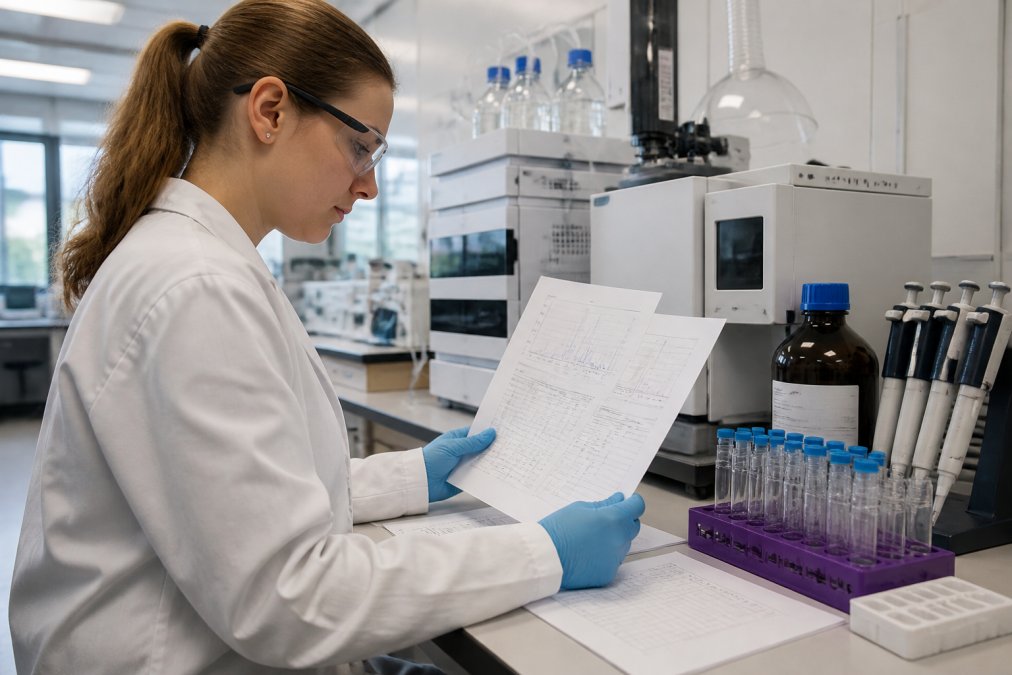
A certificate of analysis is the primary document verifying that a peptide meets its stated specifications. Reading one correctly is a core competency for any researcher procuring compounds externally.
Key Fields Every Legitimate COA Must Include
A legitimate COA for research peptides must contain:
- Product name and amino acid sequence, confirms what was synthesized
- Lot number, the specific batch identifier for traceability
- Purity percentage by HPLC, the primary purity measurement
- Molecular weight by mass spectrometry, confirms compound identity
- Synthesis date and analysis date, establishes age and freshness
- Testing laboratory name, for third-party COAs, an identifiable independent lab
- Solubility testing results, critical for reconstitution in specific buffers
- Endotoxin levels, essential for cell-based or in vivo work
- Heavy metals screening, important for sensitive assays
According to the FDA guidance on analytical procedures for pharmaceutical testing, validated analytical methods are fundamental to ensuring compound integrity in research and manufacturing.
Lot-Specific vs. Generic COAs: Spotting the Difference
A generic COA applies to an entire product line, showing that at some point some batch met purity specifications. A lot-specific COA is generated for the exact batch fulfilling your order, carrying a unique lot number matching your vial label. This is the only document type providing actual traceability. Take the lot number from your vial and ask the supplier to show you the COA for that specific lot. If they can't, or if the lot number doesn't appear on the document, you have a generic COA.
Top Peptide Suppliers for Research: Compared
| Supplier | Testing Type | Key Strength | Best For |
|---|---|---|---|
| Bluegrass Research | Third-party, lot-specific | Discreet US shipping, transparent documentation | Academic and independent researchers |
| AmbioPharm | In-house + FDA-inspected | cGMP scale, custom synthesis | Preclinical and pharma-scale projects |
| GenScript | Third-party | Speed, guaranteed quantity | Time-critical projects |
| PSPeptides | Third-party independent | Endotoxin + heavy metals reporting | High-sensitivity biological assays |
| Phoenix Pharmaceuticals | In-house, ISO 9001 | Catalog breadth, US production | Institutional accounts |
| AnaSpec | In-house + R&D/GMP | Complex modifications, libraries | Screening and modified peptides |
| Thermo Fisher | Third-party | Modification range, Fmoc synthesis | Proteomics and isotopic labeling |
Bluegrass Research: Lot-Specific Documentation and Discreet Shipping
Bluegrass Research is our top pick for researchers needing documentation they can defend. Every compound ships with a lot-specific COA from an independent third-party laboratory. The lot number on your vial matches the analytical report, and testing was conducted by an organization with no financial stake in the outcome. Discreet US shipping with no external branding satisfies institutional compliance requirements.
AmbioPharm: Large-Scale Custom Synthesis and cGMP Manufacturing
AmbioPharm operates at a different scale than most research suppliers. Their FDA-inspected facilities offer cGMP manufacturing with production capacity from grams to multi-kilogram batches, using solid-phase, solution-phase, and hybrid synthesis methods. For researchers preparing for IND-enabling studies, AmbioPharm's ability to bridge research-grade and cGMP-grade production is meaningful.
GenScript: Fast Turnaround with Guaranteed Quantity
GenScript's microwave-assisted PepPower synthesis platform delivers peptides in as few as 5 business days for standard sequences. They guarantee quantity for orders under 20 mg. Their modification catalog covers over 300 options, including amidation, acetylation, biotin labeling, and fluorescent conjugates.
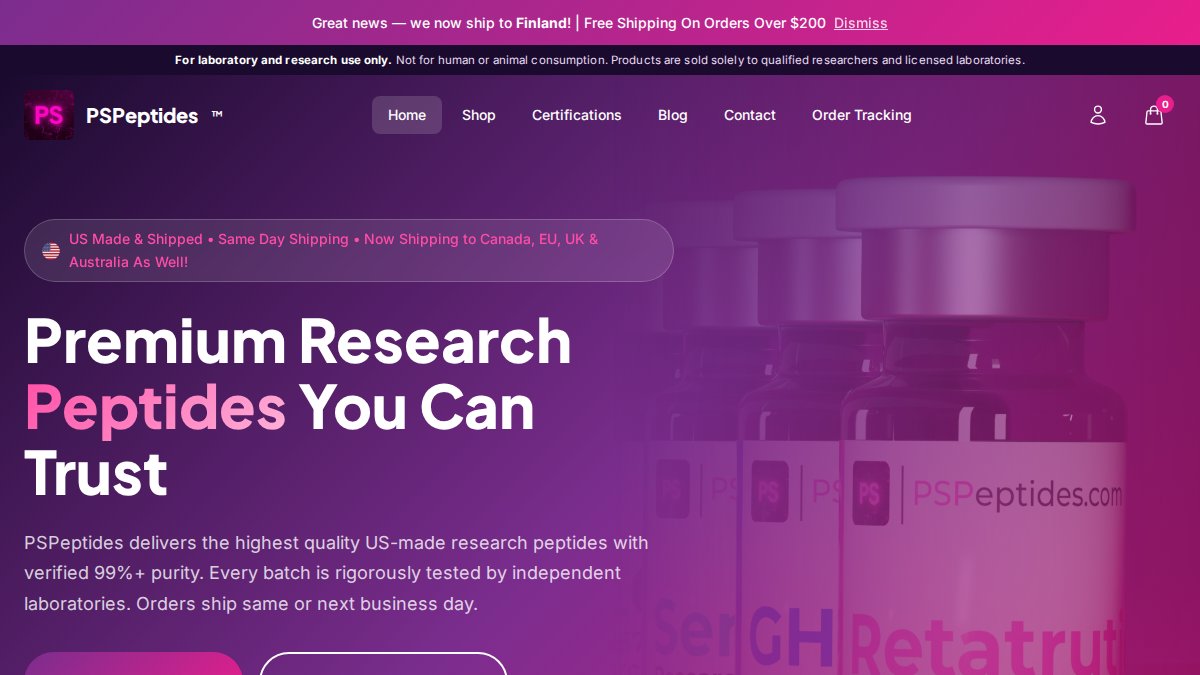
PSPeptides: Deep Testing Breakdown Including Endotoxin and Heavy Metals
PSPeptides stands out for analytical depth. Every batch undergoes independent laboratory testing covering HPLC purity, mass spectrometry, and separate endotoxin and heavy metals screening. For cell-based or in vivo experiments, endotoxin contamination is a silent confound that can invalidate entire datasets. Orders ship same or next business day.
Phoenix Pharmaceuticals: Extensive Catalog with In-House US Production
Phoenix Pharmaceuticals carries over 9,000 catalog SKUs of research peptides. All production is in-house at their US facility, ISO 9001 certified for process documentation and consistency. Phoenix Pharmaceuticals does not sell to the general public, wellness clinics, or individuals.
AnaSpec and Thermo Fisher: Complex Modifications and Library Synthesis
AnaSpec specializes in cyclic peptides (lactam, disulfide-bridged, and stapled), fluorescently labeled peptides, and peptide library synthesis for screening applications. Thermo Fisher's custom peptide synthesis covers sequences from 2 to 110 amino acids with purity options from crude to greater than 98%, and over 400 modification options including isotopic labeling for AQUA quantification.
Supply Chain Transparency Beyond the COA
The COA is the end of the analytical story. Supply chain transparency is about everything that happened before that document was generated. Questions that reveal supply chain integrity: Where are raw materials sourced? Is peptide synthesis performed in-house, or is the supplier reselling material synthesized elsewhere? What is the batch-to-batch consistency record? What quality assurance checkpoints exist during synthesis, not just at final release?
Batch-to-batch consistency analysis is the metric most guides ignore. A single high-purity COA tells you one batch met spec. Suppliers with genuine quality assurance programs maintain internal consistency records. Ask for them.
According to NIH guidance on research reagent quality and reproducibility, reagent quality and lot-to-lot variability are identified as primary contributors to irreproducible research findings.
Research Peptide Storage Best Practices After Delivery
Proper storage begins when your shipment arrives. Lyophilized peptide powders are stable under the right conditions; they degrade quickly under the wrong ones.
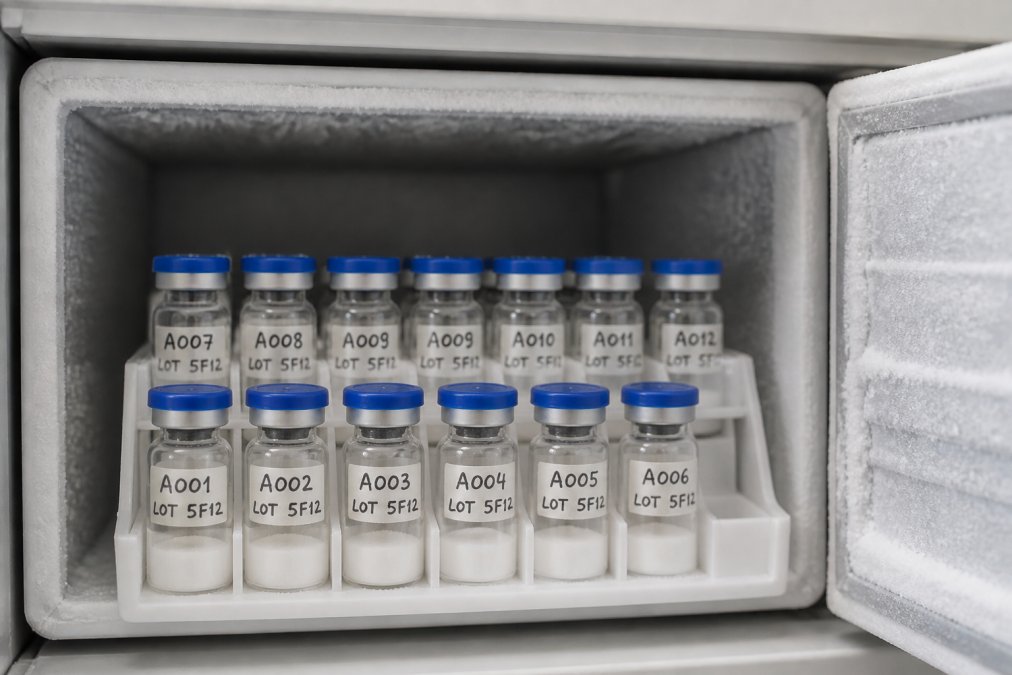
Standard storage guidelines for lyophilized peptides:
- Short-term storage (weeks to months): -20°C in a frost-free freezer, desiccated, away from light
- Long-term storage (months to years): -80°C, in sealed containers with desiccant
- Reconstituted peptides: Aliquot before freezing; avoid repeated freeze-thaw cycles
- Hygroscopic peptides: Equilibrate to room temperature before opening vials to prevent condensation
Cold chain logistics directly affect compound stability on arrival. When evaluating suppliers, ask specifically about temperature control during transit.
The United States Pharmacopeia guidelines on peptide storage and handling provide reference standards for storage conditions applicable to research-grade peptide materials.
Peptide Procurement Checklist for Laboratories
Use this checklist when evaluating any supplier for the first time or onboarding a new compound.
| Checkpoint | What to Verify | Why It Matters |
|---|---|---|
| COA type | Lot-specific, not generic | Ensures traceability to your actual vial |
| Testing method | HPLC + mass spectrometry | Confirms purity and molecular identity |
| Testing party | Independent third-party lab | Removes conflict of interest |
| Endotoxin reporting | Separate, not bundled | Critical for biological assays |
| Amino acid sequence confirmation | Listed on COA | Verifies correct synthesis |
| Lot number match | COA lot = vial label lot | Non-negotiable for traceability |
| Shipping conditions | Cold chain documentation | Protects compound integrity in transit |
| Batch history | Multiple lots available | Indicates consistency over time |
| Supplier transparency | Will answer supply chain questions | Indicates genuine quality culture |
- Request lot-specific COA before confirming order
- Verify independent testing laboratory is named on the COA
- Confirm HPLC purity meets your protocol's minimum threshold
- Confirm mass spectrometry molecular weight matches expected value
- Check endotoxin levels if compound will be used in cell or animal studies
- Verify heavy metals screening if your assay is sensitive to trace contamination
- Confirm cold chain shipping method for temperature-sensitive compounds
- Record lot number in your lab notebook at receipt
- Aliquot and store per supplier's recommendations immediately on receipt
Which Peptide Supplier Is Right for Your Research?
The right supplier depends on three variables: your documentation requirements, your scale, and your timeline.
For academic researchers and independent investigators needing rigorous, defensible documentation, Bluegrass Research is built for this use case with lot-specific, third-party COAs and reliable US shipping.
For preclinical researchers preparing regulatory submissions or scaling toward IND-enabling studies, cGMP-grade manufacturing becomes relevant. Other providers serve this segment.
For time-critical projects where speed is the primary constraint, GenScript's 5-business-day turnaround and guaranteed quantity offer meaningful operational advantage.
For high-sensitivity biological assays where endotoxin contamination is a genuine experimental risk, PSPeptides' separate endotoxin and heavy metals reporting is a differentiator worth paying for.
For complex modifications, cyclic peptides, or library synthesis, AnaSpec and Thermo Fisher have the technical infrastructure most catalog suppliers cannot match.
The most common mistake researchers make is optimizing for price first. Purity documentation and compound integrity should drive the decision. A cheaper peptide producing irreproducible results costs far more than a premium compound performing reliably across every experiment.
According to Nature's guide to reproducibility and standards in life science research, compound verification and documentation practices are among the most frequently cited factors in research reproducibility failures, making supplier selection a methodological decision, not just a procurement one.
Sourcing research-grade peptides without rigorous documentation is one of the fastest ways to undermine otherwise sound experimental design. Bluegrass Research addresses this directly: every order includes a lot-specific COA from an independent third-party laboratory, discreet US shipping with no external branding, and a research-first documentation standard built for researchers whose results will face scrutiny. For labs that can't afford to question the integrity of their compounds, that level of verified transparency is the baseline, not a premium. Shop Now at Bluegrass Research and get compounds you can trace, document, and defend.
Frequently Asked Questions
Q: What does 'research-grade' mean for peptide suppliers?
A: Research-grade peptides are synthesized and verified specifically for laboratory and scientific use, not for human consumption or clinical administration. The designation means the compound has documented purity levels, typically confirmed through high-performance liquid chromatography (HPLC) and mass spectrometry, and comes with a certificate of analysis. Reputable peptide suppliers for research provide lot-specific COAs rather than generic documentation, so every batch can be traced and independently verified against the analytical report.
Q: How can researchers verify the purity of peptides from online vendors?
A: Request the lot-specific certificate of analysis before placing an order. A credible COA will list the lot number, amino acid sequence, molecular weight verification, HPLC chromatogram, and mass spectrometry data. Cross-check the lot number against the vial you receive. If a supplier provides only a generic or undated COA without a traceable lot number, that is a significant red flag. Third-party testing from an independent laboratory adds another layer of verification that in-house analytical reports cannot match.
Q: What are the risks of sourcing peptides from unverified suppliers?
A: Peptides from unverified sources frequently fail purity standards, contain residual solvents, or carry endotoxin contamination that invalidates experimental results. Without proper analytical testing documentation, researchers cannot confirm the amino acid sequence is correct or that batch consistency holds across orders. This undermines reproducibility, wastes research budgets, and can compromise institutional compliance reviews. For studies involving metabolic peptides like Semaglutide analogs, undocumented sourcing also creates defensibility problems if results face peer scrutiny.
Q: How should research-grade peptides be stored after delivery?
A: Lyophilized peptide powders are most stable when stored at -20°C or lower in a frost-free freezer, away from repeated freeze-thaw cycles. Keep vials sealed and desiccated until use. Once reconstituted, aliquot into single-use volumes to avoid degradation from repeated opening. Peptide stability varies by sequence, so consult the supplier's analytical documentation for compound-specific guidance. Cold chain logistics during shipping are equally critical; confirm your supplier uses temperature-controlled packaging before your order ships.
Q: What should a peptide procurement checklist for laboratories include?
A: A solid procurement checklist covers: confirmed third-party testing with HPLC and mass spectrometry data, lot-specific COA with traceable lot number, declared purity levels (typically 98%+ for research applications), endotoxin and heavy metals reporting, synthesis method documentation, shipping integrity protocols including cold chain logistics, supplier regulatory compliance status, batch-to-batch consistency records for recurring orders, and packaging compatibility with institutional procurement requirements. Verifying each point before committing to a supplier reduces the risk of receiving degraded or mislabeled compounds.
This article was written using GrandRanker
Frequently Asked Questions
Q: What does 'research-grade' mean for peptide suppliers?
A: Research-grade peptides are synthesized and verified specifically for laboratory and scientific use, not for human consumption or clinical administration. The designation means the compound has documented purity levels, typically confirmed through high-performance liquid chromatography (HPLC) and mass spectrometry, and comes with a certificate of analysis. Reputable peptide suppliers for research provide lot-specific COAs rather than generic documentation, so every batch can be traced and independently verified against the analytical report.
Q: How can researchers verify the purity of peptides from online vendors?
A: Request the lot-specific certificate of analysis before placing an order. A credible COA will list the lot number, amino acid sequence, molecular weight verification, HPLC chromatogram, and mass spectrometry data. Cross-check the lot number against the vial you receive. If a supplier provides only a generic or undated COA without a traceable lot number, that is a significant red flag. Third-party testing from an independent laboratory adds another layer of verification that in-house analytical reports cannot match.
Q: What are the risks of sourcing peptides from unverified suppliers?
A: Peptides from unverified sources frequently fail purity standards, contain residual solvents, or carry endotoxin contamination that invalidates experimental results. Without proper analytical testing documentation, researchers cannot confirm the amino acid sequence is correct or that batch consistency holds across orders. This undermines reproducibility, wastes research budgets, and can compromise institutional compliance reviews. For studies involving metabolic peptides like Semaglutide analogs, undocumented sourcing also creates defensibility problems if results face peer scrutiny.
Q: How should research-grade peptides be stored after delivery?
A: Lyophilized peptide powders are most stable when stored at -20°C or lower in a frost-free freezer, away from repeated freeze-thaw cycles. Keep vials sealed and desiccated until use. Once reconstituted, aliquot into single-use volumes to avoid degradation from repeated opening. Peptide stability varies by sequence, so consult the supplier's analytical documentation for compound-specific guidance. Cold chain logistics during shipping are equally critical; confirm your supplier uses temperature-controlled packaging before your order ships.
Q: What should a peptide procurement checklist for laboratories include?
A: A solid procurement checklist covers: confirmed third-party testing with HPLC and mass spectrometry data, lot-specific COA with traceable lot number, declared purity levels (typically 98%+ for research applications), endotoxin and heavy metals reporting, synthesis method documentation, shipping integrity protocols including cold chain logistics, supplier regulatory compliance status, batch-to-batch consistency records for recurring orders, and packaging compatibility with institutional procurement requirements. Verifying each point before committing to a supplier reduces the risk of receiving degraded or mislabeled compounds.